
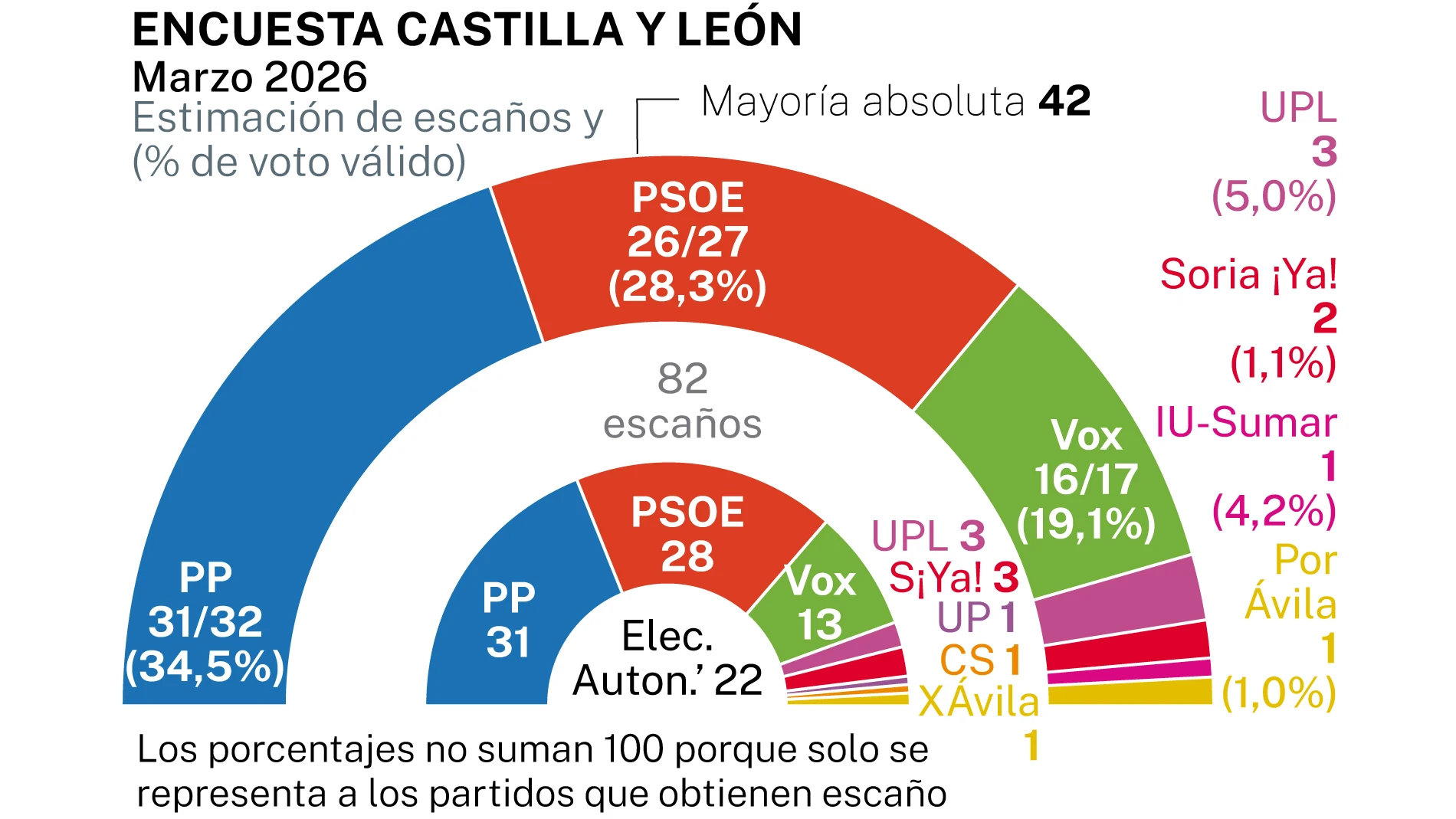
The PP will be the winner of the next elections in Castilla y León and its current president and popular candidate, Alfonso Fernández Mañueco, the only one with real possibilities of revalidating his position at the head of the autonomous community. This is according to the latest survey prepared by NC Report for LA RAZÓN. According to it, the PP would obtain 34.5% of the vote and between 31 and 32 seats.
Mañueco is still far from the absolute majority, set in the 42 attorneys, and would have to rely on Vox. Santiago Abascal’s party stands, according to the survey, at 19.1% of the vote and between 16 and 17 seats. A pact between both formations is the only possible formula, at a political and arithmetic level, to achieve an investiture without leading the people of Castile-Leon to a repeat election.
On the political level, because Mañueco has already rejected the offer of the PSOE candidate, Carlos Martínez, to let the most voted list govern; on an arithmetic level, because the PP could not rely on the regionalist parties to achieve the investiture, because the seats do not add up to enough.
Focusing exclusively on the left, the PSOE would obtain 28.3% of the vote and between 26 and 27 seats, while the alliance formed by IU, Movimiento Sumar and the Greens would be left with the only seat of Unidas Podemos, thanks to 4.2% of the votes. Podemos, which on this occasion is running separately, would end up outside the Cortes with 2.3% of the vote.
Mañueco’s victory is due to several factors, but mainly because the PP is, according to the survey, the party with the most loyal voters. 81.7% of those who voted for them in 2022 would now repeat their vote. Furthermore, Mañueco manages to attract 14.9% of those who voted for Vox and 16.4% of new voters.
Strictly speaking, Mañueco is the one that grows the most in terms of votes, since it would obtain almost 30,000 new voters compared to 2022. However, it has a problem: it is not reflected that way in seats. According to the survey, the PP could stay with the same attorneys it already has (31) or grow only one. There, the one that grows the most is Vox, which wins between three and four, despite the fact that it only adds 1.5% of the vote and 12,000 new voters.
This is because Santiago Abascal’s party would be able to snatch the last seat in some key provinces or managing to obtain many seats in the provinces that distribute the most, such as Valladolid.
The survey indicates that Vox’s main external source of power is the PP, with 10.7% of popular voters now switching to Vox. They are followed by the new voters, those who could not vote or did not vote in 2022. These will go to the far-right party by 8.6%. It is a striking fact, because only 74.4% of those who voted for Vox would repeat.
Although it is high, the PSOE beats it with 77%. A situation arises whereby, although Vox does not retain too many of its own, it does attract quite a few voters from outside and, therefore, it grows.
In fact, it continues to be the favorite party among the youngest: 10.8% of those between the ages of 18 and 29 say they will vote for this party. The second favorite is the PP, with 10% in this band, although the real champion continues to be abstention: 57.5% will not vote, a potential voting ground that the parties are not being able to attract.
On the left, the PSOE manages to retain 77% of its voters, although it loses 4.1% to IU-Sumar, 1.9 to Podemos and 7.7% to abstention. It is the party, of those at the national level, that most fuels abstention. However, it is currently very far from high levels such as those recorded in the elections in Extremadura and Aragón and that is why it falls so little in comparison. In Extremadura, ten seats were left behind; in the Aragonese, five; Now, he only hopes to lose one or two.
It is interesting, because Carlos Martínez, the PSOE candidate, is the one who has the least relationship with Pedro Sánchez. Here it seems that the distance from the President of the Government helps him avoid losing votes, something that did not happen with Pilar Alegría or Miguel Ángel Gallardo, who were also in judicial proceedings.
Part of the survival of the PSOE is also due to the fact that it is being able to attract 21% of those who voted for Unidas Podemos in 2022. Of the rest, a quarter (25% go to Podemos) and 40.3% go to IU-Sumar. This result is also important, because the left is now in a process of refoundation in which one of the main doubts is whether there will be a joint candidacy or there will be competition between the two. In this duel, the winner is IU-Sumar.
As for the regionalist parties, the only one that holds up is the Union of the Leonese People (UPL), which would maintain the three seats it currently has. Soria Now! loses one and stays with two and Por Ávila remains the same, with one. Here the same dynamic that happened in Aragón does not occur, with Chunta shooting itself as an alternative to the big games. Perhaps it is because these formations are only present in some specific provinces and have reached their electoral ceiling.