
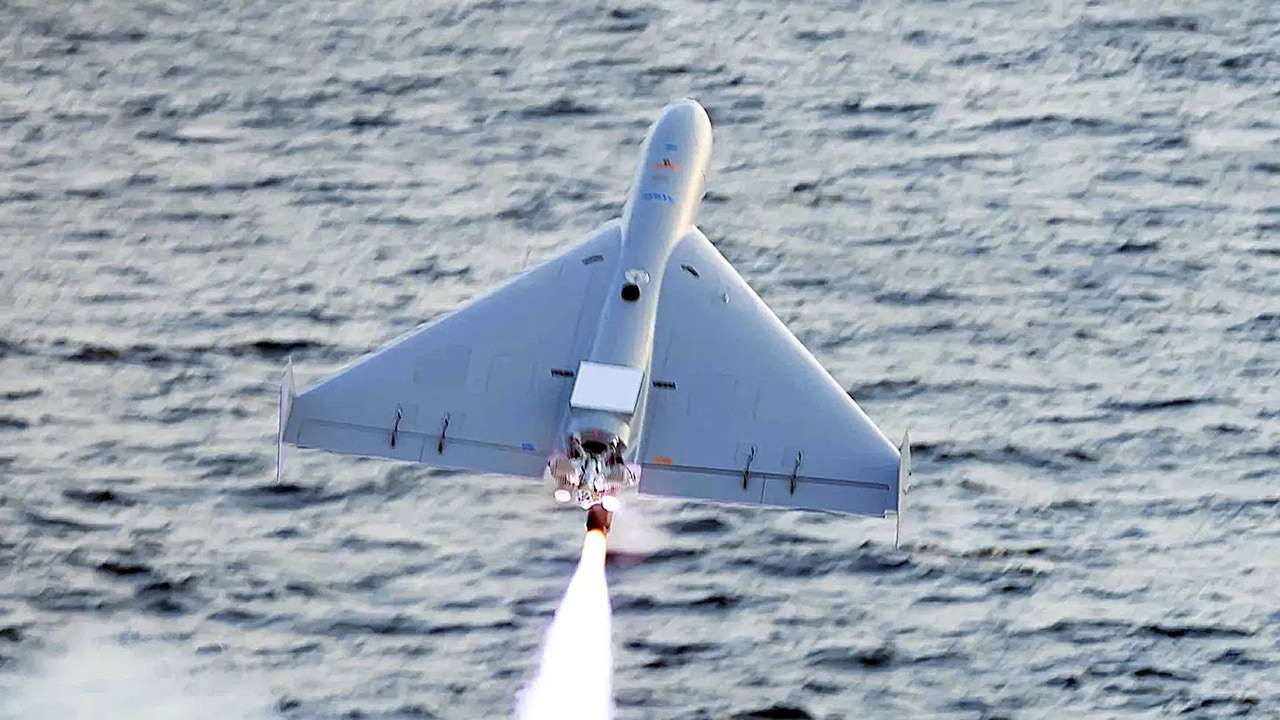
He Central Command (CENTCOM) USA has recognized that, among the attack forces used in the operation Epic Furystarted last Saturday together with Israel and against Irandrones are found LUKE. This is the acronym for Low-cost Uncrewed Combat Attack System (Low-Cost Unmanned Combat Strike System) and the current conflict with Iran marks the first time the United States has used them in combat. Ironically, LUCAS is a clone of the Shahed-136 drones designed by Iran and which cause so much havoc in Ukraine. This is a very rare case of the United States taking over enemy technology to use against them, something Iran has been known for for many years.
LUCAS is operated by the Task Force Scorpion Strike (TFSS), or Task Force ‘Scorpion Strike’, the creation of which was announced last December along with the existence of drones based on the Shahed-136. Although two weeks after the announcement the US Navy tested launching one of them from the Independence-class littoral combat ship USS Santa Barbarathose used in Operation Epic Fury are being launched from the ground. Its use illustrates the shift in US military doctrine toward large-scale deployment of long-range expendable drones.
CENTCOM’s Task Force Scorpion Strike – for the first time in history – is using one-way attack drones in combat during Operation Epic Fury. These low-cost drones, modeled after Iran’s Shahed drones, are now delivering American-made retribution. 🇺🇸 pic.twitter.com/VYdjiECKDT
— US Central Command (@CENTCOM) February 28, 2026
According to CENTCOM’s statement on the strikes, the first hours of the operation combined precision munitions delivered from the air, land and sea with the debut of low-cost one-way attack drones operated by the TFSS. Available information indicates that the LUCAS drones used in this phase were primarily assigned against fixed Iranian military targets, including Islamic Revolutionary Guard Corps command nodes, air defense assets, and missile and drone launch infrastructureas part of the broader wave of attacks by the US and Israel.
Based on Iran’s Shahed-136
LUCAS is a unidirectional attack drone derived from detailed study and reverse engineering of the Iranian Shahed-136designed, like its counterpart, to be a much cheaper attack weapon than cruise missiles or reusable armed UAVs, which not only cost more, but are also more difficult and slower to produce.
A US official explained last December to The War Zone that ‘the US Army took over an Iranian Shahed. We analyze it and reengineer it. We are working with several American companies in the innovation ecosystem. The LUCAS drone is the result of that (reengineering) effort. It largely follows the design of the Shahed‘.
The ship captain Tim Hawkinsspokesperson for CENTCOM, then told the media that ‘with an approximate cost of $35,000 per platformLUCAS is a low-cost and scalable system that offers cutting-edge capabilities at a fraction of the cost of traditional long-range US systems that can achieve similar effects. The drone system has a long range and the ability to operate beyond line of sight, bringing significant capability across CENTCOM’s vast theater of operations.
LUCAS vs Shahed-136
The LUCAS, developed by the American company SpektreWorks in collaboration with the Pentagon, is a delta wing drone of about three meters long and just over two meters wide, very similar in silhouette to the Iranian Shahed-136. According to sources cited by the media, the LUCAS design incorporates autonomous coordination functions designed for swarm and network attacks.
Basic specifications of the target drone are offered on the SpektreWorks website FLM-136developed as a Shahed-style ‘threat emulator’ and later adapted as the LUCAS operational attack platform. The FLM-136 has a maximum range of 715 kmautonomy of six hourscan carry a payload of 18 kilograms and flies at a cruising speed of 137km/hbeing the maximum of 194 km/h. It is unclear whether this data reflects the capabilities of the already operational LUCAS version.
The basic Shahed-136 is powered by a small internal combustion engine. 50 horseshas a top speed of around 185 kilometers per hour and an approximate maximum range of 2,000 kilometers while carrying a warhead 40 kilogramsaccording to the US Army’s ODIN (Operational Environment Data Integration Network) portal. In the current conflict, Iran has successfully used it to attack the US Fifth Fleet headquarters in Manama, Bahrain.