
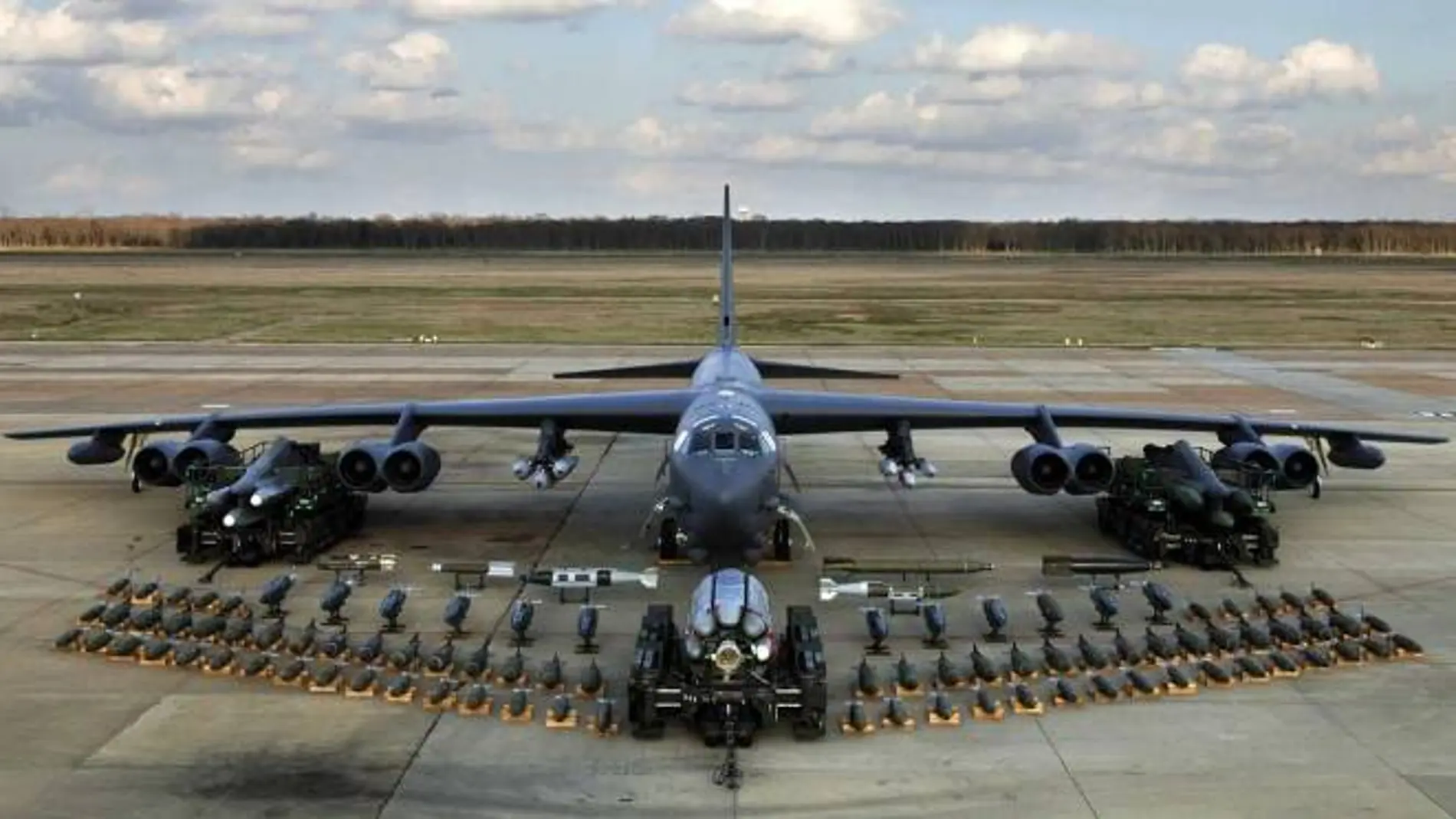
He B-52 Stratofortress It is the oldest combat aircraft in the US Armed Forces and will be so for a long time, given that it is planned to be maintained in service until the 2050s. This, logically, cannot be achieved with the same aircraft as began flying in the 50s of the 20th centurybut with periodic updates that keep in force what is the bomber with the greatest weapons capacity in the United States, a capacity that will be increased with a new external support for weapons, pylon in aeronautical language, capable of transporting ammunition up to four times heavier than those that can currently be loaded.
The United States Air Force has issued a request for information seeking industry input on the design and manufacturing of a new pylon for the B-52. The request, made by the division in charge of the B-52 program within the Life Cycle Management Center of the US Air Force, calls the program Advanced Wing Weapons Pylon and sets an initial production target between 20 and 24 pylonswith at least 12 delivered during the first year of production and a long-term forecast need of approximately 130 pylons in totalas reported by Aviation Week.
The need to update the B-52 pylons goes back a long way. The call Improved common pylon current version of the B-52, which allows the bomber to carry weapons outside its internal bay, was designed in 1959 and has been in service since the 1960s. When it was introduced, the Air Force acknowledges in the request for information, ‘there was no requirement, nor did anyone foresee the need to transport weapons weighing more than 2,270 kg (5,000 pounds)’.
The pylon received a major upgrade in the late 1990s to incorporate modern digital interface technology with weaponsallowing it to communicate with smart munitions, and, by the Air Force’s own assessment, has ‘worked exceptionally well’. But the limits of a structural design from the fifties collide with the reality of 21st century weapons, several of which weigh well over 2,270 kg.
The new pylon must be able to carry a single weapon of the class of 9,070 kg (20,000 lb), four times the current limitwhile the combined weight of the pylon and the load it carries may not exceed the structural limit of 12,700kg of the wing anchor point.
The range of configurations that the Air Force wants the new pylon to be able to handle is wide. At the lighter end, the support must carry eight munitions of the 1,180 kg (2,600 lb) class or six of the 1,540 kg (3,400 lb) class. In heavier configurations, you must be able to carry four 2,270 kg (5,000 lb) weapons, three of the 3,400 kg (7,500 lb) class, two 4,990 kg (11,000 lb) weapons, or a single 9,070 kg (20,000 lb) weapon.
This last configuration is large enough to accommodate the pump GBU-43/B Massive Ordnance Air Blastalso known as the ‘Mother of All Bombs’ or MOAB for its acronym in English, a 9,070 kg weapon that generates a huge overpressure wave that is lethal to troops and vehicles in the open and was first used in combat in Afghanistan in April 2017.
The request for information also requires that the new pylon have double certification for conventional and nuclear weaponswhich would give the Air Force flexibility to use the same hardware on all B-52 missions.
The longevity of the B-52 is unmatched. The last B-52 manufactured, a B-52Hwas delivered to the US Air Force in October 1962. Still, the Air Force hopes the plane will remain operational two more decadeswith a modernization that has included new engines, better communications, radar improvements and greater internal weapons capacity.