
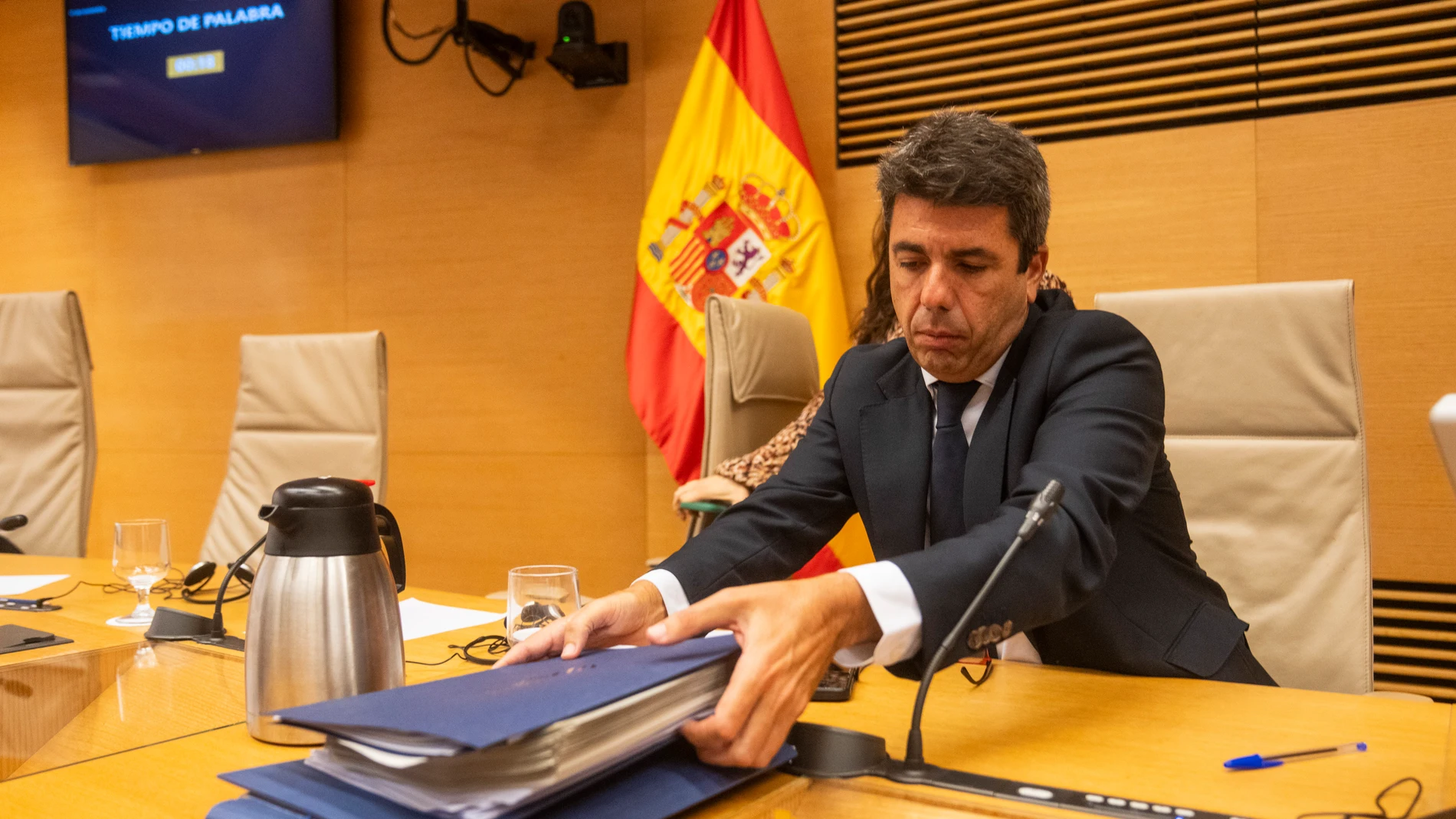
The plenary session of the Civil and Criminal Chamber of the Superior Court of Justice of the Valencian Community (TSJCV) will decide imminently if it feels the former president of the Generalitat, Carlos Mazón, on the bench for his management of the October 2024 dana, as requested by the investigating judge of the criminal case opened for the 230 deaths in the Catarroja court.
If the position of the five magistrates that make up the Chamber coincides with the judge’s criteria, Mazón will be called to testify before the Valencian high court and will have to give explanations for what he did and what he did not do, mainly, that fateful afternoon.
Judge Nuria Ruiz Tobarra sent the reasoned statement to request the indictment of Mazón on the same day that “OkDiario” published some audios in which, supposedly, the judge’s husband, also a magistrate, interrogates a witness and, although the investigation has continued after this fact became known, the consequences it may have on the process are unpredictable due to the unusual nature of the case. The former Minister of the Interior Salome Pradas and his previous number two Emilio Arguesothey already complained about this alleged intervention before the General Council of the Judiciary (CGPJ). Now three families have filed a complaint against her and are asking for the instruction to be annulled.
Given that the court that Mazón will have to face – if he is finally summoned to testify – is the TSJ, and this instance has already stated on two occasions against investigating Mazón “until there are more indications”the former president will endorse the reasoning that the judges of the Civil and Criminal Chamber and also the Prosecutor’s Office used a little over a year ago to reject the seven complaints and complaints that were filed against him and in which they requested his indictment.
His role in Cecopi
And in this sense they will defend that no one can be accused based on their position, no matter how high it may be, if there is no objective responsibility, something that Mazón’s entourage refutes and reminds that it corresponds to Emergencies, emphasizing that the former president was not even part of the Cecopi.
For this reason, the jurists who advise Mazón consider, aligned with the TSJ, that there is no established causal link to the deaths and that, even if there were, the former president of the Generalitat is not a guarantor nor does he have objective responsibility.
Furthermore, they consider that the instruction has not been completed because the declaration of the mayors, whose figure and task do appear in the flood plan, is missing.
Supported by arguments from the judges, former President Mazón faces his judicial future. In reality, he has been preparing for this moment practically since the case was opened in the Catarroja court. He will base his defense mainly on the fact that there is no expert evidence that shows that Es-Alert would have saved lives, just as there is no guarantee that confinement would have reduced the dramatic list of deaths. And this, supported by two issues: the first, that there were people who died after sending the alertwhich shows that not everyone heeded this warning, because as they say from those around the former president “there was no perception of risk because we are used to red alerts.” And the second refers to the fact that confinement is not a guarantee either that there had been no victims, given that some of them died in their homes and not outside.
Mazón’s defense, if he finally has to sit on the bench, will have a special impact on the Es-Alert, because “the entire instruction revolves around it”, but in the Flood Plan “the Es-Alert is not part of the planned protection measures.” At this point, the reasoning of the president’s defense is that “if no specific precept is violated, it is impossible for any criminal negligence to be established.”
They will also try to refute “the axiom” that prior sending of the alert would have saved lives because they consider that the messages by themselves are not sufficient elements to achieve this objective.
According to the former president’s environment, the list he makes the investigating judge of the 230 victimsas well as the circumstances of their deaths, does not include “the content of the alert that should have been sent and how receiving it would have saved that victim’s life.”
They also influence the information that was available at all times and in every place where a victim died, That is, when people died due to the overflowing of the ravines, there was no information that they were overflowing.
Mazón’s defense will also try to close the gap in which it can be considered that his chief of staff was acting in the name and by order of the then president of the Generalitat and, therefore, they will defend that when José Manuel Cuenca made the comment to former counselor Pradas, accused in the case, about the confinement it was 7:54 p.m., a time at which practically all of the victims had already died.