
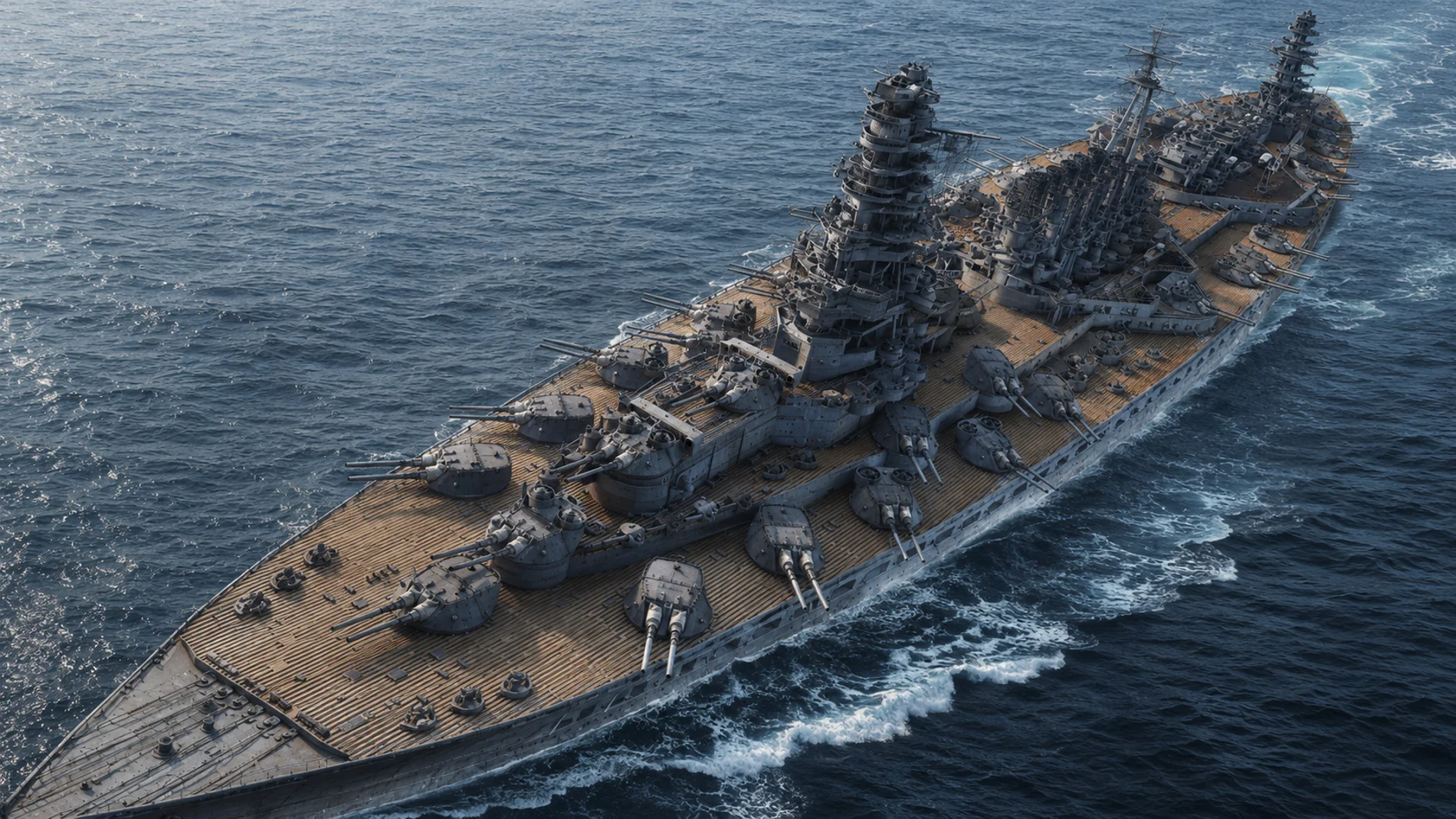
The Navy American can boast of having built the largest warship in the world. In service since 2017, the aircraft carrier USS Gerald R. Fordwith their 342 meters in length and a displacement of 100,000 tonssurpasses any other military ship in any navy. But this might not have been the case. if Japan had made the IJN Zipang mega-battleship a reality a little over a century agowhen the lieutenant commander Hidetaro Kaneda proposed one of the most ambitious naval concepts ever proposed.
Just before the World War IKaneda proposed this megaship, which would have weighed an incredible 500,000 tons and responded to the idea of having the firepower of an entire fleet in a single ship.
As a reference, at that time a medium battleship displaced between 25,000 and 30,000 tons. It would also have dwarfed the famous Japanese super-battleships of the class Yamatowhich weighed 72,000 tons and they had 263 meters of length.
Designed with a sleeve of 90 metersthe ship would have exceeded 609 meters in length, almost double that of the current USS Gerald R. Ford. These dimensions, however, were not arbitrary. Kaneda maintained that this sleeve was necessary to maintain stability in the Pacific Ocean.
The 90 meters coincide, precisely, with the average length of the waves in that part of the worldaccording to Historic Mysteries. A helmet of those dimensions would allow, in theory, to ride the Zipang quite a bit. more than 100 heavy cannonspossibly of a caliber as large as 20 inches, 51 centimeters.
The ship was also envisioned as a very agile vessel, with a potential maximum speed of 42 knots, about 78 km/h; an undoubtedly ambitious design.
Japan was not the only country dreaming of warships of colossal scale. During the Second World Warthe United Kingdom came to study a gigantic aircraft carrier, with 600 meters in length and made of pykretea mixture of ice and wood pulp, known as draft HMS Habakkukalthough it was discarded before being built. The idea was to create an unsinkable ship to counter German submarines.
Could Japan have built the IJN Zipang?
In short, no. Then, Japan lacked both the resources and the capacity to undertake a project of this scale..
At the beginning of the 20th century, the single-caliber battleships, the so-called ‘dreadnoughts’they were the centerpiece of any top-tier navy. In 1912, Japan barely had enough shipyards to build them, much less a colossus like the Zipang. His largest warship at the time, the Kongohad to be ordered from British shipyards, for example.
Such a 500,000-ton monster would have required the largest dry docks ever seen until that moment. It would also have needed equally enormous cranes, gigantic steel capacity, and transportation systems capable of handling it all.
And that’s just to build the hull. For the ship to move, it would have needed huge steam turbinesmuch superior even to the largest built then.
The fuel consumption of such a ship would probably have bankrupted the Japanese Navy. And even if they had managed to build it, It is debatable whether it would have been useful in combat.
Not so good for war
In combat, it would probably have performed quite poorly on the high seas, especially by its radius of gyration. The ship would also have been almost impossible to conceal and would have become an easy target for submarines.
The idea that Kaneda wanted to convey with the Zipang, which Japan had to concentrate its limited resources on fewer, but larger and more powerful ships.would inspire Yamato and the Musashithe latter also 263 meters long and 72,000 tons.
The Zipang, as the Yamato would later discover, would have been very vulnerable to air attacks. Curiously, the designer of the Yamato, Yuzuru Hiragaacknowledged Kaneda’s ambition and explained that he was on the right track, although the scale was somewhat blown out of proportion.
Although the IJN Zipang It was never approvedwas not as crazy a concept as it might seem at first glance. In the context of naval strategic thinking of the time, the idea of a single ship to dominate them all makes sense.
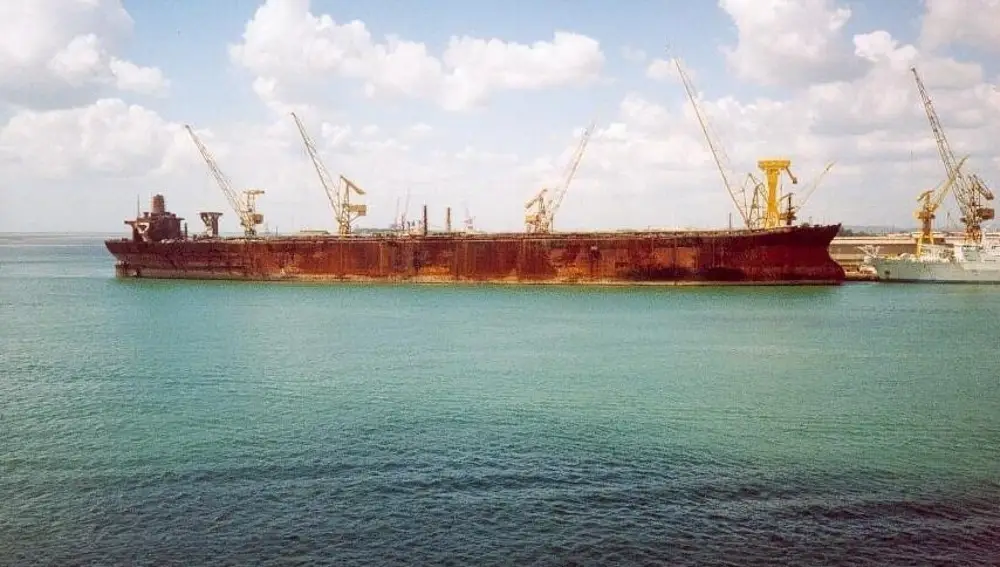
Furthermore, Kaneda’s dream would later come true, although not for war but for trade. Built, appropriately, in Japan, the Seawise Giant supertanker, weighing more than 500,000 tons fully loaded, began operating in 1979.