
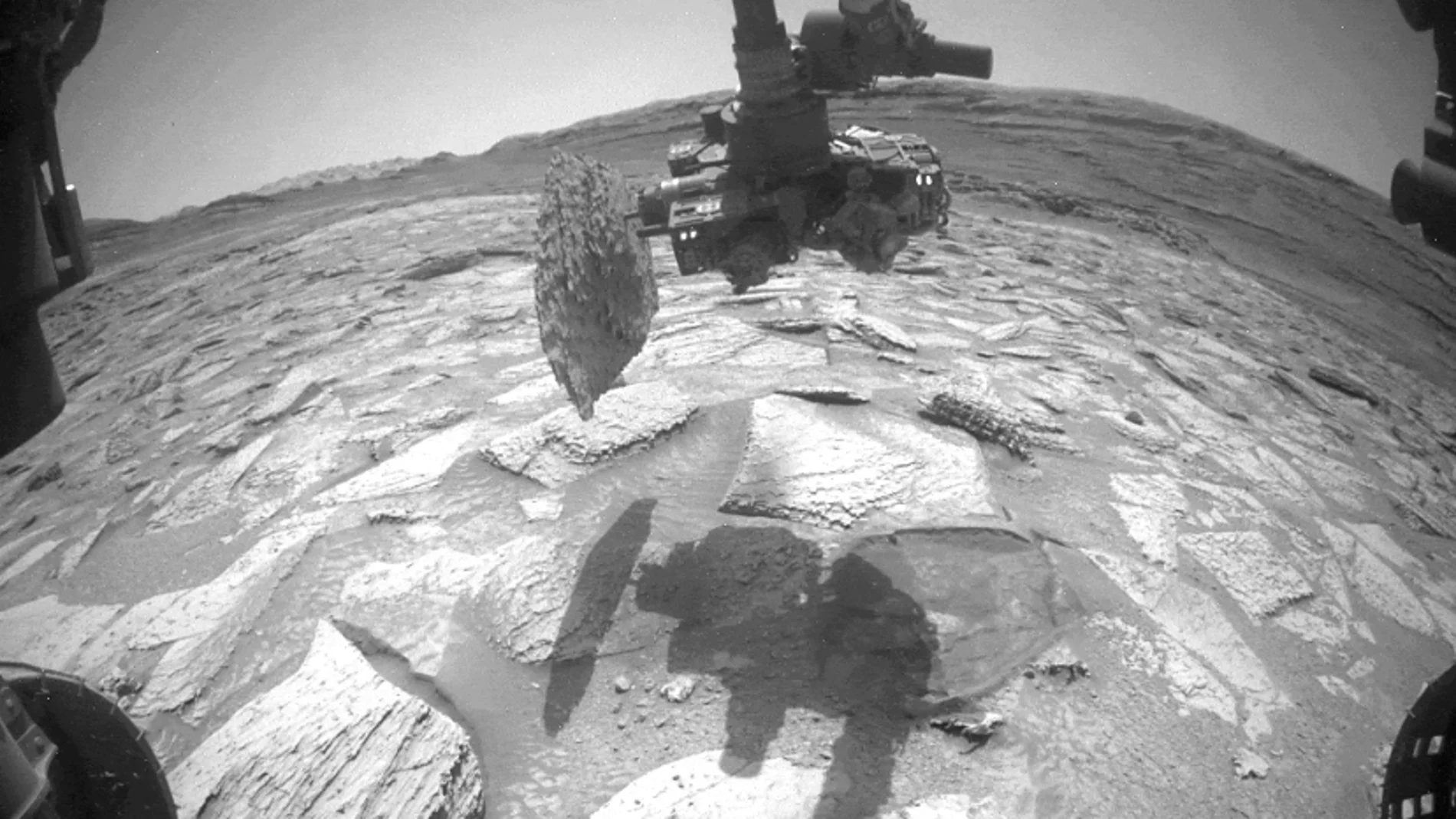
The extreme conditions of Mars include strong radiation, dust storms and temperatures that drop to -127 °C, something that the NASA rovers POT They are used to it. However, Curiosity had last month a setback he had never faced before, a rock that wouldn’t come loose from the drill.
On April 25, the Curiosity rover drilled into a Martian rock nicknamed Atacama and, without intending to, he tore it completely from the ground. Instead of breaking cleanly during sampling, The rock remained stuck to the rover’s drill when Curiosity removed its robotic arm from the surface.
The name of the rock has a reason. The Atacama Desert, in Chiliis the mid-latitude desert driest in the worldwith about 15 mm of annual precipitation; only the dry valleys of Antarctica receive less.
The Atacama rock was not small. NASA calculate what did it measure about 0.5 meters wide at its base, about 15 centimeters thick and weighed approximately 13 kilos.
Now, NASA engineers have faced many challenges during missions to Mars. But an entire rock stuck in the drill and refusing to come loose? This had never happened in Curiosity’s more than 13 years on the red planet..
The team’s first attempt to free the rover was to make vibrate the drill to shake the rock and loosen itbut it was of no use. Four days later, operators reoriented the arm and tried again with vibrations. Atacama released some sand, but the rock remained attached.
While the team was trying to free the drill, on-site science activities were ruled out, so Curiosity focused on remote observations with other instruments.
On May 1, engineers went further. They tilted the drill further, rotated it, vibrated it, and rotated the bit. Although they planned to repeat the entire sequence several times, it was not necessary. On the first attempt, Atacama broke free, finally breaking up as it fell onto the Martian surface..
The event led to an unexpected scientific opportunity. By moving the rock, the team was able to observe with ChemCaman instrument to analyze the composition of Martian rocks and soils, the granular material beneath the block, the cavity wall it left behind, and another clear block that had been covered by the Atacama. That is to say, The accident exposed material that normally would not have been visible.
For a multibillion-dollar scientific mission located 225 million kilometers from Earth, it was a surprisingly mundane problem. Now free of its unwanted passenger, Curiosity has resumed its usual programming to continue studying Mars.