
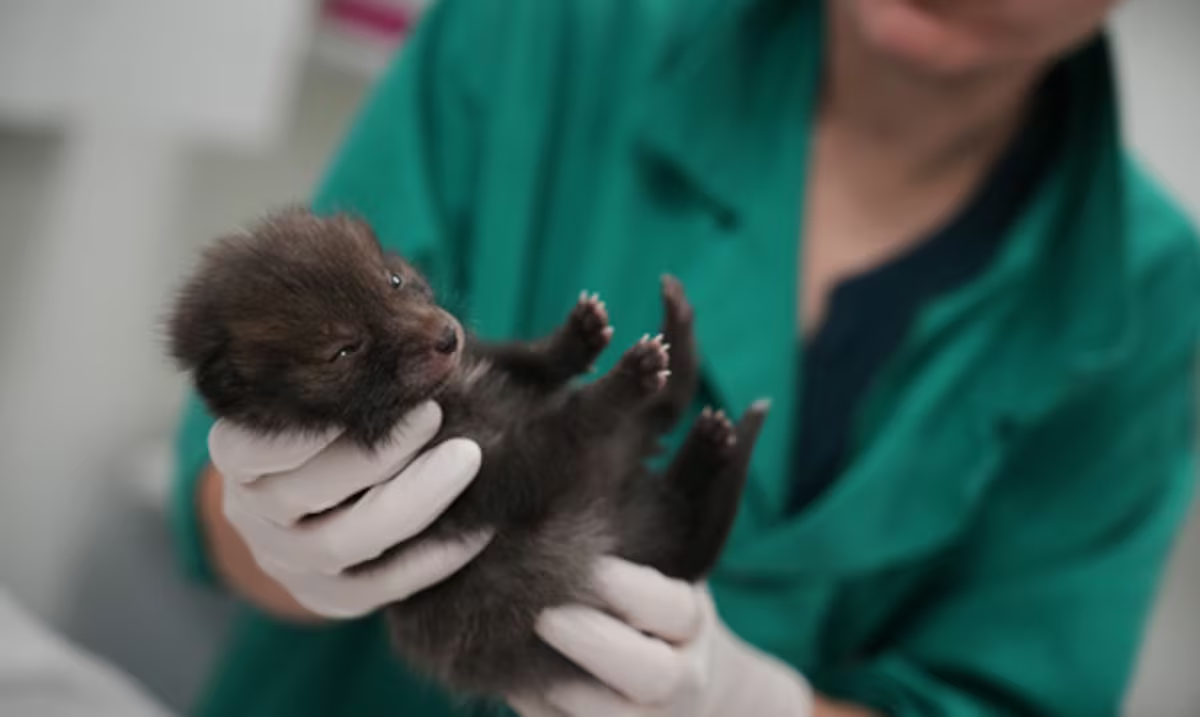
Maisons-Alfort, France – In a hospital for wild animals located in a suburb of the southeast of Paris There is no pampering, but there is a lot of care. Help injured, sick and orphaned animals – often victims of human activity and increasing urbanization – to heal so they can return to their natural habitat.
Last week they found a baby fox alone in a garden on the outskirts of the city, with no sign of its mother. Now a team of volunteers takes care of her 24 hours a day.
“We will make sure he eats well,” explains Valentin Delon, animal caretaker. “If not, we might give him supplemental bottles to make sure he gains enough weight.”
In the last year, the Maisons-Alfort Wildlife Veterinary Hospital has welcomed more than 10,400 wild animals, including a wide variety of European birds and mammals such as foxes, deer and hedgehogs.
Like the little brown-furred puppy, animals can easily capture the heart of a caregiver, but bonding with humans is not an option when the goal is to return them to the wild.
Caring for a fragile fox cub
The baby fox was found by neighbors who have hunting dogs. She was estimated to be about two weeks old, but she was too young to survive alone.
At the Maisons-Alfort hospital, veterinarian Julie Piazza examined her carefully and, apart from a minor wound, possibly caused by the bite of a wild animal or a dog, she was found to be in good health.
The calf was fed with artificial milk – a product that matches the composition of milk of animal origin – and, due to this, its abdomen swelled, Piazza explained.
“This is common in a young person who has had an alteration in their diet,” he added.
Once cured, the animals are moved to outdoor enclosures and aviaries to prepare them for reintroduction into their natural environment.
Delon, the keeper, states that “any type of imprinting” should be avoided, that is, measures that bind the animals to their long-term keeper.
“So we don’t hug them, we don’t talk to them,” he said. “You really have to keep a distance for their own good in the end, so they can be released later.”
Since she is just a cub, when she grows old enough, the baby fox will first be moved to a rehabilitation center and placed with other foxes in an enclosure.
“We can’t release it into the wild like that,” Delon says. “First she has to enter an enclosure and then, little by little, open the door so that she can come and go while still being fed. Then we will gradually reduce the food, and thus we will achieve a true gradual release.”
Young people are especially vulnerable
The Faune Alfort group’s hospital is the only one in the Paris region that cares for a wide range of wild species. 86% of his patients are birds.
Last week there was a swan with a broken wing, injured hedgehogs, dozens of ducklings that are often found on balconies and other places without parents, and lots of pigeons that are treated with as much care as the rarest birds.
Elisa Mora, communications manager for Faune Alfort, a non-profit association that manages the Maisons-Alfort hospital, states that last summer a record number of 200 admissions were recorded in a single day. The hospital is funded primarily by donations from individuals and charities, and has volunteers who help feed and care for the animals.
April to September is the “juvenile period in which wild animals reproduce” and the peak of admissions, according to Mora.
“Wild animals are already vulnerable, but young people even more so,” he says. Those that are too badly injured or cannot return to their natural habitat have to be euthanized.
Respond to human impact
Veterinarian Jean-François Courreau started Faune Alfort in 1987, inspired by students eager to better treat wild animals. Six years later, the idea became a hospital itself, housed by the National Veterinary School of Alfort, founded in the 18th century.
“It is hard to remain helpless in front of an animal in distress without being able to do anything,” Courreau said, adding that it is his duty to help as a veterinarian.
When people find a wild animal in distress, they think “I can’t do anything, and the animal is going to die,” he said. “So when they know that there is a care center and that they can take the animal there, it is a great relief.”
The vast majority of animals brought to the hospital – between 60% and 80% of admissions – are victims of road collisions, animals trapped in barbed wire or injured by people using gardening tools or agricultural machinery, among other causes related to human activity, explains Courreau.