
There are sensors that measure temperature, others that detect movement or light. We carry them in our pocket, in the car or at home. In total, it is estimated that there are about 40 billion sensors on the planet. To this we must add that an average smartphone contains almost 20 sensors (accelerometer, gyroscope, light sensor, GPS, etc.), a car can reach 70 sensors and between all of them they generate more than 402 million terabytes of data daily… information that would fit on more than half a billion CDs. But they all share one limitation: They are outside our body, outside where the most important processes really occur.
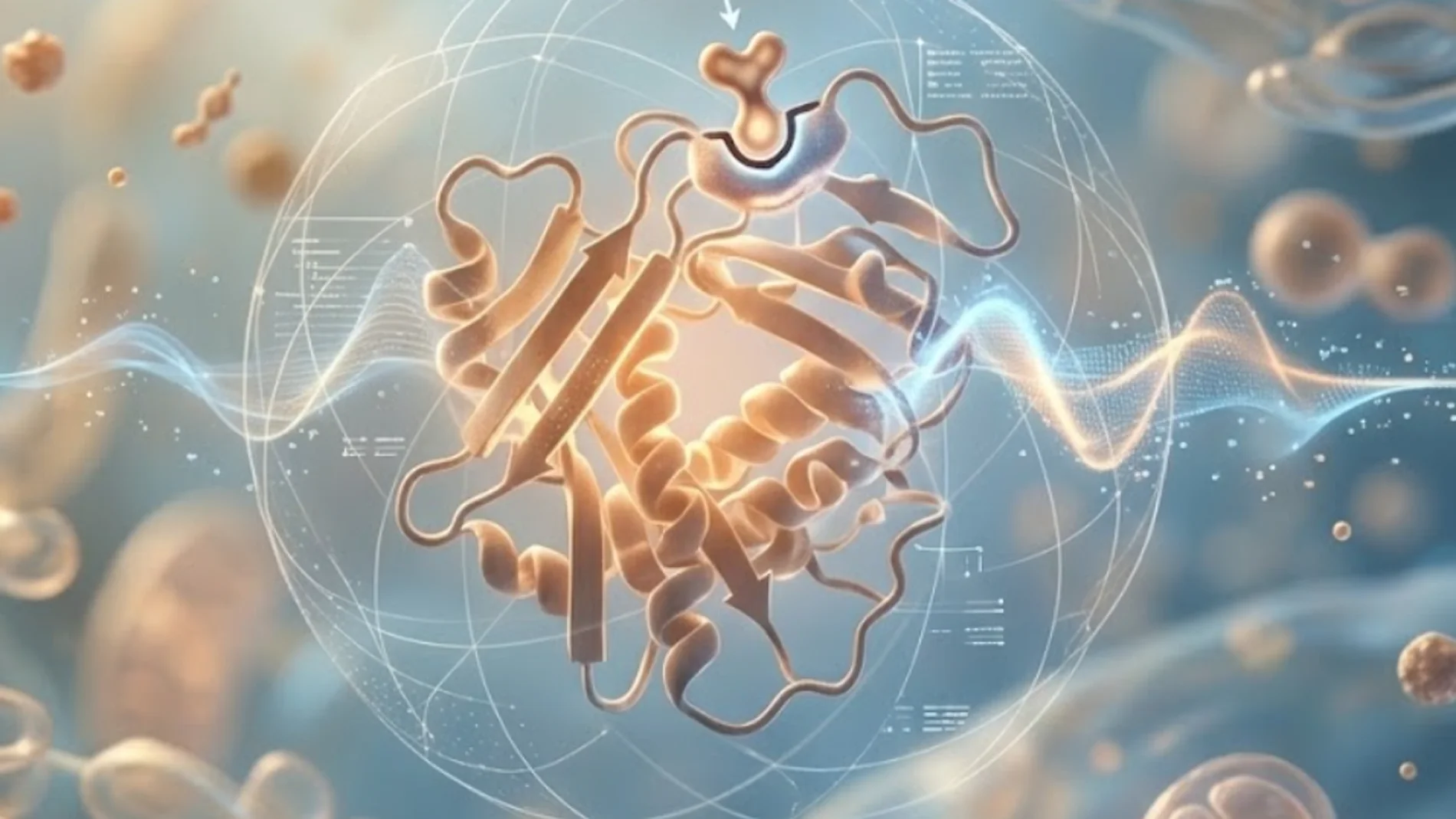
Now, an international team led by Kirill Alexandrov of the Queensland University of Technology has taken a step in the opposite direction: creating sensors so small that they can operate within the machinery of life itself. These are not miniature devices, but something more radical: proteins designed with artificial intelligence.
Proteins are, in essence, the tools of cells. They detect, react, transform. Everything that happens in a living organism goes through them, in one way or another. Therefore, for years, one of the great objectives of synthetic biology has been to design proteins capable of detecting specific signals and activating a response.
The problem is that, until recently, scientists could only modify proteins that already existed in nature. It was like trying to build a faucet from old models: you could make adjustments, but you couldn’t create something completely new. This is where artificial intelligence comes in.
Alexandrov’s team used machine learning models to design proteins capable of recognizing specific molecules (from small chemical compounds to other proteins) and, in doing so, change their behavior. That change is the key.
When these proteins “detect” their target, they are activated. And that activation can be translated into visible signals: a change in color, the emission of light or even an electrical signal. Something that can be measured. That is to say: a molecule that works like a switch. And not just any switch, but a programmable one.
In a study published in Nature Biotechnology, Alexandrov’s team showed that these sensors can work inside living cells, such as bacteria, and also be integrated into electronic systems. In one of the experiments, They connected these proteins to electrodes to generate electrical signals, in a mechanism similar to that of glucose meters.
But perhaps the most interesting thing is not what they do, but how they do it. For decades, it was thought that proteins that act as sensors needed to drastically change shape to activate, like a key turning in a lock. This study suggests something different: All it takes is a subtle change in its dynamics, a small adjustment in how its parts move.
“It was believed that sensor proteins had to undergo large changes in shape to function as switches – confirms Alexandrov -. We discovered that these artificial receptors do not need drastic structural reorganization. Instead, Binding of the target molecule subtly modifies the movement of the protein, which is sufficient to activate its activity. “This gives us new insight into how natural protein regulation works and provides a powerful new strategy for designing useful biosensors.”
That seemingly technical detail changes the rules of the game. Because it simplifies the design and opens the door to creating custom sensors, almost on demand. The applications are as broad as they are immediate to imagine. Portable devices capable of detecting diseases from a drop of blood. Systems that monitor contaminants in real time. Cells designed to react to specific chemical signals, activating or deactivating biological processes. But there is something deeper. Until now, measuring meant observing from the outside. This advance points to another possibility: measuring from within.