
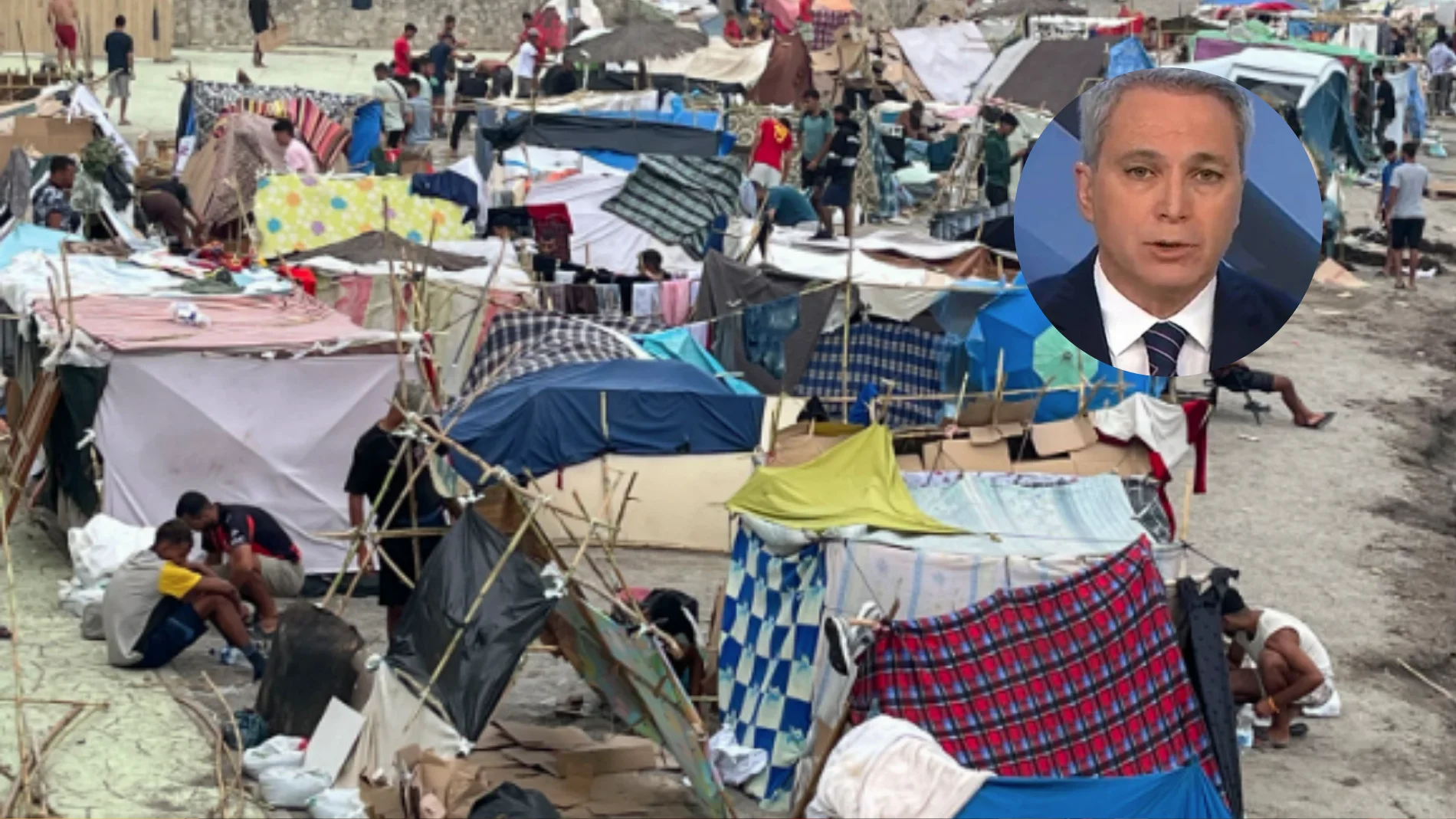
Vicente Valles has once again analyzed the management of the Ceuta crisis, this time with the focus on the open judicial investigation to determine what information the authorities were handling before the massive entry and how they acted once they received the notices.
The presenter has pointed out that, after weeks marked by political confrontation, the investigation by the National Court introduces a new dimension that may have different consequences from those of the parliamentary debate.
“In the month and a half that has passed since the assault on the Ceuta border, we have witnessed a political debate about the Government’s management, about what has been done, and about what has not been done – but should have been done,” Vallés began.
For the journalist, this debate will continue, but now it will coexist with a second way. “As of today, this political debate will continue, but another avenue will be added, which can be considered even more important, due to the consequences it may have: the judicial route”.
The National Court enters fully into the Ceuta investigation
Vallés’ words come after the judge of the National Court Maria Tardon has agreed to new proceedings in the case opened by the massive entry registered from Morocco at the end of July.
The judge has summoned the president of Ceuta as witnesses, Juan Jesus Vivasand the former Chief of Staff of the Government Delegation, Gonzalo Sanz. The first is called to testify on September 30 and the second on October 1. That same day the head of the Local Police of Ceuta must also appear as a witness.
“Because the National Court has already entered into the matter, citing as witnesses the president of Ceuta and who was, until a week ago, the chief of staff of the Government delegate,” Vallés explained.
The judge has also requested different police and military organizations to provide the alerts and risk analysis that they had prepared before the events. The request includes knowing who received these notices, by what means they were communicated and on what date and time.
Vallés focuses on who knew about the prior warnings
It is precisely this point that Vallés has placed at the center of his analysis. “And even more so, because the judge has requested all available documentation regarding the warnings prior to the assault,” he noted.
The journalist then summarized the objective that, in his opinion, the judicial proceedings now pursue: “Ultimately, justice tries to find out who knew what, when they knew it, and what the person who knew it did or did not do, after knowing it.”.
The judge’s order seeks to reconstruct what information the authorities had before the massive entry and what decisions were made after receiving the various existing alerts.
Among other actions, the National Court has requested information from the National Center for Immigration and Borders, the CNI and other police and military organizations. It also investigates the organization of the call on social networks and tries to identify those who could have acted as facilitators or organizers.
The investigation also reaches the Government delegate
The judicial route has also been extended to the actions of the Government delegate in Ceuta, Miguel Ángel Pérez Triano. A court in the autonomous city agreed to refer to the National Court the proceedings it had opened regarding its actions during the crisis.
Vallés ended his speech by focusing precisely on this point. “And the initial suspicion points towards the Government delegate, who at some point will also be called to testify before the judge, and who has not appeared in public for a week,” he stated.
These words are part of the analysis carried out by the presenter. The judicial investigation remains open and the proceedings ordered seek to clarify the responsibilities that may arise from the events without, at the moment, there being a resolution that establishes any criminal responsibility.
The judge wants to reconstruct what happened before, during and after
María Tardón’s investigation is not limited to determining what notices existed. The judge has also requested information aimed at reconstructing the actions carried out. before, during and after of massive entry.
The National Court wants to know the chain of information, identify the possible organizers and analyze the circumstances that led to the situation experienced at the border.
A judicial scenario that, as Vicente Vallés highlighted, now adds to the political debate that has accompanied the crisis since the end of July and transfers part of the questions about the management of those days to the courts.