
There is a scene that is repeated in many kitchens: someone opens the dishwasher, sees a dish with food remains stuck to it and decides that it needs an intensive program. Then he looks at the cups, glasses and plates that have barely passed the table and thinks that perhaps they should not undergo the same treatment. The alternative is usually to remove the remains by hand, rinse some pieces or run a second cycle. It is a small domestic contradiction that the OCU has already pointed out: washing by hand can consume up to 60 liters of water compared to 10-15 liters for an efficient dishwasher. However, pre-washes and additional cycles significantly reduce that benefit. What do we do then?
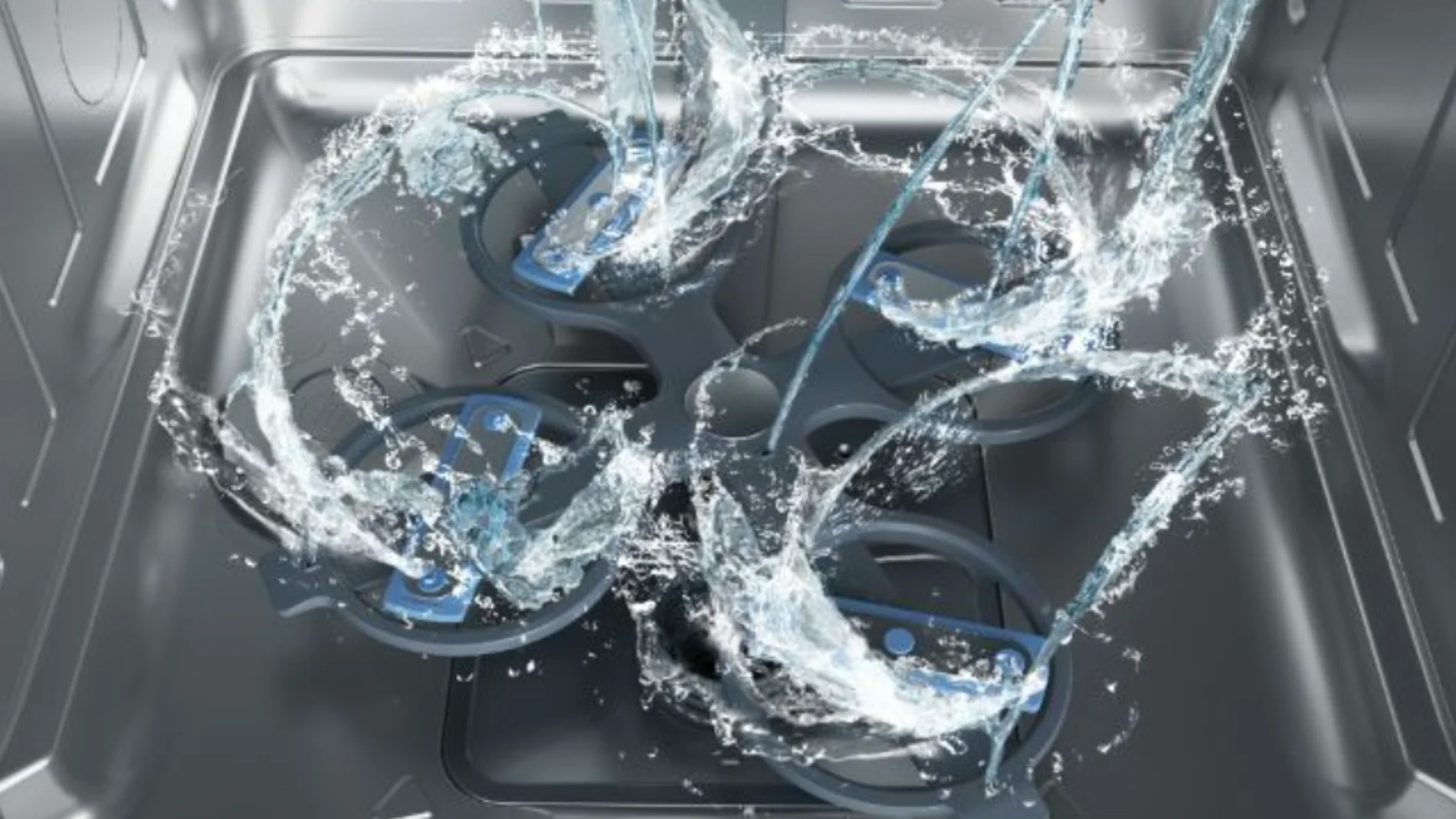
Beko wants to attack precisely that problem with PowerIntense, a washing technology that introduces four spray arms with bidirectional movement. The idea is to expand the coverage of the water inside the tank and reach areas that may be less exposed in a conventional system. It is not simply about adding more jets, but about modifying the distribution of the water so that it reaches the dishes from different angles and can deal with loads in which light remains and more resistant dirt coexist. The challenge is comparable to trying to illuminate all the walls of a maze… with the same intensity and without consuming more energy. Tests show up to five times better cleaning results using the intensive program at 70 degrees. It also talks about a wash coverage of up to 234%.
The second part of the proposal is less visible, but perhaps more important in everyday use. SensorAdapt combines sensors and artificial intelligence to analyze the amount of dishes, temperature and soil level, and automatically adjust cycle parameters. Instead of treating all loads as if they were equal, the dishwasher tries to adapt its water, energy and time consumption to what is actually in front of it. Beko announces savings of up to 50% in these three sections. And this not only saves water, but also time and energy: An efficient dishwasher is not only one that consumes little when it works, but also one that avoids having to run again because it has not managed to clean properly the first time.
The system is supported by a ProSmart Inverter motor, designed to offer efficient, long-lasting and silent operation. Here the technology fulfills a less spectacular, but fundamental function: controlling the movement of the water and helping the whole work with stability. In an appliance that can run for hours and is used several times a week (and even a day), Durability and noise matter as much as consumption figures.
Drying also has its own protagonist. TargetDry directs the heat towards the dishes instead of heating the entire tank: again the objective is to make better use of energy. This solution can reduce energy consumption by up to 25% during drying compared to standard dishwashers of the same capacity that do not incorporate this technology. Connectivity completes the set. Through HomeWhiz, the user can control different functions from their mobile phone, consult information about cycles and monitor water and energy consumption. It also allows access to additional programs. It is not an essential function to wash better, but it can provide useful information for use at the most economical time.
Overall, PowerIntense presents an evolution that does not seek so much to add flashy functions as to solve a very specific frustration: that the dishwasher adapts to the load and not the other way around. The four spray arms try to improve water distribution; SensorAdapt adjusts the cycle; TargetDry seeks to make better use of energy during drying and HomeWhiz adds a layer of control over consumption. and this should be the future of technology: not in creating something that is visible, but rather in something that is useful and long-term.