
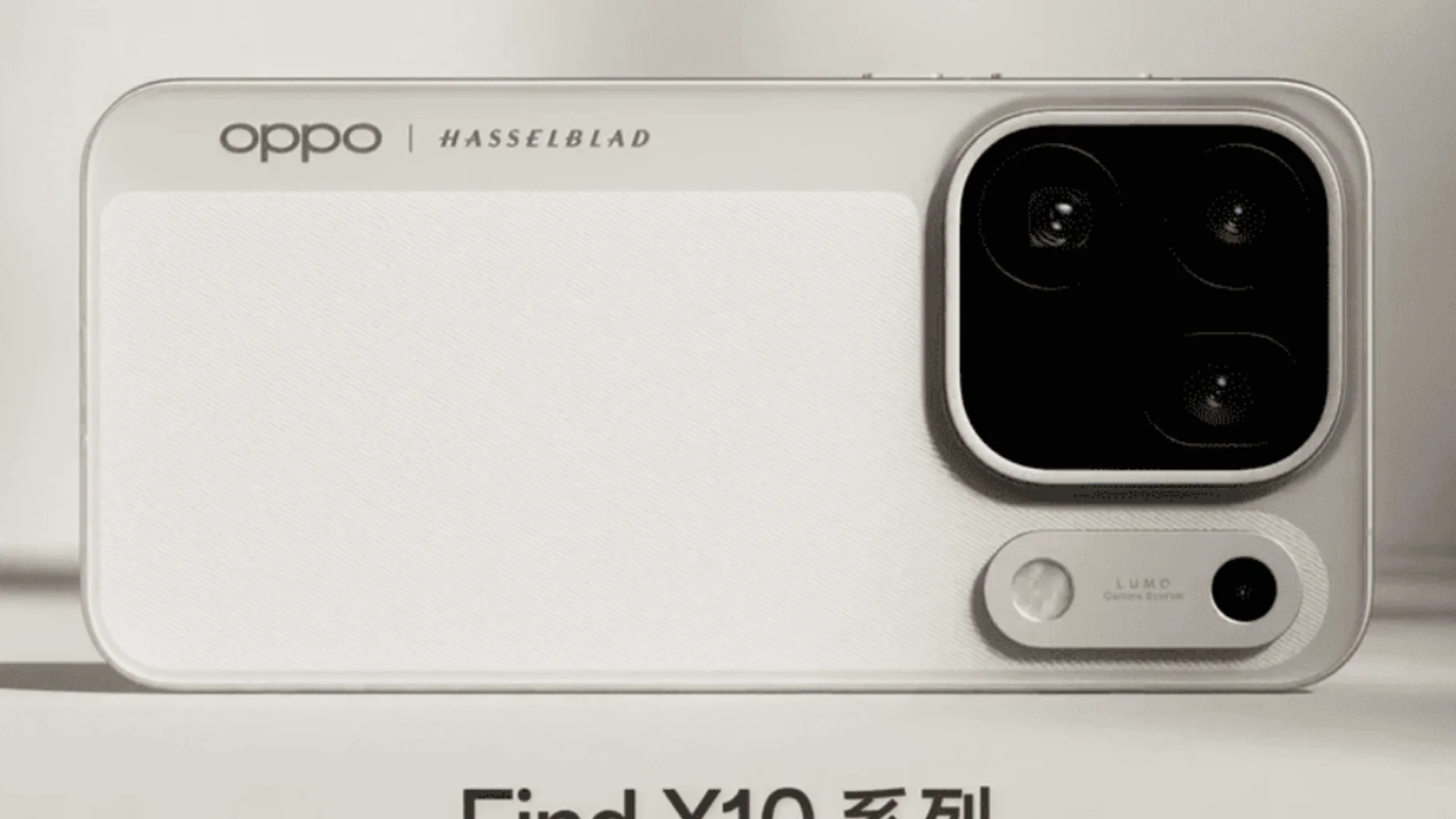
There was a time when megapixels were the big battle in mobile photography. Six years ago Samsung was the first to cross the 100 MP barrier. Then came the larger sensors, periscopic zoom, computational photography and artificial intelligence. Now OPPO seems to want to recover that race, but with a difference: it doesn’t want to put a 200-megapixel camera on its phone, but three. The result, when adding its resolutions, reaches 600 megapixels.
The protagonist will be the OPPO Find X10 Pro Max, the new top of the range from the Chinese company. According to the information released by OPPO and previous leaks, the phone will have three rear cameras of 200 MP: a main, an ultra wide angle and a telephoto lens. It is an unprecedented configuration in a smartphone and brings the total resolution of the photographic system up to those striking 600 MP.
But it is worth stopping for a moment before that figure. It doesn’t mean the phone takes 600MP photos. Each camera has its own 200 MP sensor and can capture images at that resolution. The 600 MP are simply the sum of the three sensors. The really interesting thing is where OPPO has placed those sensors. The main camera will use Samsung’s new ISOCELL HPC, also 200 MP, while the ultra wide angle and telephoto lenses will also use sensors of that resolution. The first of them is especially striking: it would be the first 200 MP ultra wide angle installed on a phone.
Why can such a large number of pixels be useful? One of the possibilities is to have more room to crop a photograph without losing so much detail. It can also help stabilize video or perform certain computational photography processes. But megapixels are just one piece of the puzzle. The physical size of the sensor, the quality of the optics, the amount of light that reaches itstabilization and, increasingly, algorithmic processing, have a decisive influence on the final image.
OPPO has already demonstrated with the Find X9 Ultra that its strategy involves combining high-resolution sensors with cameras of different focal lengths and collaboration with Hasselblad. That model incorporated two 200 MP cameras, one main and one telephoto, as well as a 50 MP ultra-wide-angle camera and a 50 MP periscopic telephoto lens with 10x optical zoom. The Find X10 Pro Max would take that philosophy one step further: 200 MP wherever the user changes perspective.
And to handle such an amount of information will require muscle. OPPO has confirmed that the Find X10 Pro Max will be one of the first phones to use the MediaTek Dimensity 9600 Pro, manufactured using TSMC’s 2nm process. The new chip incorporates two C2-Ultra cores capable of reaching 4.55 GHz and six performance cores. According to OPPO, Delivers 17% more CPU performance and 27% more graphics performance under sustained loads.
But perhaps the data most related to cameras lies elsewhere: artificial intelligence. The processor incorporates a new dual NPU architecture and, according to OPPO, Its high-performance unit achieves 51% faster language model prefilling. This capacity not only serves to run AI assistants: it can also intervene in the computational processing of photographs, precisely the place where a mobile phone transforms the raw data captured by its sensors into the image that we finally see.
The paradox is that the megapixel race is no longer just about accumulating pixels. A 200 MP sensor generates a huge amount of information, but then you have to know what to do with it. The challenge for OPPO will be to make these three sensors work as a coherent system and that the resulting photograph is better, not simply larger. The Find X10 Pro Max will be presented in China on September 22 and OPPO has confirmed that it will also arrive in international markets.