
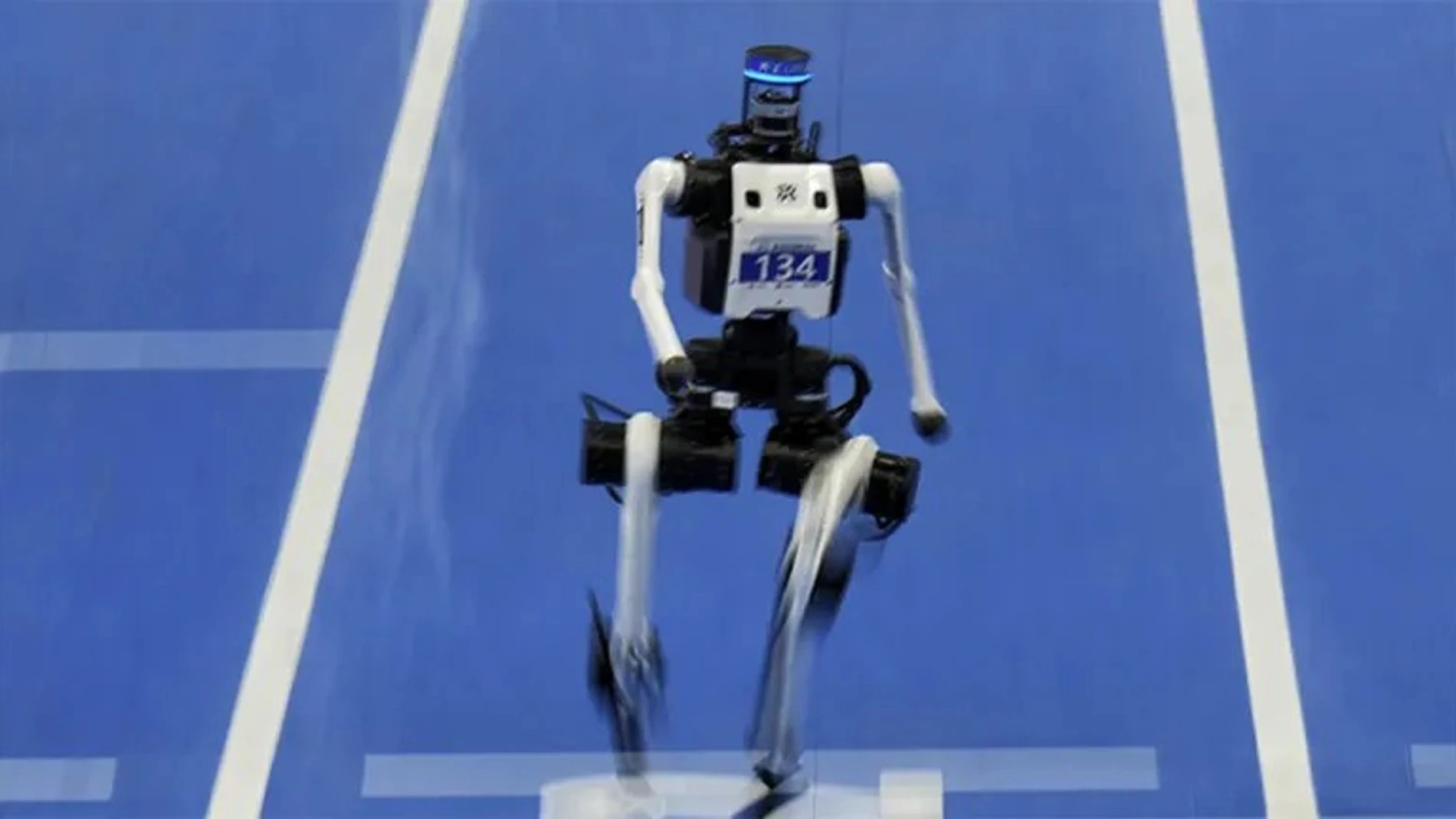
Two humanoid robots have managed to surpass several world records in male athletics during recent years. Humanoid Robot World Games celebrated in Beijing. His results were better than the records obtained by athletes like Usain Bolt and others, although the tests were held under specific categories and conditions for machines, so they cannot be considered directly equivalent.
The competition brought together 2,056 robots of 666 teams coming from 16 countries between August 22 and 26, 2026. The event program was not limited to sports alone but combined them with logistics, industrial assembly and recharging tasks. The results show notable advances compared to the first edition of 2025, especially in high jump, where the best robotic mark went from 0.95 to 2.88 meters. The following are the four human sports records that the machines broke during those days.
100 meters
human mark
Usain Bolt set the world record for 9.58 seconds at the 2009 World Cups in Berlin.
Robot result
Tiangong Ultra won the final for large robots with a time of 8.64 secondsan improvement of 0.94 seconds over Bolt. The machine, developed by Humanoid Robot Innovation Center from Beijing, had previously recorded 9.39 seconds and then 8.86 during qualifying.
400 meters
human mark
Wayde van Niekerk achieved the world record 43.03 seconds at the 2016 Rio de Janeiro Olympic Games.
Robot result
Tiangong Ultra also won this test by completing the final in 38.15 seconds. His time reduced the South African athlete’s record by almost five seconds.
1,500 meters
human mark
The Moroccan Hicham El Guerrouj set the world record in Rome in 1998 with 3 minutes and 26 seconds.
Robot result
Tiangong Ultra completed its third victory with a mark of 2 minutes and 21.6 secondsmore than a minute below the human record. The next two qualifiers also improved El Guerrouj’s time.
High jump
human mark
The Cuban Javier Sotomayor It exceeded 2.45 meters in Salamanca in July 1993.
Robot result
A machine X-Humanoid reached the 2.88 meters in a jump from a standing positioncompared to 0.95 meters in the previous edition. This comparison requires clarifying that Sotomayor jumped with a previous career and using the Fosbury style. They are modalities with different mechanics.
Fewer components to improve performance
The improvement of these machines is partly explained by simplifying your design to perform a specific task. Scott Walterhead of robotics analysis at the investment fund RoboStrategyexplained to Live Science that eliminating unnecessary components reduces weight, possible points of failure and coordination difficulties.
‘Many degrees of freedom were removed in the arms, including the shoulders, elbows, wrists and hands, as well as the hips and ankles. This reduced mass and allowed the weight of the extremities to be shifted to higher areas of the kinematic chain, which improved the efficiency of movements.‘, he points out.
These modifications They allow you to run more efficiently, but they also limit other capabilities of the robots. Some could only accelerate in a straight line and could not stop without crashing into the padded barrier behind the finish line. The absence of hands also prevented them from handing over a baton in a relay race. During the games there were falls, crashes and even some robots caught fire.
The remaining challenge is to get humanoids to perform varied tasks reliably. More than 40% of the tests required autonomous operation, with activities such as manipulating objects or connecting cables. Walter considers that developing dexterous and resistant hands remains especially difficult and points to the decathlon as a possible next objective to demonstrate more diverse capabilities. ‘The human decathlon record is the true test of speed, endurance, power, strength, robustness, coordination and dexterity. I wouldn’t be surprised if next year they try to beat it‘, he concludes.