
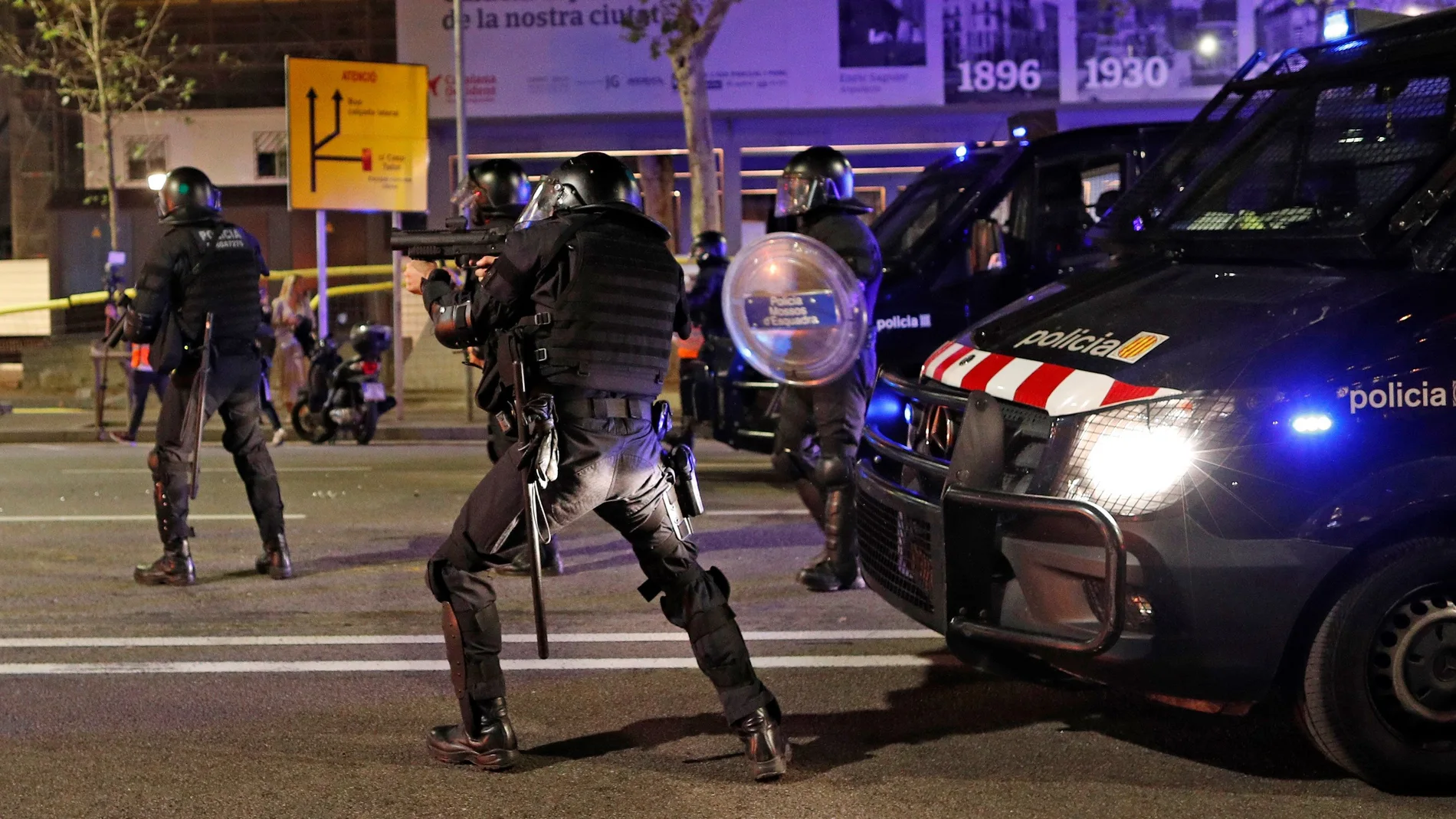
Insults against officers, disqualifications of police unions and messages that directly call for attacks on officials have become a constant on certain digital channels. A situation that worries police organizations, especially after the latest episodes of violence recorded in Barcelona, where several officers were injured during the riots.
One of the most recent examples is that of the Federal Police Union (UFP), which has received hundreds of responses to its X publications, many of them with insults and expressions of a violent nature. The controversy has intensified as a result of the confinement carried out by union representatives in the Secretary of State for Security to demand recognition of the National Police as a risky profession and a dignified retirement.
One of the publications related to this protest, published on October 27, accumulated 438 responses and a hundred quotes, in addition to exceeding 100,000 views. Qualifiers such as “fascists”, “pigs”, “scum”, “traitors” or “sellouts” appear recurrently in the comments. Expressions such as “go to hell” and much more serious personal disqualifications are also repeated. «At least they don’t beat you to death like you would do. Pigs,” wrote one of the users. “I hope they beat you out,” noted another comment, which accompanied the message with several insults directed at the police officers.
The sampling carried out on the responses to this publication and other recent mentions allows us to place the proportion of especially hostile or insulting comments between 20% and 40%. There is, however, no complete count that allows establishing a definitive figure. The available consultation tools do not offer access to all the responses nor do they allow for exhaustive statistical analysis. In any case, the volume of aggressive messages is significant and reflects the degree of polarization that currently surrounds the Security Forces and Corps.
The disqualifications are not limited to police unions. In many of these messages, the agents are reproached for their actions during riot control and authoritarian behavior is attributed to them. The terms “fascists” or “gorillas” appear associated with criticism of the use of force in demonstrations, while other users accuse union organizations of defending extreme right-wing political positions. This is a particularly bitter debate, in which the labor demands of police officers end up mixing with ideological disagreements about the role of authority and public order.
But the concern of police organizations goes beyond insults. The Unified Police Union (SUP) has warned of the circulation of messages in messaging groups in which direct attacks against officers and deliberate damage to police vehicles are proposed. According to the information collected by the union, some participants would be exchanging proposals to attack officials and render patrol cars useless.
The SUP believes that these messages should be analyzed with special attention because they could point to something other than the usual episodes of vandalism that occur during certain riots. The organization maintains that it is necessary to investigate whether behind these conversations there are preparations to commit deliberate and coordinated attacks. In any case, it warns that the spread of these threats does not ensure that attacks will occur, although it does justify a rigorous risk assessment and the adoption of preventive measures.
Concern has been increased by the latest incidents recorded in Barcelona. During the riots, several police officers were injured and 130 people were arrested, of which 76 were minors, according to data collected by the union. A youth participation that has led the SUP to demand a review of the criminal response to violent crimes committed by minors, especially when there are indications of prior planning or coordinated action.
The organization plans to evaluate the effectiveness of Organic Law 5/2000, regulating the criminal responsibility of minors, and study possible modifications that allow it to offer a proportionate response to attacks against authority. The union maintains that minority status should not generate a perception of impunity and recalls that attacks against police officers constitute criminal conduct, regardless of who commits them. At the same time, he defends that any reform must maintain the objectives of reeducation and prevention of recidivism.
Another aspect that requires investigation is the possible responsibility of those who promote or facilitate the attacks, beyond the people who ultimately carry them out. The SUP considers that investigations should also reach those who induce or contribute to preparing the attacks, as long as there is sufficient evidence to prove their participation.
The union organization also demands to strengthen Information services, improve coordination between the different police forces and guarantee that security devices have the necessary human and material resources. Their argument is that the protection of officers cannot depend exclusively on their ability to respond when violence has already occurred.
The scenario described by the unions thus combines two different phenomena, although related by the climate of hostility that surrounds police activity: on the one hand, the systematic disqualification of officials on social networks and, on the other, the appearance of messages that directly raise the possibility of attacking them. Insults, by themselves, do not establish that there is a real threat or that their authors are going to take their messages to the streets. But the circulation of calls that contemplate physical attacks introduces an additional element of concern for those responsible for security.
The SUP insists that the principle of authority constitutes a guarantee for all citizens and that threats against those entrusted with their protection cannot be assumed as an ordinary consequence of police work. The issue, they maintain, is not to prevent criticism of the agents’ actions, but to prevent political and social confrontation from turning attacks against them into normalized behavior.