
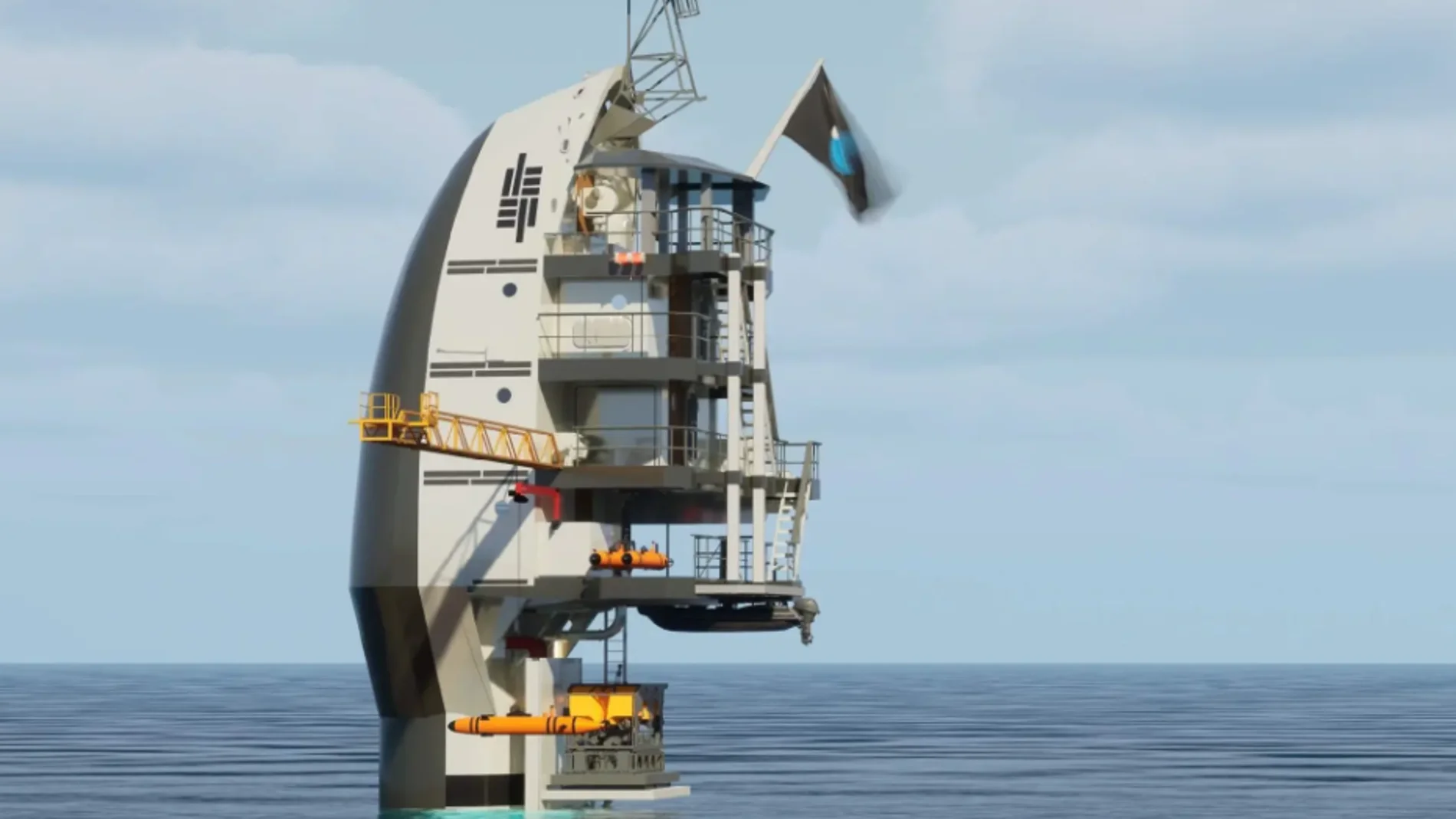
Let’s imagine a ship that, when the sea becomes dangerous, decides to sink. It’s not an emergency or an accident: it’s exactly what you need to do to accomplish your mission. The R/P FLIP (Floating Instrument Platform) was conceived to change position on the high seas and become a vertical structure, with much of its hull underwater. At first glance it appears to be shipwrecked. In reality, he is looking for calm in the most unexpected place: under the waves.
Built in 1962 for the U.S. Office of Naval Research and operated for decades by the Scripps Institution of Oceanography at the University of California, San Diego, the FLIP was not a conventional ship. Its 108 meters in length and about 700 tons of steel made it a floating platform designed to carry out highly precise measurements. His specialty was studying sound underwater, although over time it was also used to investigate currents, waves, ocean temperature, meteorology and even the behavior of marine mammals.
Its transformation begins when a tugboat takes it to the work area. There, the FLIP initially remains horizontal, like an elongated and relatively conventional-looking vessel. Then the maneuver that gives it its name begins. Their ballast tanks are flooded in a controlled manner and the displacement of water modifies their balance. The structure rotates about 90 degrees until it is almost vertical. The process takes about 20 minutes, although Scripps notes that it can be completed in less than half an hour.
In that position, about 90 meters of its length are submerged and only a relatively small part protrudes from the sea. The key is that most of its structure is below the area most affected by the movement of the waves. Its hull also has a variable diameter: it reaches about 6.5 meters in much of the submerged section and tapers towards the surface. The result is an extraordinarily stable platform. In tests with waves up to ten meters, its total vertical movement became less than one meter.
This stability is not a luxury, but the reason for the project. To study how sound propagates underwater, measure currents, or analyze internal ocean waves, scientists need to know that their instruments remain in a known position. If the platform rocks continuously, the measurements can be confused with the movement of the support itself. The FLIP reduces this problem and allows working with sensors, hydrophones and sonars installed at different depths.. Some instruments could descend to around 4,000 meters, while the platform could be anchored in depths of up to 5,000 meters.
Life on board also had to adapt to this dual personality. The FLIP could accommodate 16 people: five crew members and a scientific team of eleven members. It had two laboratories, work spaces and offices to sustain research campaigns of up to 30 days without receiving supplies. For drinking water, it had a tank of about 5,700 liters and a reverse osmosis plant capable of producing around 117 liters per hour. Its interior facilities were prepared for both positions: there were doors that served horizontally and others vertically, and some furniture, sinks and toilets could be rotated and fixed so that they remained usable after the maneuver.
The FLIP also did not have propellers or its own propulsion. It could not move across the ocean at conventional sailing speed: it needed to be towed to the research site and back to port. Three diesel generators provided a combined electrical power of 340 kilowatts to power the systems. of the platform and scientific equipment.
His career, however, was not free of difficult episodes. In 1969, during an operation in the Pacific, the team had to abandon the platform after losing power in high swell conditions, with waves exceeding 24 meters. A rescue had to be organized. The ability to remain stable in a vertical position did not make the FLIP an invulnerable structure nor did it eliminate the risks of working in the open sea.
After more than six decades of history, his career with Scripps ended in August 2023. The institution decided to withdraw it after an evaluation concluded that the costs of its renovation were not justified. It seemed destined for scrapping in Mexico, but in 2024 the British company DEEP, specialized in underwater technology, rescued it and announced an ambitious project to return it to service.
The reconstruction is taking place at the MB92 shipyard in La Ciotat, France. In April 2026, the responsible team explained that they had found corrosion and fatigue in different areas of the structure, which forced them to replace hull plates and repair internal elements. Also About 180 tons of concrete ballast were removed to access parts of the structure. The modernization includes new instruments, sensors, computer systems and communications, in addition to adapting the platform to integrate equipment from other organizations.
DEEP wants FLIP to once again be a tool for ocean research and to support its future underwater habitats, such as Sentinel. Its return does not consist, therefore, in exactly recovering the 1962 boat, but in taking advantage of an exceptional engineering idea and providing it with current capabilities. FLIP was born to find stability where almost everything moves. Now, After almost disappearing, he tries to find a second life in the ocean.