
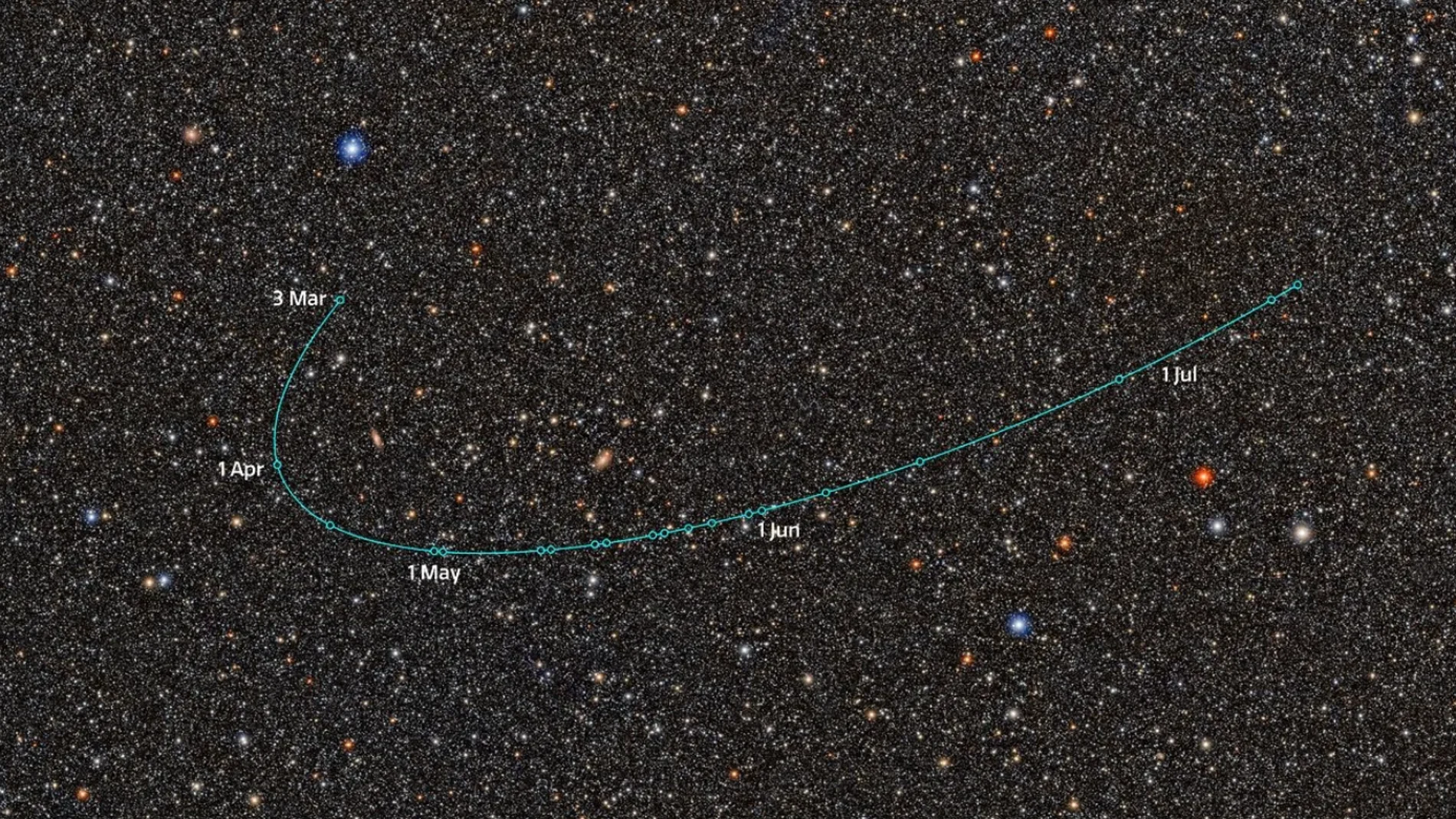
There are objects that do not need to be hidden to go unnoticed. It is enough that the place where they are located is so full of lights that no one can distinguish them. This is what has happened to 2026 ED138, an icy body located beyond Pluto that has just become a candidate for a dwarf planet. The Vera C. Rubin observatory in Chile has made it possible to recognize it in a region of the sky so populated by stars that its presence had gone unnoticed for years.
The discovery, announced by the Minor Planet Center of the International Astronomical Union, has attracted attention due to the size the object could have. The first calculations place its diameter between 600 and 1,500 kilometers. If subsequent observations confirm that it is large enough that its own gravity has given it a roughly round shape, it could join the small family of recognized dwarf planets officially, which includes Pluto, Ceres, Eris, Haumea and Makemake.
For now, however, ED138 is a candidate, not a confirmed new dwarf planet. The breadth of the estimate of its size reflects a common difficulty in astronomy: brightness does not allow us to directly know the dimensions of a body. A relatively small, reflective object may appear as bright as a much larger, darker object. To specify its characteristics, new observations will be necessary, including measurements at infrared wavelengths that help determine its real size.
The discovery began on October 13, when astrophysicist Matthew Holman of the Harvard-Smithsonian Center for Astrophysics was processing data that Rubin had collected over the previous months. He used a program developed together with his colleague Kevin Napier, designed to compare billions of detections and find those that correspond to the same object in different images.
The combination of its brightness and its distance aroused Holman’s suspicions. “My first reaction was a mixture of disbelief and enthusiasm – Holman himself explained -. Objects like this are very rare, so I immediately started checking if I had made a mistake or if it was the code”.
Holam’s team then sought more observations. Mario Jurić, Rubin’s solar system program scientist, located other images of the object in the observatory’s catalogs and archives. In total, Rubin had recorded it 30 times over 20 nights, between March 4 and July 11, 2026. To these observations, archival images from the Dark Energy Camera, installed on the Victor M. Blanco telescope, were added, which made it possible to trace its trajectory until 2016. Thus, it was possible to reconstruct more than ten years of movement.
ED138 is currently about 46 astronomical units from the Sun. One astronomical unit is equivalent to the average distance between the Earth and our star, so the object is about 46 times further from the Sun than we are. Pluto, by comparison, is at an average distance of about 40 astronomical units. Both belong to the trans-Neptunian region, populated by icy bodies that preserve clues to the early days of the solar system.
ED138’s orbit is inclined about 24 degrees to the plane in which most planets move. Scientists believe that gravitational interactions with Neptune could have disturbed its original trajectory. Analyzing these orbits helps reconstruct how the giant planets moved during the formation of the solar system. and how they dispersed small bodies towards their outer regions.
But history also demonstrates the potential of the Rubin observatory. The object was near the plane of the Milky Way, an area of the sky packed with stars that makes it difficult to identify faint, moving bodies. The ability to repeatedly observe large regions of the sky and automatically relate detections allows you to discover objects that have been hidden between background light sources. The discovery comes when Rubin begins his great mapping of the southern sky, planned to take place over ten years. In April, before the formal start of that program, the team had already submitted observations of more than 11,000 new asteroids to the Minor Planet Center, including about 380 trans-Neptunian objects.
ED138 could be one of the first signs of what is to come. Not only because maybe joins the family of dwarf planets, but because it shows that large bodies still exist waiting to be recognized in the farthest regions of our cosmic neighborhood. Sometimes discovery is not about finding something new, but about learning to distinguish what was always there.