
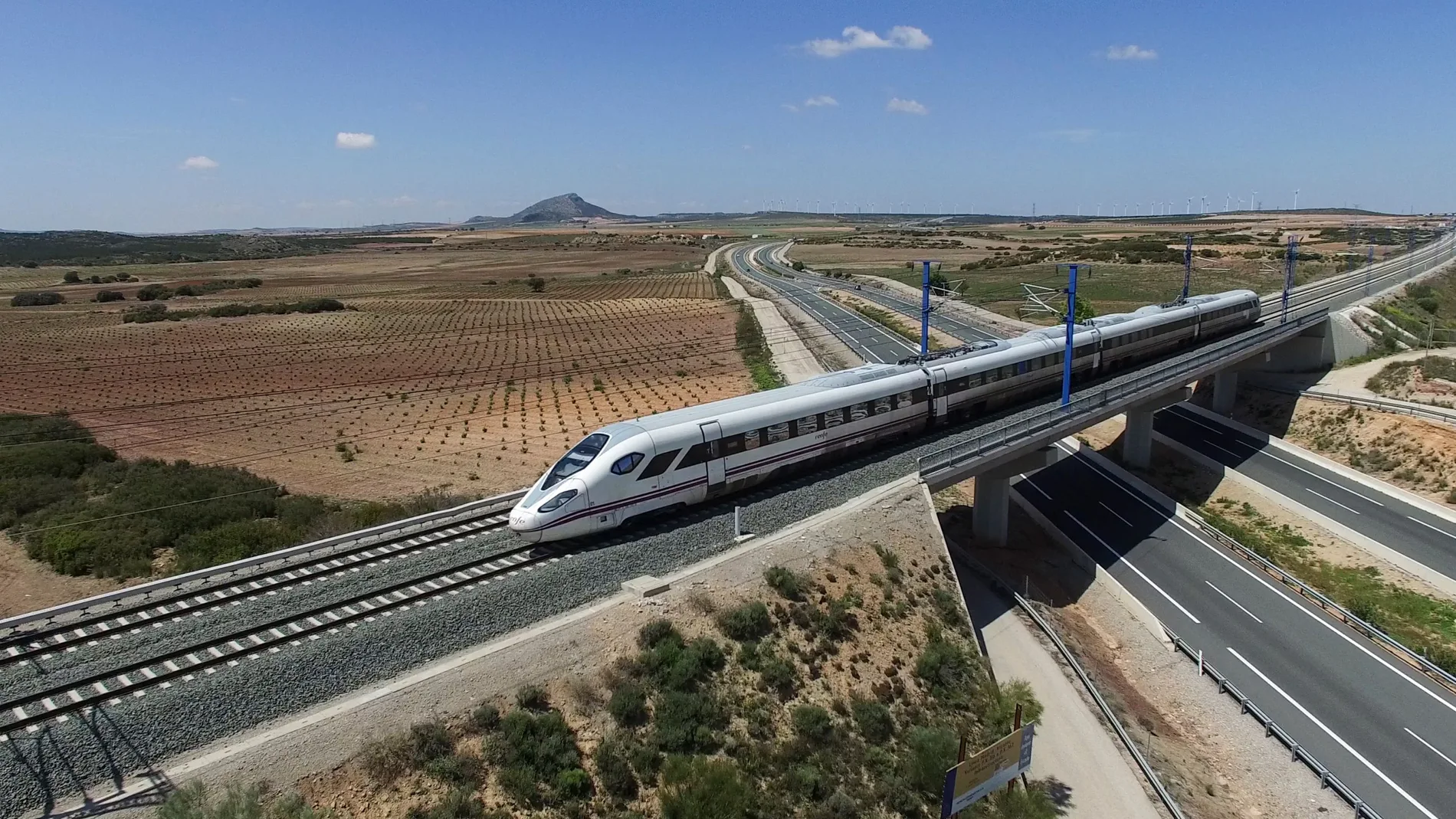
A train traveling at 300 kilometers per hour travels 83 meters every second. When you begin to brake, therefore, you do not stop at the point where the system is activated: you still have to dissipate the energy of your movement and progressively reduce your speed. The necessary distance depends on the characteristics of the train, its brakes, the initial speed and the conditions of the track. Physics explains why that distance can reach several kilometers.
To understand it, we must start with a fundamental property of movement: kinetic energy, the energy that a body possesses by being in motion. It depends on two variables, its mass and the square of its speed. The latter is decisive. If a train doubles its speed, it does not double its kinetic energy: it multiplies it by four. If you go from 100 to 300 kilometers per hour, your kinetic energy increases nine times, as long as your mass remains the same.
That energy does not disappear when the driver applies the brake. The more energy the train accumulates, the more work the brakes have to do to stop it. Therefore, other things being equal, driving faster requires a much longer braking distance. But there is a second important distinction: braking distance is not the same as total stopping distance. The first is the one that the train travels from when it begins to effectively reduce its speed until it stops. The second also includes the space traveled during the previous intervals, while a situation is detected, the corresponding order is transmitted and the brakes develop the necessary force.
How does a railway composition stop then? Trains combine different mechanisms. Friction brakes press pads or shoes against discs or wheel surfaces, converting kinetic energy into heat. Many trains also incorporate electric brakes that use the traction motors to resist movement. and, depending on the system, recover part of the energy or dissipate it. The specific combination depends on the vehicle design and operating conditions.
The objective is to distribute the braking force in a controlled manner throughout the train. It is not enough to generate a very intense force: stability must be maintained, excessive efforts between the vehicles must be avoided and the wheels must maintain sufficient grip on the rails. If the applied force exceeds that which can be transmitted through contact between wheel and rail, slipping may occur which reduces braking effectiveness.. Rain, road pollution and other factors can modify that grip.
The slope also matters. On a descending track, gravity exerts a component of force that favors the movement of the train and opposes its stopping. The opposite happens on a rise. That’s why, Braking distances cannot be calculated solely from the maximum speed of the train: They must also take into account their braking performance and the characteristics of the route.
This is where railway signaling and protection systems come into play. Equipment such as ERTMS (acronym for European Railway Traffic Management System). monitor the position and speed of the train and calculate braking curves: mathematical models that indicate how speed should be reduced to respect the limits established along the road. If the train exceeds these limits or does not brake when appropriate, the system can order an automatic intervention.
But… how long does it take for a train to stop? Dozens of variables come into play here, as we have said. From the weight, the speed, the characteristics of the road, the type of brakes. Just as a theoretical example we are going to see three hypothetical scenarios. We have a train made up of a locomotive and five cars traveling at 250 kilometers per hour on a straight, horizontal and dry road. If we assume that the assembly reaches a constant deceleration of 0.7 meters per second squared, it would need to travel about 3.45 kilometers from the moment it begins to brake to a complete stop. To this distance we would have to add the space traveled during the system’s response time: if we assume two seconds before the indicated deceleration begins to act, the train would advance an additional 139 meters. In total, the stop would require approximately 3.6 kilometers.
The second scenario is the same train in the same conditions, but at 300 km/h. Going from 250 to 300 kilometers per hour (a 20% speed increase) increases the total braking distance from about 3.6 to 5.1 kilometers, about 44% longer. Finally, if that same train were traveling at 50 kilometers per hour, maintaining the assumed average deceleration of 0.7 meters per second squared and the two seconds of response time, it would need about 166 meters to stop completely.