
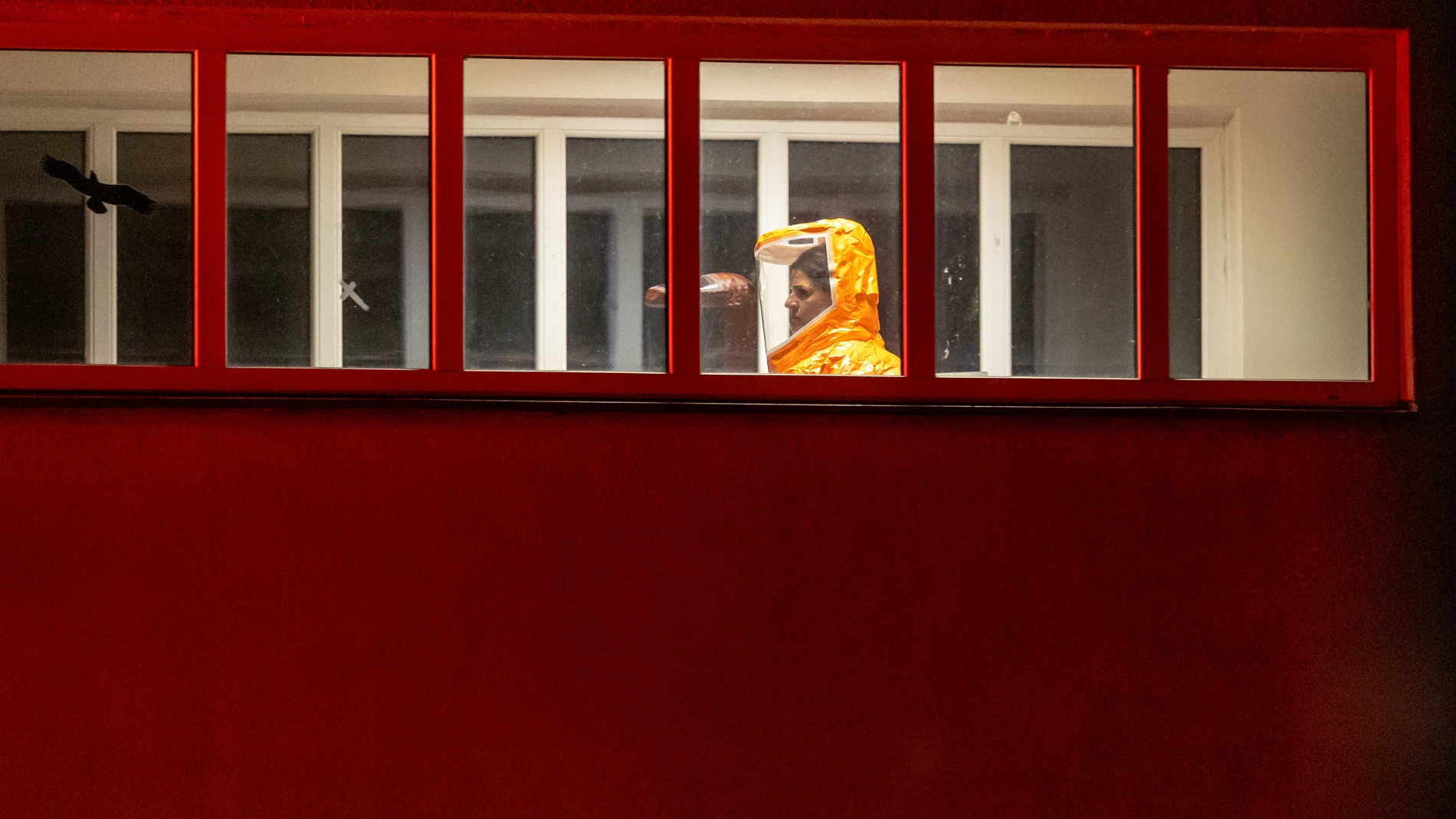
When a health worker at the hospital in Bunia, in the northeast of the Democratic Republic of Congo, began sweating fever and vomiting blood on the morning of April 24, no one thought about Ebola. The dangerous virus was far away on the map, far away on the calendar, far away in the region’s recent memory. Three days later, the man was dead. And three weeks later, the same tests that had ruled out Ebola as the cause of his death continued to come back negative, again and again, with successive patients. Not because Ebola wasn’t there. It was because they were looking for the wrong strain.
Today, almost a month laterthere are 134 deaths, more than five hundred suspected cases and thirty confirmed by laboratory. Figures that the Congolese authorities recognize are incomplete due to the difficulties of obtaining the necessary tests. And the World Health Organization declared an international health emergency last Sunday, and this Wednesday it raised its risk level to the highest category on its scale at the national and regional level.
This is the seventeenth Ebola outbreak that the DRC has suffered since 1976, although it has a worrying peculiarity. It is not caused by the Zaire strain, which is the most common and the one that the tests cited above were looking for, but by the Bundibugyo, a minority variant and even more difficult to identify. The difference is not minor. “The outbreak is complicated because it is another strain, it is not Zaire, and the vaccine was made for Zaire,” explains Luis Flores, a veterinarian from Jerez who currently works as head veterinarian of the Lwiro Primate Rehabilitation Center, in the Congolese province of South Kivu, a few hundred kilometers from the current outbreak. Today he also directs the One Health laboratory at the Lwiro Natural Sciences Research Center, where he trains Congolese veterinarians. Flores knows well the diseases that incubate in these forests. “It is not known if it can have cross protection, which surely not,” he adds, “because the Ebola viruses are very different.”
This difference is what explains the three-week silence. Three weeks where the virus has rampant without barriers. The Bunia laboratory, where the first tests were carried out, does not have the appropriate genetic sequencing equipment to identify rare variants, and its staff archived the negative samples instead of sending them to the capital. This was a colossal, almost inexplicable failure, the results of which are being dramatic. Virologist Jean-Jacques Muyembe, head of the Congolese response, said in a recent statement that “something went wrong, and that is why we have ended up in this catastrophic situation.” It would not be until May 14 that a laboratory in Kinshasa managed to elucidate that the mysterious strain was, in fact, Bundibugyo, and this had to happen twenty days and dozens of deaths after the first case recorded in Bunia. Because, by the way, it is not known who patient zero was. It is likely that we will never know. And this means that it is not possible to know exactly how long ago the outbreak really began to spread.
Deadly, catastrophic
From here, everything accelerated. On May 15, Uganda confirmed a case imported by a Congolese who had traveled to Kampala and died there. On the 16th, the WHO declared an international health emergency. And a day later a first case was confirmed in Goma.
But Goma deserves a separate paragraph. It is the capital of the province of North Kivu, a bustling city with more than a million inhabitants that pulsates on the shores of Lake Kivu and next to the Rwandan border. Since January 27 of last year, it has not been governed by the Congolese State, but by the rebel militia M23, supported by Rwanda, which conquered the city after a lightning offensive that left nearly a thousand dead in the streets in just a few days.. The Rwandan border has been up and down over the last year, but was finally closed this week, as soon as the first case of Ebola was confirmed in the city. Elsewhere around Goma, war fronts against the Congolese army block any reliable humanitarian corridor. Goma is, for all intents and purposes, under siege. Because of illness and war.
Flores already said it: “After (the virus) has gotten into Goma, we are going to see what happens there with the M23 inside.” Their concern is valid because, paradoxically, it is in this city where one of the only two laboratories in the country capable of identifying the Bundibugyo strain is located, the Rodolphe Mérieux, currently guarded by the M23 rifles. “It is not easy because all diagnoses depend on Kinshasa,” insists the veterinarian. And Kinshasa is almost two thousand kilometers from the outbreak.
Samples that do not fit into the capacity of the laboratory under rebel rule have to cross a country riddled by war, precarious infrastructure and economic difficulties until they reach the place where it is decided what they are or stop being.
The international community has reacted at an uneven speed. This Monday and for the next thirty days, the United States invoked Title 42 (the same legal figure it used during the Covid pandemic) and has extended entry restrictions to travelers without a US passport from, not only the DRC and Uganda, but also South Sudan. The WHO advises against closing borders and has recalled that the outbreak does not yet meet the criteria for a pandemic, but it should not be surprising that the WHO’s instructions do not dictate Donald Trump’s policy. An American missionary doctor infected in the area has been evacuated along with six exposed compatriots to a specialized center in Germany, instead of the United States.
And it is this discrepancy that shows (once again) the asymmetry with which the world reacts to African health emergencies. All this while the Congolese health authorities are installing three treatment centers on the ground that aim to alleviate the overflow of Bunia’s hospitals.
Uganda is already investigating a group of citizens who returned to the country with compatible symptoms after attending a funeral in Congolese territory, which is a classic route of transmission of Ebola and which multiplied infections in the West African outbreak of 2014. The Democratic Republic of the Congo awaits the arrival of doses of an experimental vaccine developed in Oxford against several strains of Ebola and which will be administered under a research protocol, while the WHO is also studying authorizing the off-label use of Ervebo, a vaccine already approved against the Zaire strain with the possibility of offering some cross protection. Although said authorization would take two months to be given.
The Doctors Without Borders teams deployed in Ituri estimate that the mortality of the Bundibugyo strain is between twenty-five and forty percent. Mortal. Catastrophic. Uncertain. And, in the words of Luis Flores: serious. These are the adjectives left for the worst Ebola outbreak in the Democratic Republic of the Congo for more than five years.