
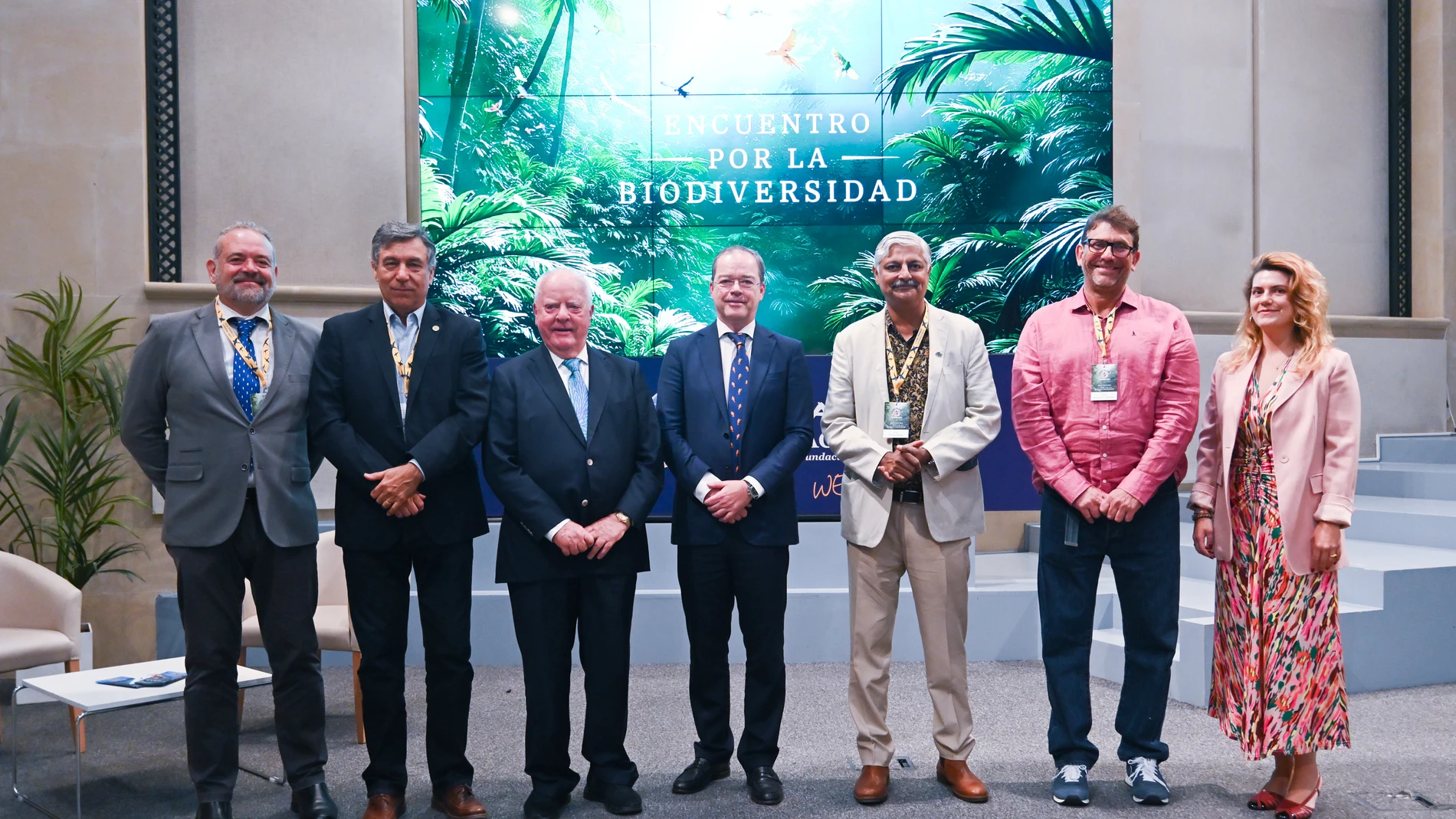
On the occasion of Biodiversity Day, the Loro Parque Fundación has held the Biodiversity Meeting in Madrid, with the attendance of personalities from the academic, political and conservation fields. The event coincided with the presentation of the National Red List of Spain in the Congress of Deputies on the occasion of the International Day of Biological Diversity, an event in which Ángel Curros, biological director of the Poema del Mar aquarium, participated to present the progress in the protection of critically endangered species such as the angelshark and the mantelina; and Dr. Javier Almunia, who presented the CanBIO.L project
The Meeting for Biodiversity began with a few words of welcome from the president of Loro Parque, Wolfgang Kiessling, who highlighted Loro Parque’s position as a world leader in animal welfare.
Next, Vivek Menon, the president of the IUCN Species Survival Commission, highlighted the importance of focusing efforts on the individual defense of each species. In this sense, Menon gave as an example of success the recovery of the Lear’s Macaw in Brazil, which has gone from being on the verge of disappearance to having more than 2,200 specimens in the wild, an action that has had the collaboration of the Loro Parque Foundation. “Nature is very resilient and grateful; if you do something for it, it will give it back to you,” said Menon, who offered the support of the 15,000 researchers who make up his commission to continue collaborating with the Foundation.
The president of the Loro Parque Fundación, Christoph Kiessling, presented the SofiaNet Project. An initiative to develop an advanced continuous and automated acoustic monitoring system to determine the presence of cetaceans in the Strait of Gibraltar. By applying the technology developed in the Canary Islands through the CanBIO project, SofiaNet will generate high-quality data to better understand the threats derived from noise of human origin and improve the management of this critical marine space. SofiaNet is a project that has the collaboration of the Reina Sofía Foundation, the University of La Laguna and the CIRCE association (Conservation, Information and Study on Cetaceans.
During the day, other scientific projects developed with the support of the Foundation also took center stage.
The professor of Animal Pathology at the University of La Laguna, Antonio Fernández (ULPGC) presented the book “Dolphin Cells”, a work that uses electron microscopy for pathological diagnosis, allowing “to speak with death to help life.”
For his part, Renaud de Stephanis. doctor in Marine Sciences, expert in cetaceans and founder of the CIRCE association detailed how 22 years of studies have allowed interactions with sailboats to be reduced by 80% thanks to science-based recommendations, such as sailing in shallow waters and not stopping the boat.
Javier Almunia, doctor in Marine Sciences from the University of Las Palmas de Gran Canaria and professor in the Department of Zoology at the University of La Laguna, presented the Cambio project, which studies ocean acidification, underwater noise and the impact of climate change on terrestrial and marine biodiversity, being a global reference and funded by the Loro Parque Fundación and the Government of the Canary Islands, in collaboration with the universities of La Laguna and Las Palmas de Gran Canaria.
With this meeting, the Loro Parque Fundación wanted to reaffirm its role as a driver of global conservation, having already saved 18 species from extinction thanks to a cumulative investment of 30 million dollars.