
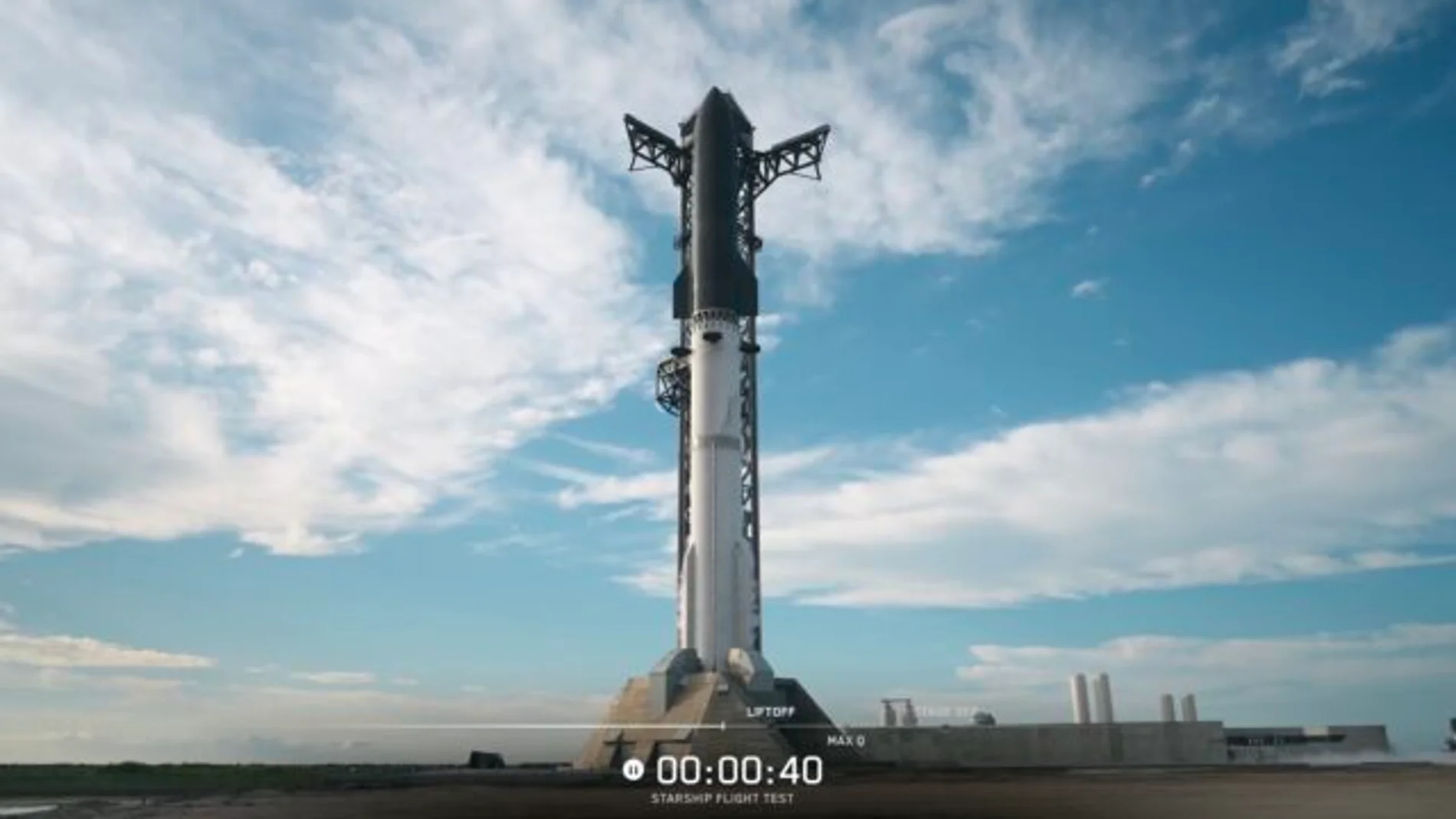
It was an exciting countdown, but in the end it was not to be. SpaceX First he delayed the launch for an hour, 00:30Spanish peninsular time, at 01:30and then start the countdown and stop it with 40 seconds remaining. On five occasions, he resumed it and then interrupted it and returned to the 40-second mark before takeoff.until at 01:47 hours Dan Huotwho hosted the SpaceX broadcast, acknowledged that ‘It looks like we won’t be able to resolve this issue in time today, so we’re canceling the release.. We load the vehicle completely. We had a couple of problems while processing the count,’ without specifying more.
It is not the first time that the takeoff of Starship V3. The first scheduled date was last Tuesday, but the company already announced on Sunday that it was delaying it to Wednesday. And on Tuesday he did it again, this time on Thursday, May 21. On both occasions, announced in advance, SpaceX did not reveal the reasons for the changes.
Now he has done it. Elon Muskfounder and CEO of SpaceX, attributed the cancellation to a hydraulic pin that did not retract on an umbilical arm that connects the launch tower to the rocket. ‘If it can be fixed tonight, there will be another launch attempt tomorrow‘, Musk said in X. If this is finally the case, the launch window will open at 00:30, Spanish peninsular time, this Saturday, May 23. Again, with 90 minutes left to carry out the launch. At the time of writing, SpaceX has not yet confirmed whether it has been able to fix the issue or not.
The hydraulic pin holding the tower arm in place did not retract.
If that can be fixed tonight, there will be another launch attempt tomorrow at 5:30 CT. https://t.co/DJAdvDYQpH
— Elon Musk (@elonmusk) May 21, 2026
This will be the first flight of Starship V3
Flight 12which is the name of the mission, will be the twelfth test flight of the booster Super Heavy and the ship Starship and the first with the new design that SpaceX calls Starship Version 3.
Starship V3 introduces numerous changes, including 39 new Raptor engines more efficient and with greater thrust, a propulsion system redesigned, three grille fins larger ones replacing four smaller ones and an interstage ring Reusable for hot stripping, permanently attached to the top of Super Heavy.
Flight 12 will follow a flight profile similar to previous test flightsbut there are some adjustments. The rocket will head slightly further south over the Gulf of Mexico, passing through the space between the Yucatan Peninsula and the western tip of Cuba, instead of flying over the Florida Keys.
The Super Heavy propellant, of more than 20 stories highwill separate from the Starship upper stage almost two and a half minutes after takeoff before heading toward a controlled splashdown off the coast of Texas. The upper stage’s six engines will give Starship enough speed to travel halfway around the world on a suborbital trajectory, but not enough to reach low-Earth orbit.
Once in space, the ship will release 20 mockups of next-generation Starlink satellites from SpaceX, in addition to two deployable Starlinks equipped with cameras to take images of the rocket’s upper stage in flight. Starship V3 features a modified payload deployment mechanism to release Starlink satellites at a faster rate than Starship V2. This demonstration will help pave the way for Starship to launch operational satellites, potentially as early as later this year, according to SpaceX.
Afterwards, some 48 minutes after takeoffEarth’s gravity will cause Starship to re-enter the atmosphere over the Indian Ocean. Engineers will monitor the performance of the heat shield during reentry before the spacecraft restarts its engines for a final landing maneuver, with the goal of making a precise splashdown northwest of Australia.
‘The main objective of the flight test will be demonstrate for the first time each of these new elements in the flight environment‘, with each component of the Starship architecture significantly redesigned to enable complete and rapid reuse that incorporates learnings from years of development and testing,’ SpaceX notes on its website.
If this flight does not go well, SpaceX has a ‘large portfolio of V3 ships and boosters in the factory’Musk wrote in X. The seven-month gap since the last Starship launch ‘was due to the almost total redesign of the primary structure, engines, electronics and launch tower compared to V2’.