
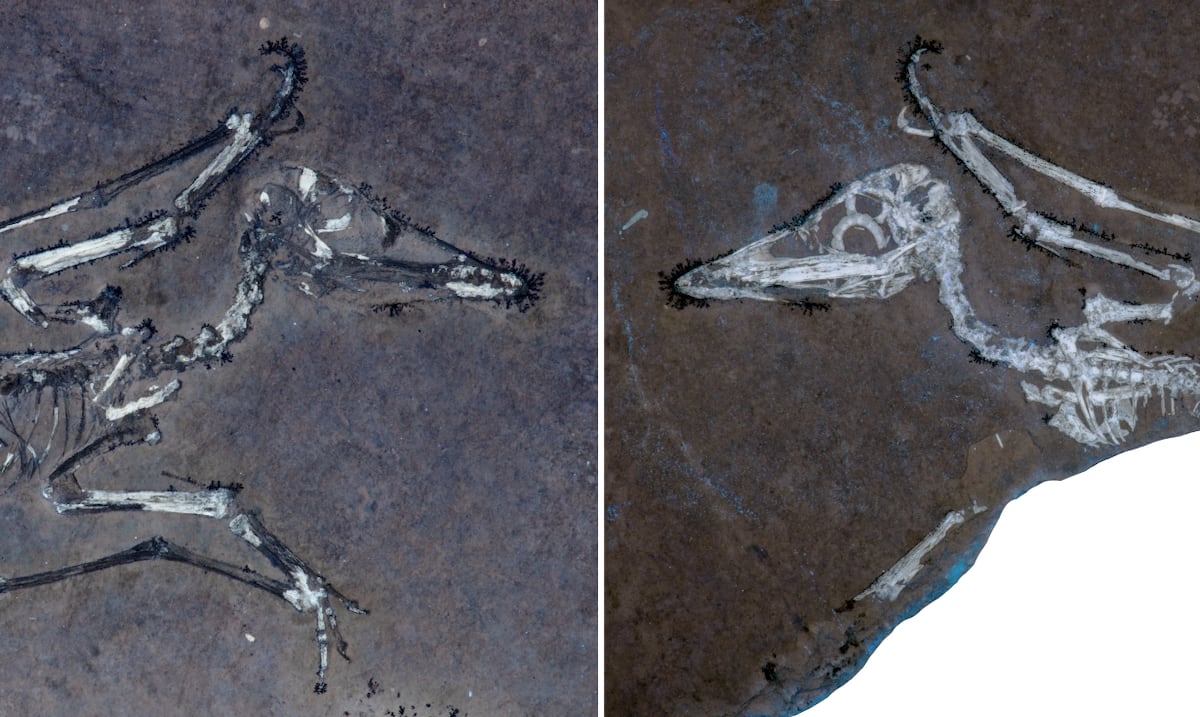
The new paleontobiology techniques are allowing advances, until recently unthinkable, such as being able to perform a ‘autopsy’ to a group of pterosaurs, some winged lizards who lived 150 million years ago and would have perished in an abrupt storm.
The finding, described this Friday in the magazine Current Biology, is the result of the fossil study of these flying reptiles of the Mesozoic found in the limestone lands of Solnhofen, in Baviera (Germany).
These lagoon deposits are famous for the good state of conservation of their fossil remains, especially juvenile specimens.
The authors, from the University of Leicester, explain that although in the collective imaginary it is that Mesozoic was an era of ‘giants’, with imposing dinosaurs, monstrous marine reptiles or pterosaurs of huge wings like those that preside over the museums of natural history, the truth is that most of the ecosystems “were populated by small animals.”
The reason why the great prehistoric creatures have imposed that “fossilization tends to favor the greatest and most robust organisms, while the smallest and fragile beings rarely become part of the paleontological record,” explains the principal researcher, Rab Smyth, Paleobiologist at the University of Leicester.
A fossil record molded by nature
But sometimes, the nature ‘conspira’ to preserve the tiny inhabitants of past times, and the German limestones of Solnhofen is one the places where this miracle has worked. There hundreds of pterosaurs have been found, almost all of very small individuals.
Researchers have focused on two pterosaurs skeletons, which are complete, articulated and practically unchanged since they died about 150 million years ago.
Lucky and Lucky II have nicknamed them and both correspond to Pterodactylus specimens, the first scientifically appointed pterosour. With a wingspan less than 20 centimeters, these young are among the smallest pterosaurs that are known.
Both have the same unusual injury: a clean and inclined fracture in the humerus: Lucky’s left wing and Lucky II’s right wing broke in a way that suggests a powerful torsion force. Researchers believe that it is due to the result of a collision with a hard surface after being pushed by strong winding bursts.
Seriously injured, these pterosaurs would have precipitated to the surface of the lagoon, drowning in the waves caused by the storm and quickly sinking into the sea bed, where they were quickly buried by the calcareous sludge removed by those storms.
This rapid burial in calcareous terrain is what would have allowed the good condition of fossils.
Dragged by storms
Like Lucky I and II, who only had a few days or weeks when they died, there are many other small and very young pterosaurs in Solnhofen limestones, preserved in the same way, but without obvious evidence of skeletal traumatisms.
The authors believe they should have fall into the water, unable to resist the strength of the storms.
“This discovery explains why the smallest fossils are so well preserved: the strong storms caused death for the pterosaurs that lived in the region and their rapid fall to the calcareous sludge have ensured their conservation,” says another of the authors David Unwin, Paleobiologist at the same university.
“For centuries it has been thought that these small pterosaurs fossils were of animals in the region. However, the new autopsy techniques have revealed that many of these pterosaurs were not native to the lagoon, but youthful that probably lived in nearby islands and were dragged by the winds of strong storms,” adds Smyth.
The great individuals would have been able to resist those storms, although their bodies had to float for days or weeks in the now calm waters of the Solnhofen lagoon, dropping parts of their bodies as they were decomposing, so they have not preserved so well.
“These tiny fossils are a powerful evidence of the old tropical storms and how they molded the fossil record,” concludes Smyth.