
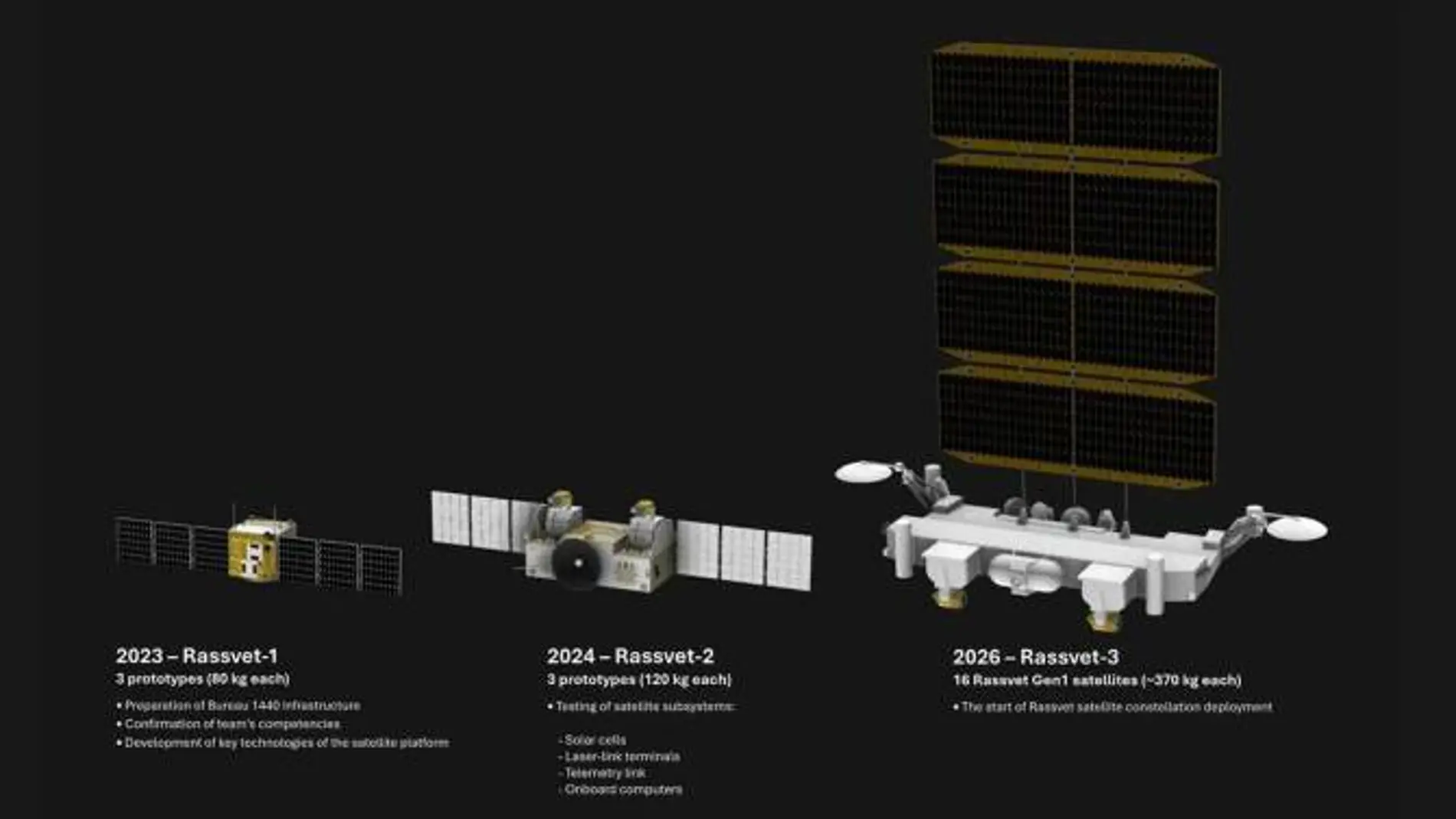
Building an internet network from space requires more than launching satellites. Each device must reach the appropriate height, perform the necessary maneuvers and remain in its working orbit. Two Russian satellites intended to compete with Starlink are having problems precisely in that last phase: they lose height quickly and could return to the Earth’s atmosphere in the coming days.
The protagonists are two Rassvet-3 devices, belonging to the second batch of satellites in the constellation that Russia is developing to provide broadband connections from space. According to orbital data collected by astrophysicist Jonathan McDowell of the Harvard-Smithsonian Center for Astrophysics, both have descended below 230 kilometers in altitude, while most of its companions are around 500 kilometers.
The difference is decisive. In low orbit, satellites still encounter traces of atmosphere, which generate resistance capable of progressively slowing their movement. As they lose speed, they descend towards denser layers, where friction increases and accelerates the fall. If they do not manage to regain altitude using their propulsion systems, they may end up re-entering the atmosphere.
The 16 satellites of this second batch were launched on July 19, 2026 from the Plesetsk cosmodrome, in northern Russia, using a Soyuz-2.1b rocket. After separating from the launcher, they had to complete their maneuvers to reach the working orbit. However, Two of them have not shown the expected evolution and their decline suggests a return in the near future. The data allows you to follow your trajectory, but not confirm what has gone wrong. The absence of orbital lift maneuvers could point to a propulsion problem, although it is not enough to determine its cause. Bureau 1440, the company responsible for the project, has not offered a specific public explanation about these two devices.
It wouldn’t be the program’s first loss either. The first batch, launched on March 23, included another 16 satellites. One of them re-entered the atmosphere on June 6 without having managed to raise its orbit. If the two current devices suffer the same fate, There will be three satellites lost of the 32 launched in the first two production missions. Something, on the other hand, nothing strange, considering that Starlink has lost more than 30 in recent years.
Rassvet is the project with which Bureau 1440 aims to build a Russian alternative to Starlink, SpaceX’s satellite internet network. Its objective is to deploy a constellation of devices in low orbit capable of providing broadband connectivity. The announced schedule includes a partial commercial service in 2027, with a goal of 292 satellites by the end of that year and a possible expansion to 900 in 2035.
The challenge is not just to place enough devices in space. To provide continuous service, they must occupy the planned orbits, be appropriately distributed and maintain communication with ground stations and user terminals. Each satellite that does not reach its planned position makes network deployment difficult. Altitude also affects operation. The closer a satellite operates to Earth, the less time a signal needs to complete its journey, but the surface it can cover is also reduced.. This forces us to deploy more devices to guarantee the continuity of the service. In addition, an orbit that is too low increases atmospheric friction and can shorten the useful life of the satellite.
The Rassvet situation illustrates the difficulties of moving from first launches to an operational constellation. Most of the satellites from the first two batches have managed to stabilize around 500 kilometers, although two of the most recent devices continue to lose height. This is not, therefore, a confirmed failure of the entire constellation, but rather a specific problem whose scope has yet to be determined. For now, the exact re-entry date remains a forecast subject to change. During descent, a large part of the satellites usually disintegrates due to the heat generated when passing through the atmosphere, although it cannot be guaranteed that all their components will disappear before reaching the ground.