
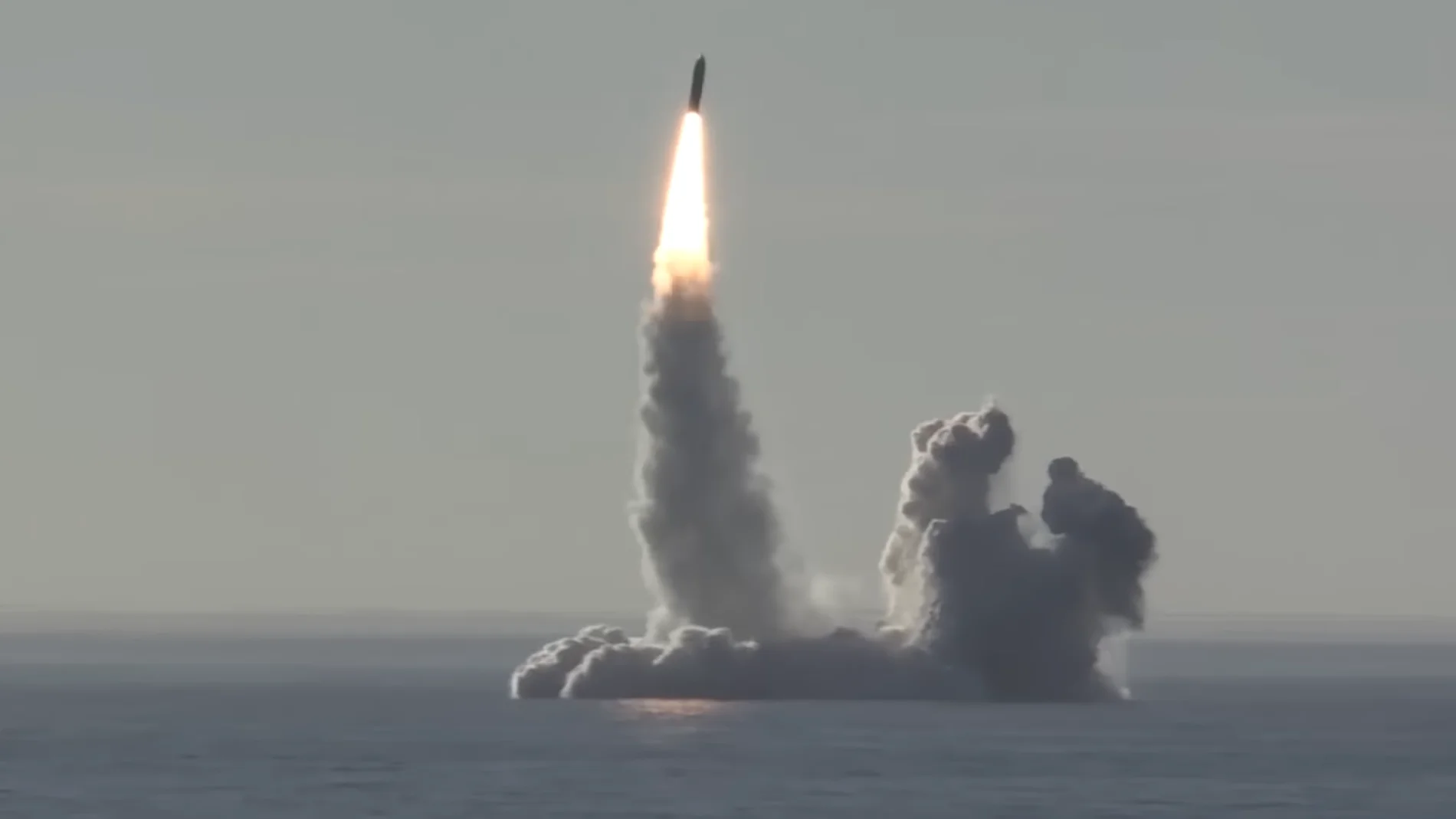
He Generalissimus Suvorova Russian nuclear submarine, has once again demonstrated a capability that belongs to the war of the future: launching an intercontinental ballistic missile from beneath the surface of the sea and directing it against a target located thousands of kilometers away. On October 28, the submersible fired a Bulava missile from the Sea of Okhotskin the far east of Russia, towards the Chizha range, in the Arkhangelsk region, in the north of the country.
According to the Russian Ministry of Defense, the warheads reached the planned area at the scheduled time. The rehearsal was part of the crew’s training plan. Moscow did not release details about the flight time nor technical data that allows the result to be independently evaluated. The official information was collected by the Russian agency Interfax and by specialized media.
The distance between the launch point and the test range is estimated at about 5,500–6,000 kilometers. It is a considerable figure, but it is worth distinguishing it from maximum range attributed to the Bulavá, located around 8,000 kilometers. The missile did not travel that distance during this exercise: the maximum range is an estimated performance of the system, not the result of this specific launch.
The Bulava, Also known as RSM-56 and designated SS-N-32 by NATO, it is a submarine-launched intercontinental ballistic missile. It measures approximately 12 meters in length and weighs about 37 tons at the time of launch. It employs three stages of solid fuel propulsion and is designed to carry several nuclear warheads. The United States Center for Strategic and International Studies (CSIS) lists an estimated capacity of up to ten reentry vehicles with independent objectives, although the actual configuration of each missile depends on its payload and operating conditions.
The ability to fire from underwater is essential to the function of these submarines. Unlike a ground facility, whose location is known, A submersible can move through large maritime areas and remain hidden for long periods. Its exact position is much more difficult to determine, complicating the planning of a preemptive strike against the nuclear force it carries.
That is the foundation of nuclear deterrence from the sea: maintaining a response capability even if an adversary destroys land facilities or attacks other components of strategic forces. The submarine does not need to be near the coast of the country it intends to deter. The range of the missile allows it to cover intercontinental distances from different patrol areasalthough the effective distance depends on the load transported and the flight profile.
He Generalissimus Suvorovidentified as K-553, belongs to the Boréi-A class, the modernized model of the strategic submarines of the project 955A. It is nuclear powered and can carry up to 16 Bulava missiles. It entered service in the Russian Navy at the end of 2022 and was transferred to the Pacific Fleet in 2023. Its task is not to attack conventional ships, but to be part of the Russian strategic nuclear force.
The launch is not a technological novelty either. Russia has been testing the Bulava from submerged submarines for years. In December 2020, for example, the submarine Vladimir Monomakh fired four missiles from the Sea of Okhotsk at targets in the Arkhangelsk region, in an exercise that covered more than 5,500 kilometers. The October test confirms that Moscow continues to train its crews and keep this component of its arsenal operational.
The test does not prove that Russia has developed a new missile or expanded the range of the Bulava. What it shows is that one of its strategic submarines continues to practice launching a nuclear weapon from a submerged position. In nuclear deterrence, that possibility is precisely the key: preserving a force that is difficult to locate and capable of responding even after a devastating attack.