
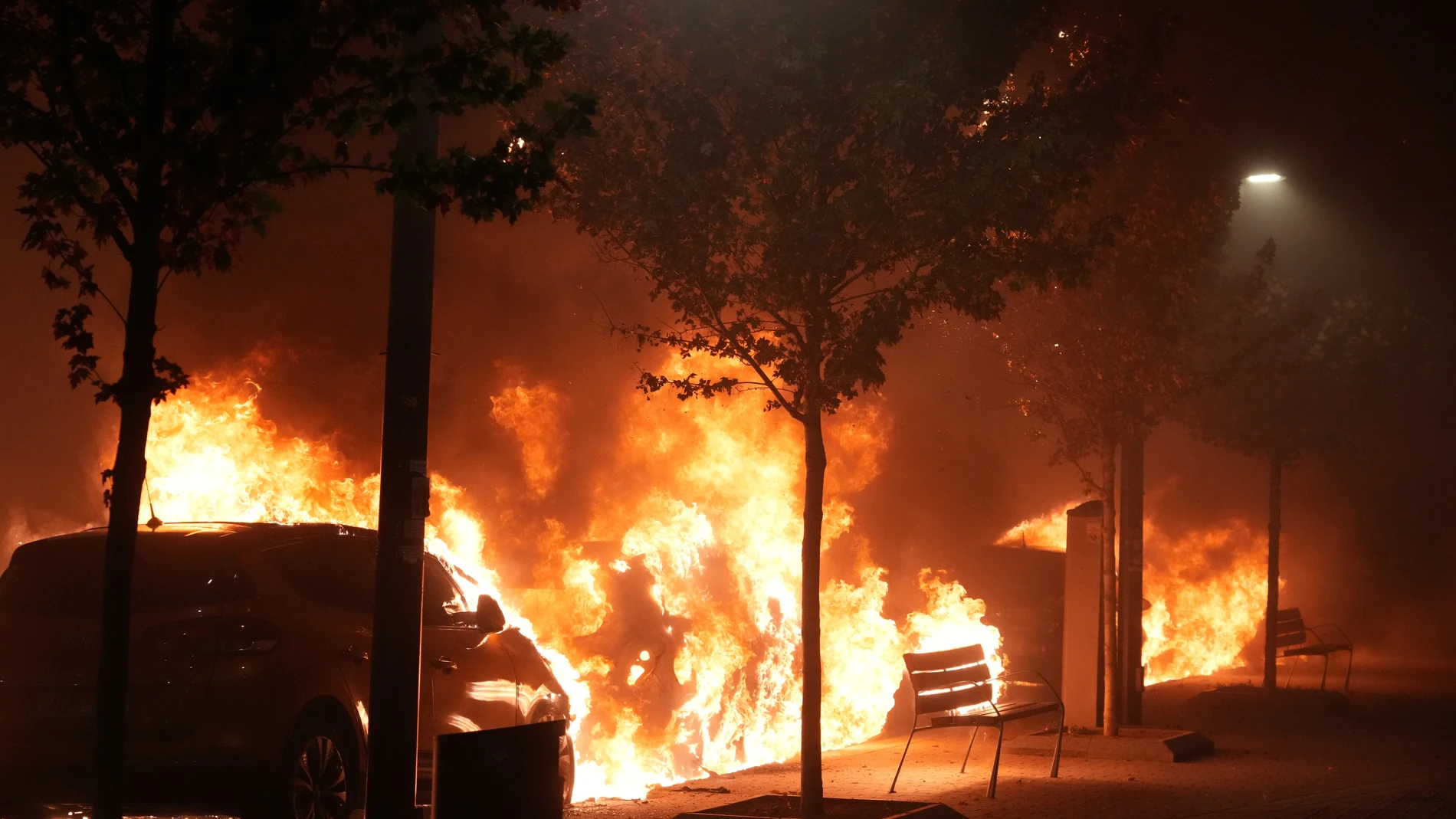
who ordered remove reinforcements three hours ahead of schedule? ¿Who gave instructions not to intervene while containers were burning and there were serious disturbances of public order? Why did it take approximately an hour to intervene?… These are some of the questions raised by the Ertzaintza Professional Union (Si.PE) after the serious disturbances experienced yesterday afternoon in Bilbao, where there were no shortage of the burning of containers, barricades and numerous material damages.
Some incidents that the agents already warned about just three days ago, even going so far as to present a formal complaint to the Basque Security Councilor on Saturday the 24th to demand the “urgent adoption of preventive measures.” Far from it, The troops were reduced and the agents were ordered not to intervene. “The ertzainas who comply with the orders received they cannot become responsible of the decisions taken by those who direct the police forces,” they denounce. For this reason, they demand that the Lehendakari, Imanol Pradales, the dismissal of the Security Advisor, Bingen Zupiria.
According to the information handled by this police union, the police reinforcements, whose service was scheduled until 9:00 p.m., were sent to their homes at 6:00 p.m., three hours earlier than planned. But who made this decision, What information was available and what risk assessment justified it?. In his opinion, these events raise “enormously serious” questions about the planning, direction and execution of the police operation and require a formal investigation and the clarification of responsibilities.
Because the only thing clear so far is that the agents present during the burning of containers and the disturbances of public order were ordered not to intervene, despite the seriousness of the events and the escalation of violence. So much so that police intervention It was not authorized until an hour later.
The ertzainas are not responsible
At this point, Si.PE also demands that they clarify whether the sit-ins and occupations of the road in the vicinity of the University of Deusto were contemplated in the communications of the demonstrations, what information those responsible for the operation handled and what instructions were given to manage these events. “It is not enough to organize a device on paper. It is essential that decisions be made with foresight, proportionality and clear operational criteria, and that those who have the responsibility of directing it are responsible for their decisions,” the union states.
Fires, attacks, barricades and the destruction of public and private property are not part of peaceful demonstrations, to which every citizen has the right. There were risks anticipated, there were warnings and yet, the ertzainas were left at the horses’ feet. “You cannot require agents to guarantee citizen security and, at the same timeleaving them exposed to risk situations without explaining the decisions that condition their ability to act.” And what is more important, “they cannot be allowed to the operational consequences fall on the professionalss who are on the street while the instructions issued from the command levels remain unclear,” they warn.
For all this, the Ertzaintza Professional Union demands answers. AND They do not plan to close this episode without those answers, without documentation and without an investigation that allows us to know what really happened. “The seriousness of the events demands transparency, rigor and accountability,” he says.
Thus, the union requests a detailed chronology of eventsfrom the beginning of the incidents to the police intervention, which allows knowing the decisions taken at each moment;, the preservation and delivery, through the corresponding channels, of the documentation related to the planning of the service, its modifications, risk assessments and operational orders issued; an explanation of the preventive measures adopted after the public warnings and the formal complaint presented by Si.PE Finally, they demand the clarification of responsibilities that, where appropriate, could arise from the decisions investigated.