
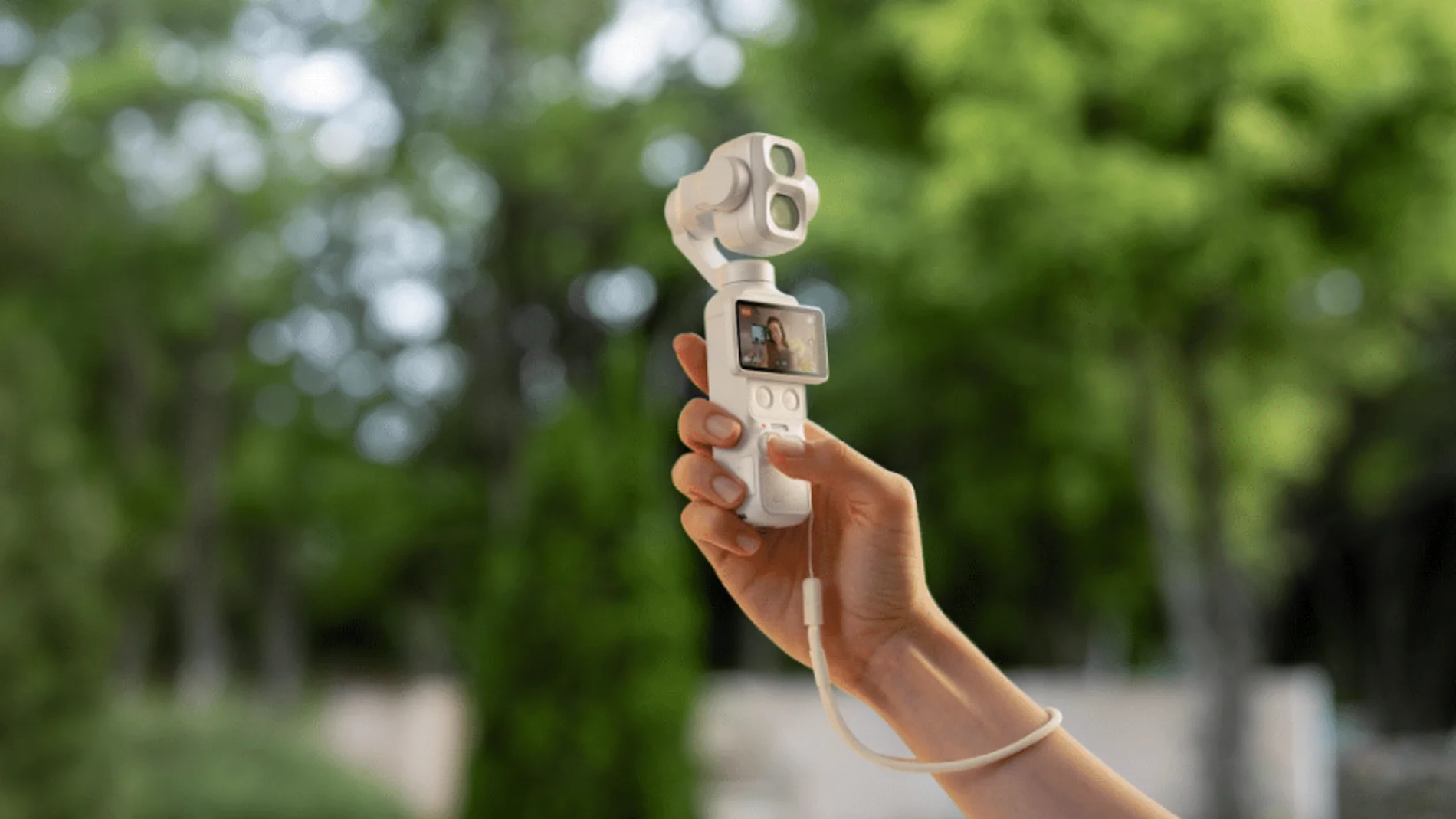
There are objects that we choose for what they do and others that also say something about us. For years, technology seemed determined to convince us that function should prevail over form: black devices, metallic surfaces and an industrial aesthetic that made sobriety synonymous with professionalism. But something is changing. Colors are beginning to occupy a place that previously belonged almost exclusively to technical specifications. DJI had already explored that territory with the colored housings of its wireless microphones. Now bring that same idea to the Osmo Pocket 4P, which debuts in a pearl white finish. We could call it aesthetics: the union of aesthetics and technology.
The word does not yet appear in any dictionary, but it describes a trend well. The design of a device is no longer limited to resolving how it works, but also seeks to express how we want to relate to it. In the case of a camera designed to record trips, portraits and everyday scenes, that component takes on special meaning. It is a creation tool, but also an object that accompanies those who look at the world through it. The objective is for looking, the color is for being looked at.
The new finish of the Osmo Pocket 4P is not simply about painting a case white. DJI uses pearlescent pigments with mica and a multi-layer spray-applied coatinga combination that produces subtle variations in brightness depending on the lighting and the angle from which it is viewed. The result seeks to move away from both the purely technical appearance and the uniform white of so many electronic devices. The intention is to approach a discreet elegance, the kind that does not need to attract attention to be noticed.
But the technique only works when the form does not hide the function. And the Osmo Pocket 4P has arguments to support that combination. Its central element is a one-inch CMOS sensor, accompanied by two lenses that cover focal lengths equivalent to 20 and 60 millimeters. The first, wide angle, has an f/2.0 aperture; the second, a medium telephoto lens with f/1.8 aperture, offers threex optical zoom. In practice, this allows you to go from a wide scene to a closer portrait without relying exclusively on digital zoom.
The camera also boasts 17 stops of dynamic range, a number that indicates how much difference between the brightest and darkest areas can register. This is an especially useful feature when filming complicated situations, such as a person in front of a window or a landscape during sunset. LOFIC technology, designed to improve information capture in high-contrast scenes, helps preserve detail in both highlights and shadows.
Added to that capability is 10-bit recording with the D-Log 2 color profile. Instead of delivering an image with all the contrast and saturation already decided, this profile retains room to adjust colors during editing. It is an important difference for those who want to build their own visual atmosphere, from the warm tones of a summer memory to the colder palette of an urban story. The camera can record up to 4K at 240 frames per secondallowing the action to be slowed down up to eight times under certain playback conditions.
The compact format also matters. Weighing about 230 grams, the Osmo Pocket 4P integrates the camera and the stabilizer in a body that can accompany the user without requiring the equipment of a conventional production. ActiveTrack 8.0 intelligent tracking helps keep moving people, animals or vehicles in frame. For those who work from mobile, the file transfer via USB 3.1 reaches, according to DJI, up to 800 MB/s (more than 17 minutes of video in 30 seconds), while the battery can offer up to 210 minutes.
The pearl white finish does not change these features nor does it by itself turn the camera into a more professional tool. What changes is the way of presenting it and, perhaps, of integrating it into the life of those who use it. Technology has become so everyday that performance is no longer the only argument to distinguish a device. The touch, color, shape and even the emotional relationship we establish with the objects we carry also matter.
The white Osmo Pocket 4P arrives in Spain for 599 euros in its Standard configuration, including the camera, a fill light, a grip, a strap and a carrying case, all in white. It is a proposal that unites two languages: that of the cinematographic image and that of personal design. There is no need to choose between a camera that aspires to tell stories accurately and one that fits the way we look.
Perhaps therein lies the idea that summarizes this new stage: technology does not lose rigor when it takes care of its appearance. Sometimes, design is precisely what invites us to use it, explore it and create with it. The technique begins when the object stops being just a sum of components and also becomes a form of expression.