
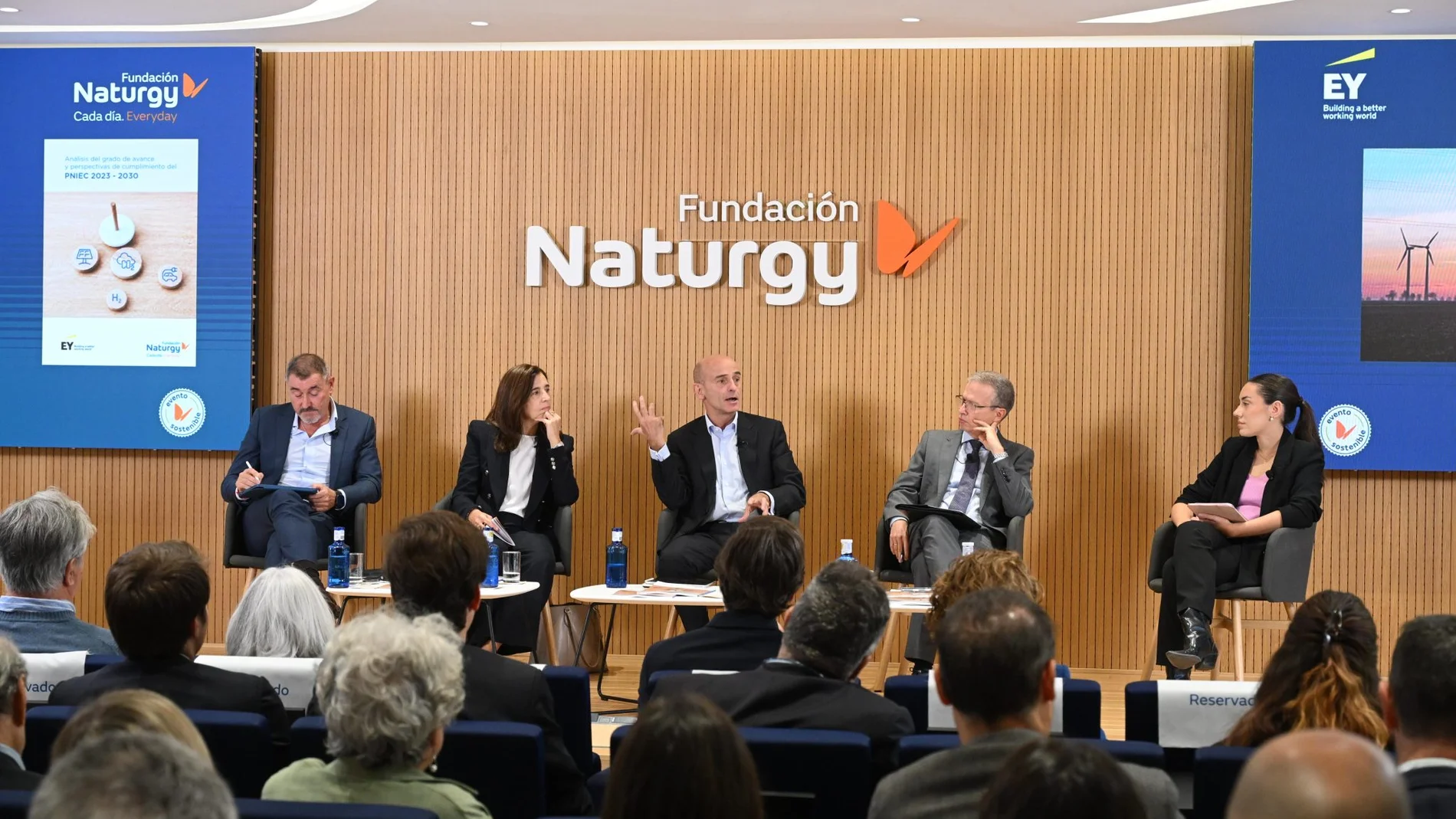
Spain is on the right track in the energy transition, but it is going slowly. That is the main conclusion of the study “Analysis of the degree of progress and prospects for compliance with the National Integrated Energy and Climate Plan 2023-2030”prepared by the consulting firm Ernst & Young and presented by Naturgy Foundation.
The report reviews the main energy and climate indicators to measure the extent to which they comply with the objectives of the Integrated National Energy and Climate Plan (PINEC). It distinguishes between areas that are progressing as planned and those that still have important challenges ahead.
The diagnosis is clear. The general trajectory points in the right direction, but the current pace is not enough to meet many of the goals set for the end of the decade. According to the authors of the study, the second half of the 1920s will be decisive in accelerating pending measures and closing the gaps detected.
María Eugenia Coronado, general director of the Naturgy Foundationin charge of opening the day of presentation of the study, has defended the need to have rigorous analyzes that measure the real progress of the energy transition and feed the public debate on the pending challenges. Afterwards, the authors of the report, Marta Sánchez Álvarez, partner responsible for the Energy Sector at EY and Jaime Moretón Poch, director of the firm’s Energy Sector Consulting, presented the main conclusions.
Emissions, the great weak point
The main concern of the study is the evolution of greenhouse gas emissions. If current trends continue, the expected reduction will be below what is set the National Integrated Energy and Climate Plan. The most lagging sectors are transportation, construction, agriculture and waste management. In all of them, decarbonization is progressing more slowly than necessary.
The second front is the electrification of the economy. Installed renewable capacity continues to grow at a good pace, but electricity demand remains below what was foreseen in the Plan. This makes it difficult to efficiently integrate new renewable generation. To take advantage of the investments already made, experts propose boosting energy storage, strengthening networks and accelerating the electrification of key sectors.
The report also detects delays in energy efficiency and in the deployment of technologies called to be important in the transition, such as electric vehicles and renewable hydrogen. The participants agreed that regulatory and economic signals are needed to favor its adoption.
Biomethane, the positive exception
The study is more optimistic with biomethane. Current production is still low, but The portfolio of planned projects would allow us to get closer to the 2030 objectives. For this potential to become a reality, the authors point out two conditions, a stable regulatory framework and a boost to demand. If they are met, biomethane could be one of the fastest growing energy vectors in the coming years.
Networks, storage and realism
After the presentation of the report, a colloquium was held in which the Pedro Larreageneral director of Naturgy Networks; Antonio Hernandezpartner in the Regulated Sectors and Economic Analysis area of Ernst & Young; Diego Rodriguezprofessor of Applied Economics at the Complutense University of Madrid, and Ana Barreira, general director of the International Institute of Law and Environment.
Everyone agrees on the diagnosis that infrastructure must be accelerated, regulatory signals reinforced and investment encouraged. Throughout the colloquium they combined the positive assessment of the progress with a general call for realism and faster execution.
The general director of Naturgy Networks, Pedro Larrea warned that the National Integrated Energy and Climate Plan (PINEC) is moving away from the planned path, especially due to the weakness of electricity demand, the delay in transportation and the deviations in decarbonization and efficiency. Although he recognized the progress of the electricity sector, he asked to review the objectives that may be unattainable, offer consumers different ways of decarbonization and balance climate ambition with competitiveness, energy autonomy and guarantee of supply.
For its part, Antonio Hernández focused on the advantage that having abundant renewable resources means for Spain, capable of improving competitiveness and reducing external dependence, but pointed out the need for a predictable financial and regulatory framework that mobilizes private investment, to adapt demand, networks and storage to the growth of supply, and to reinforce the social acceptance of the projects.
Diego Rodríguez, professor of Applied Economics, appreciated that the Plan provides discipline, transparency and a reference to measure results, although he called for continuous supervision and achievable goals. In addition, it highlighted photovoltaic expansion and the improvement of efficiency and industrial emissions, but considered it unfeasible to reduce emissions by 32% in the foreseeable scenario and placed the main obstacles in transportation, storage, hydrogen demand and network capacity.
Finally, Ana Barreira, in her capacity as general director of the International Institute of Law and Environment, framed the National Integrated Energy and Climate Plan (PINEC) in the energy and climate policy of the European Union and in the Paris Agreement and highlighted the progress of renewables since 2018, although he agreed that infrastructure and demand are not progressing at the pace of generation. For this reason, he identified networks, storage, interconnections, energy efficiency and industrial decarbonization as priorities, in addition to streamlining permits through better coordination between administrations and more human resources.