
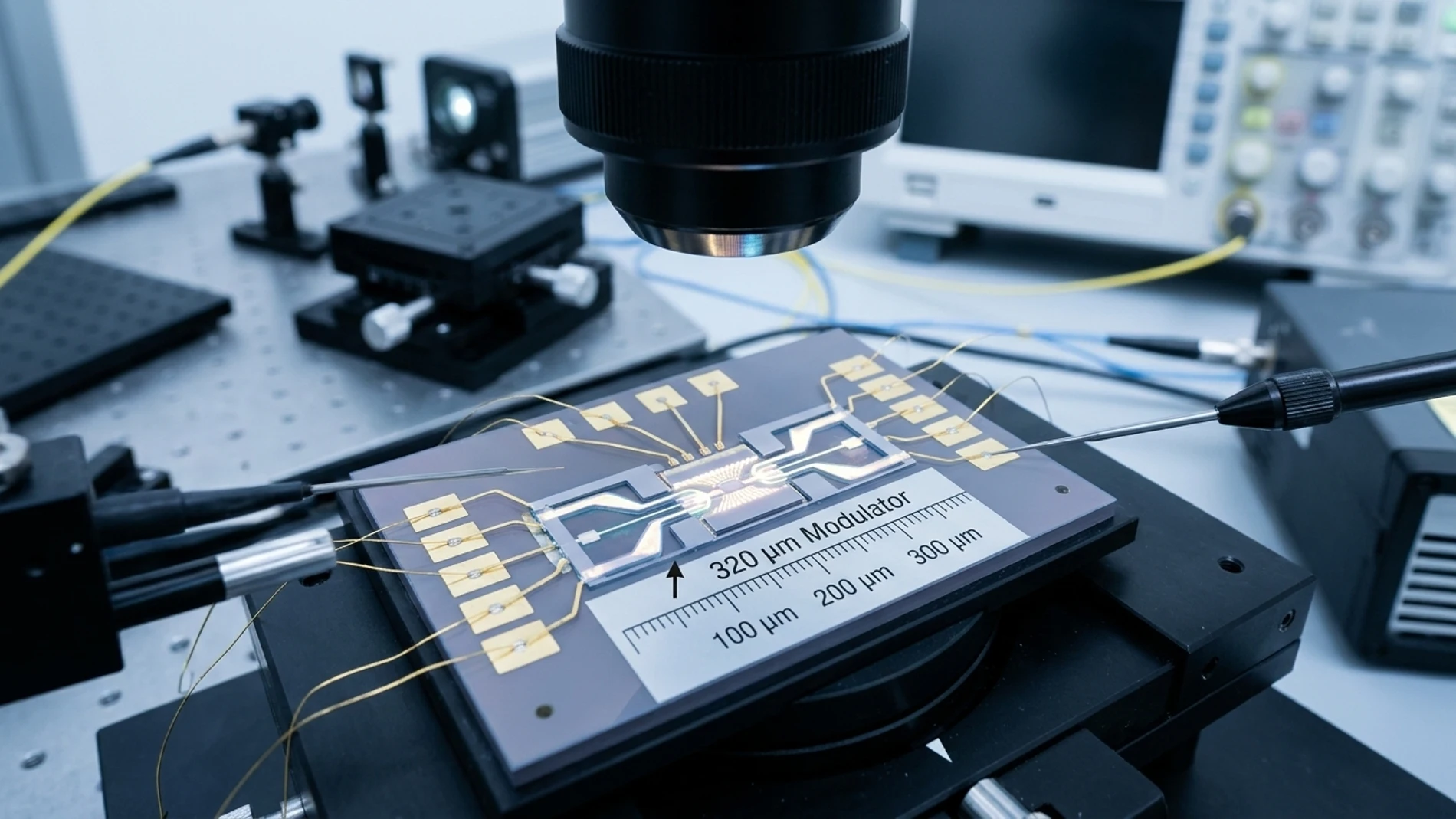
There is a paradox at the heart of a new technology that could help move the enormous volumes of information needed by artificial intelligence: to transmit data faster, a team of scientists has turned to a method that makes light move more slowly. He The secret is not to accelerate the photons, but to modify their behavior within a microscopic structure to better control the information they carry.
The device, developed by scientists from several Japanese institutions and described in Nature Communicationsis a silicon optical modulator just 320 micrometers long. That is, it measures just over three tenths of a millimeter. Despite its size, it has proven to be able to transmit up to 200 gigabits per seconda speed that points to new possibilities for high-capacity optical communications.
To understand why it matters, it’s best to first look at data centers. These enormous computer complexes, which process everything from our Internet searches to queries to artificial intelligence systems, need to exchange increasing amounts of information. When chips are close together, they can communicate using electrical connections. But, As distances and speeds increase, electrical signals lose quality and generate heat. Light, on the other hand, allows information to be transported through optical fibers with lower losses over long distances.
The problem is that digital information does not travel through fiber optics by magic. First you have to convert the electrical signals into light pulses and modify that light to encode the data. A component called optical modulator takes care of this task, a kind of translator between the electronic and photonic worlds. Improving its speed and reducing the energy it needs has become one of the challenges for future digital infrastructures.
The Japanese proposal is based on a silicon structure perforated with tiny holes that form a photonic crystal. Their arrangement alters the propagation of light and can reduce its group velocity within the device. This phenomenon, known as “slow light” prolongs the interaction between the light signal and the material, allowing it to be modulated more efficiently.
However, making the light move more slowly is not enough. Modulators of this type faced a limitation: electrical resistance made it difficult for them to operate at high frequencies. To overcome that obstacle, the scientists incorporated an integrated electro-optical equalizer, a structure that helps compensate for the loss of response at high frequencies and allows the benefits of slow light to be preserved without sacrificing so much speed.
The result was a device capable of reaching 140 gigabits per second with a simple encoding format and an energy consumption of 26 femtojoules per bit. A femtojoule is an extraordinarily small amount of energy: one billionth of a joule. Using PAM-4, a technique that encodes information using four signal levels instead of two, the authors, led by Keisuke Kawahara, reached 180 gigabits per second without digital signal processing. With some relatively simple additional electronic equalization, it reached 200.
But what does that figure mean in practice? Here is a difference that often goes unnoticed. A bit It is the minimum unit of information; a byte equals eight bits. Therefore, 200 gigabits per second is not 200 gigabytes per second, but the theoretical equivalent of 25 gigabytes every second. In one minute, that rate would allow about 1.5 terabytes of data to be transported. It is an enormous capacity, although it should not be confused with the download speed that a computer connected to the Internet would have: it is the transmission rate demonstrated by the modulator under experimental conditions, not the guaranteed speed of a full connection.
According to the authors, the new design reduces the length of the device approximately tenfold and improves the modulation efficiency by approximately one hundredfold compared to comparable conventional technologies. It has also been manufactured using a process compatible with CMOS technologywidely used to produce chips, which could facilitate their manufacturing on an industrial scale.
The relevance of the discovery is not, therefore, that tomorrow it will multiply the speed of the Internet by a hundred. It’s something more concrete: it shows that it is possible to combine a known physical phenomenon with an ingenious design to build a smaller, more efficient component. In the race to fuel artificial intelligence, the future does not depend only on more powerful processors. It also requires finding ways to move data with less energy. And, sometimes, to make information move faster, you have to start by learning to stop the light.