
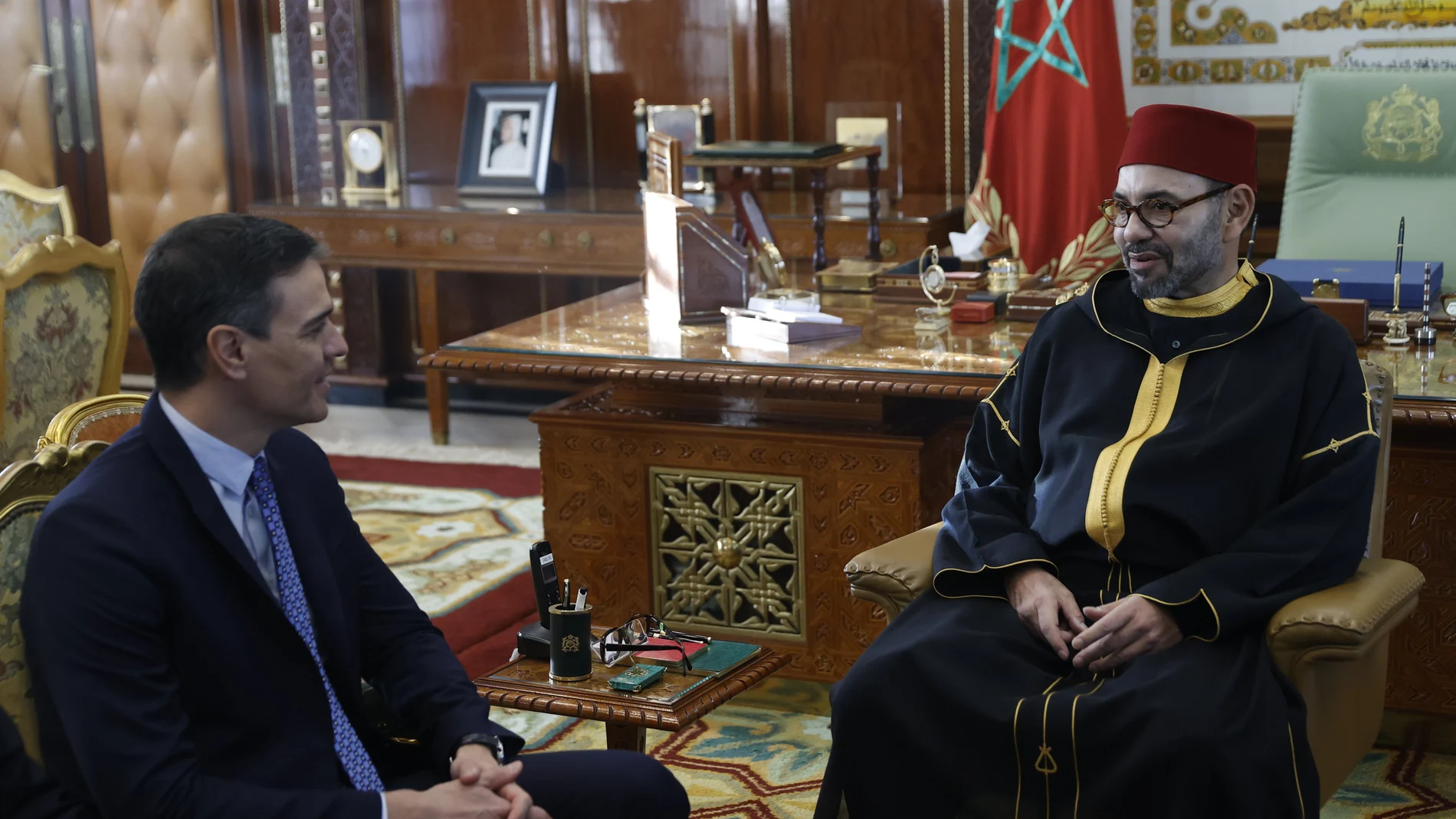
A notice to sailors that arrives coinciding with the visit of the Kings to Ceuta and Melilla and in the middle of the countdown to the electoral campaign for the elections, those of November 29, which could be the end of Sanchismo and political change in Spain. Two and a half months after the assault on the Tarajal border, and with barely an official communication from the Moroccan authorities, in this case from the Ministry of Foreign Affairs – on September 10 – regarding what happened, King Mohamed VI was in charge, on the occasion of the inauguration of the legislature last Friday, of establishing his country’s position in a moment with an air of change of era.
The Alawite monarch reserved the final and climactic section of his speech – one of his three annual addresses to the nation – to ensure that The model of migratory cooperation with its partners, and Spain was the only one of them mentioned explicitly, “has become obsolete.” In the opinion of the King of Morocco, cooperation with Madrid “today faces great challenges related to certain outdated legal provisions and judicial decisions that are far from reality.” In case there were any doubts, and in the same line as what was advanced weeks ago by political figures such as the outgoing Minister of Justice and the new head of the government, Mohamed VI links Spanish legislation and international obligations for the protection of children, as well as the ruling of the Supreme Court of July 8, with the delay in the repatriation of Moroccan minors and “people who adopt the attitude of refugees” in Ceuta since the assault.
Furthermore, the Moroccan head of state attributes to the same legal provisions the potential of “feed the greed of criminal networks”, also pointed out by the Government of Spain as exclusively responsible for the massive displacement of young people towards the border with Ceuta in the days prior to the avalanche of July 30 and 31.
A model that does not work
By considering the bilateral cooperation model “exhausted”, the Alawite sovereign refutes what was maintained by the governments chaired by Pedro Sánchez, who again and again praised the current relations between Spain and Morocco as “the best in history” since the diplomatic turn in the Sahara – months of Moroccan pressure bore fruit with the government’s support for the autonomy proposal for the former Spanish province – and the staging of the new stage in bilateral relations during the spring of 2022.
But the monarch went further in his speech to announce a new model of migratory cooperation with Spain (and the rest of the partners, referring to the entire European Union) which at this time constitutes a complete mystery since precisely collaboration on the matter had been the flagship of bilateral relations in the last four and a half years. The Moroccan head of State advances “a strategic, clear and practical vision, which establishes a new orientation aimed at consolidating shared development, economic competitiveness and regional stability.”
In the opinion of Moroccan diplomatic advisor and specialist in Spanish-Moroccan relations Samir Bennis, it is likely that the Moroccan authorities will raise Spain «a reform of the immigration law in a realistic way so that their laws stop preventing direct returns and the signing of migration agreements with sending countries, especially in sub-Saharan Africa, because Morocco has become a transit country. “In addition, he will ask that the community budgets dedicated to Morocco be adapted to the enormous efforts that my country deploys every day to help control migratory flows,” the political analyst adds to LA RAZÓN.
But Mohamed VI’s speech in Parliament is also a warning message to a possible coalition government between PP and Vox that emerges from the polls on November 29. From Rabat Sánchez has long been considered amortized, and the change in attitude towards the new government is worrying, especially in the priority of Moroccan foreign policy: the question of the Sahara. In Morocco, aware that the images of the assault on the border went around the world, what is considered a media campaign of discredit carried out by certain political forces, the Popular Party and Vox, but also the formations to the left of the PSOE, and, furthermore, by part of the Spanish media panorama during the last two months, has hurt.
Although without publicly admitting the inhibitory attitude of its armed forces or at least the mere security failure that allowed the departure of at least 70,000 people from its territory in the critical hours of the last two days of July, official Morocco regrets the Spanish and European “ingratitude” towards a country that is required to play the thankless role “of permanent gendarme” of its borders and that then receives the “cynical” condemnation of its institutions, citing as an example the resolution supporting Ceuta that was approved by the European Parliament.
On the other hand, the Ceuta migration crisis had a military dimension that until now had not been publicly recognized by the Government. Pedro Sánchez confirmed, during the official reception of the National Holiday, that Moroccan warships entered without authorization into waters of Spanish sovereignty on July 30 and 31, coinciding with the massive entry of immigrants into the autonomous city. An incursion that forced Spain to mobilize Navy units to protect its territorial waters.
The President of the Government admitted, in an informal conversation with journalists, that Defense deployed a frigate to respond to the movements of Moroccan ships. According to the information published by El País, the first reaction consisted of mobilizing a Spanish maritime action ship, which docked in Ceuta on August 3. Subsequently, the device was reinforced with the frigate Santa María, later replaced by the Navarra due to a breakdown. Sánchez did not clarify the reasons for the incursions or whether there was any relationship between the military movements and the migratory pressure registered during those days. However, the temporal coincidence of both episodes incorporates an especially relevant element to the crisis: while thousands of immigrants tried to access Spanish territory, Moroccan military units entered waters whose sovereignty corresponds to Spain.
The Chief Executive did acknowledge that both countries went through moments of tension, although he defended that the incident was resolved thanks to dialogue at the highest level between their respective Armed Forces. Sánchez maintains that bilateral relations are recovering “normality.” The revelation also comes in the middle of the electoral pre-campaign and when Ceuta is once again at the center of the political confrontation. Besides, It opens new questions about the management of the attack on the border, such as what objectives the Moroccan ships were pursuing or how long they remained in Spanish waters.