
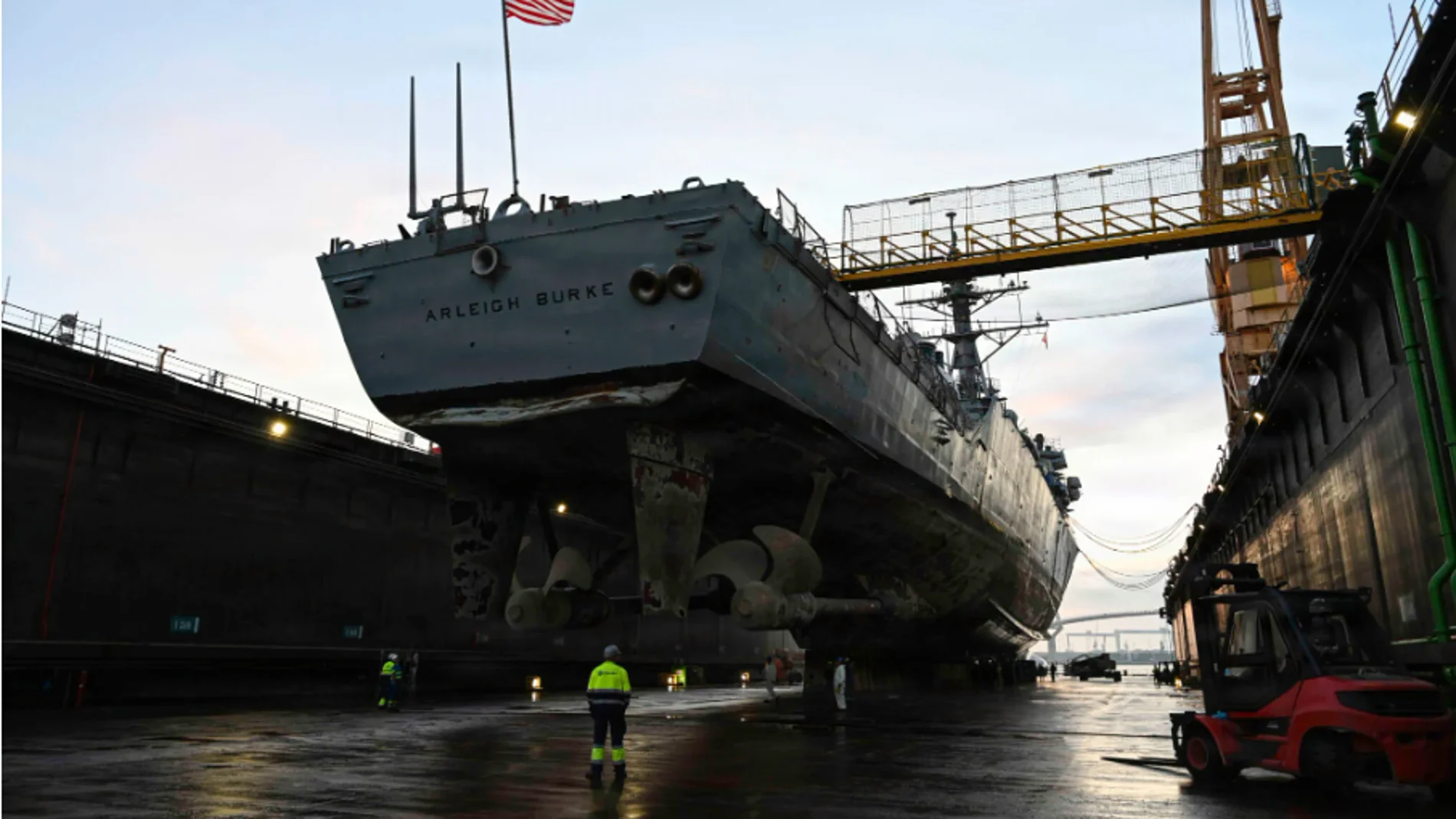
A warship can continue sailing and yet require an intervention that cannot be carried out at sea or with the ship moored to a dock. To check its submerged part, repair the propellers or work on the hull, it is necessary to remove the water that supports it. That is precisely what a dry dock allows. The American destroyer USS Arleigh Burke entered one of the Navantia shipyards in Cádiz to carry out scheduled maintenance and modernization work. The maneuver represents a milestone for the United States Navy: it is the first entry of this type into the area of operations of its Sixth Fleet since the arrival of the destroyers permanently deployed in Europe.
The difference may seem purely technical, but it has operational consequences. Until now, certain interventions of this magnitude could require resorting to more distant facilities, with the travel and time that this entails. By having dry docking capacity in Spain, the US Navy can keep its ships closer to the areas where its missions are assigned. and reduce the periods in which they are not available.
“The entry into dry dock of the Arleigh Burke is a major milestone in expanding the US Navy’s deployed maintenance capabilities in Europe,” said Vice Admiral JT Anderson, commander of the Sixth Fleet. As he explained, integrating this type of work into scheduled maintenance periods abroad allows for improving the material availability of ships. The intervention is carried out with the participation of the crew, US military and civilian personnel from the Regional Deployed Maintenance Center and Navantia workers. The Navy has not yet detailed how long the work will last, its cost or what specific modifications will be made.
The protagonist of the operation is not just any ship. The USS Arleigh Burke (DDG 51) is the ship that gives its name to one of the most numerous and recognizable classes of destroyers in the US Navy. It entered service on July 4, 1991 and arrived at its current Rota base in April 2021, after nearly three decades in Norfolk, Virginia. With nearly 154 meters in length, About 18 meters wide and with a speed of over 30 knots (more than 55 kilometers per hour), it is a combat ship designed to operate in very different scenarios.. It is powered by four gas turbines and has the Aegis combat system, which integrates sensors, radars and weapons to coordinate detection and response to threats.
Its function is not limited to attacking other ships. These destroyers can participate in anti-submarine missions, combat air threats and contribute to ballistic missile defense. Its vertical launch system can use different types of missiles, including Tomahawks for attacks against ground targets. That combination makes the Arleigh Burke class a centerpiece of American naval capabilities.
The ship is part of the five destroyers currently deployed at Rota Naval Base, assigned to Task Force 65 and linked to the NATO air and anti-missile defense device. From this position, US units can operate in large areas of Europe and Africa, from the Mediterranean to waters near the Arctic and the Cape of Good Hope.
Therefore, dry docking has a meaning that goes beyond repair. A fleet does not depend solely on its missiles, radars or speed: it also needs a logistics network capable of keeping it in operating condition. Having specialized facilities close to their base allows ships to spend less time moving to receive maintenance and more time available for your missions.
For Navantia, the operation confirms the relevance of its Cadiz facilities as industrial support to a foreign naval force that has one of its main European bases in Spain. For the United States, it adds one more option when it comes to supporting its ships deployed on the other side of the Atlantic. At sea, combat capability is measured by what a ship can do; on land, also because of the speed with which it can do it again.