
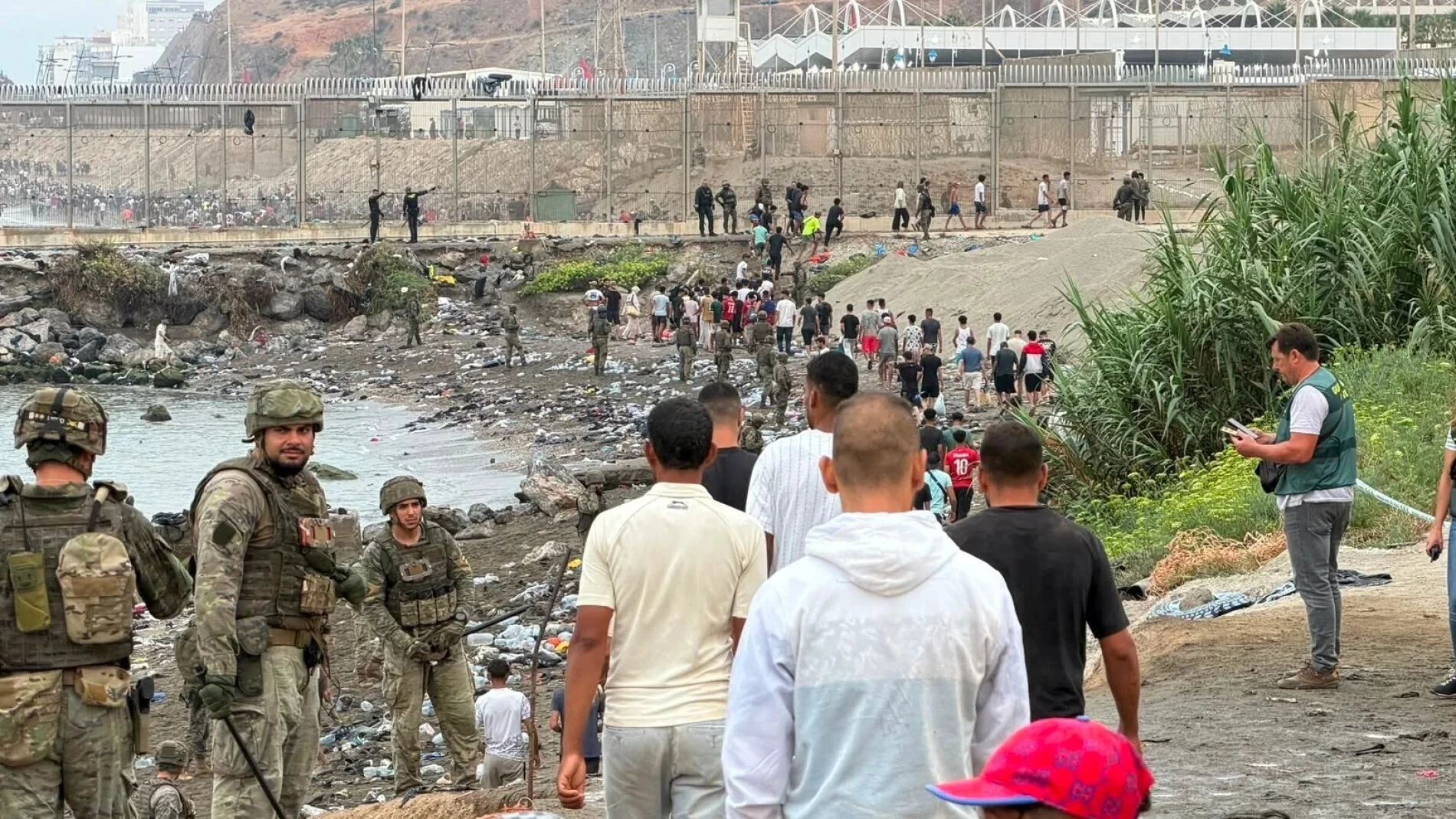
Military associations have brought to the Ombudsman the conditions under which soldiers serve in Ceuta after the migration crisis. They report attacks, insufficient means of protection and unclear instructions to intervene. Added to these complaints is the uncertainty regarding financial compensation: ATME assures that Defense still does not specify who will receive the incentives or how much.
The Professional Association of Non-Commissioned Officers (Asfaspro), the Unified Association of Spanish Military (AUME) and the Union of Military Troops (UMT) announced that the Ombudsman has accepted their joint claim, presented on September 22, for processing. According to its statement, the institution has opened a file and initiated proceedings before the Undersecretariat of Defense.
The admission letter, signed by the Ombudsman’s first deputy, addresses complaints that the organizations claim to have repeatedly conveyed to the Administration. All three consider that the step supports the urgency of their demands. The opening of the file begins its examination, without yet constituting a resolution on the merits of the complaints.
Their claim describes a situation of physical and legal exposure for those who patrol the streets and the border perimeter. Military representatives denounce that personnel perform highly demanding services without having all the necessary guarantees. They claim that Defense specifies the rules of action and provides legal and functional coverage for the tasks entrusted to it.
Legal certainty has an immediate application: that each soldier knows what he can do, how far his intervention goes and what responsibilities he assumes when acting on public roads. Associations ask for clear instructions before facing these situations. ATME had already requested information in August on the assigned functions and the legal limits communicated to staff.
Physical protection occupies another section of the complaint. Asfaspro, AUME and UMT require adequate individual means against possible attacks and prevention protocols against contact with communicable diseases. They denounce that the occupational risk prevention measures are insufficient for the conditions in which the service is carried out. The concern reaches families. The associations warn that the possibility of identifying and locating the military can facilitate accusations and reprisals. Therefore, they request measures to protect their personal data and those of their environment.
“It is incomprehensible that the Armed Forces must resort to the highest institution of constitutional guarantees to demand decent, safe and protected working conditions,” the three organizations maintain in their note. The reproach is directed at the Ministry of Defense, from which they demand immediate solutions.
The unrest also reaches the payrolls, since the Association of Spanish Troops and Sailors (ATME) denounces in another communication that the responses received about the incentives of the operation still do not clarify the beneficiaries, the amounts or how the units must justify the participation of each soldier.
According to ATME, the General Directorate of Personnel has communicated that there is an economic forecast and that the compensation will take into account the number of participants and the duration of the operation. The association considers this response too generic and demands to know what activities will give the right to payment, how they will be accredited and what controls will be applied. His warning refers to DANA, in which ATME assures that there were soldiers who were paid without working directly in the field and others who, after participating, suffered subsequent discounts when the amounts paid were reviewed. Ask to publish the rules before distributing the money to avoid new returns and claims.
Protests over the conditions of the deployment began weeks before, as early as August 6, ATME described days of between 14 and 16 hours, with breaks of just two hours between shifts, and bags of food that it considered insufficient: a sausage sandwich, tuna with a roll, an apple or yogurt and two 330-milliliter bottles of water.
The association itself then recognized that the food was beginning to improve after the intervention of the General Command of Ceuta and the base’s services unit. He thanked her for their response and asked for explanations about how the rations had been organized.
Five days later, ATME requested a procedure to compensate for the expenses caused by the suspension of previously authorized permits. According to communications from their partners, there were soldiers with tickets, accommodation or contracted trips who could lose the money or face penalties. The association recognized the needs of the service, but rejected that its economic consequences fell on those affected.
Defense has defended the magnitude of the effort made. On September 23, Margarita Robles estimated in the Congress of Deputies the deployment at 4,100 soldiers and more than 7,000 patrols carried out, day and night. The minister highlighted the actions to support the State Security Forces and Bodies.
Protective means have also been incorporated. As reported by “El País” on September 24, the Operations Command distributed pepper gas sprays and the General Staff disseminated rules of engagement. A spokesperson for this organization defended that the use of the spray was authorized for legitimate defense, subject to proportionality and coordinated with the Security Forces.
Now, the Undersecretary of Defense is the recipient of the actions opened by the Ombudsman. Asfaspro, AUME and UMT have announced that they will follow the file and the information sent by the Ministry. The complaint filed on September 22 has passed its first process; The response regarding the safety conditions of the personnel is pending.