
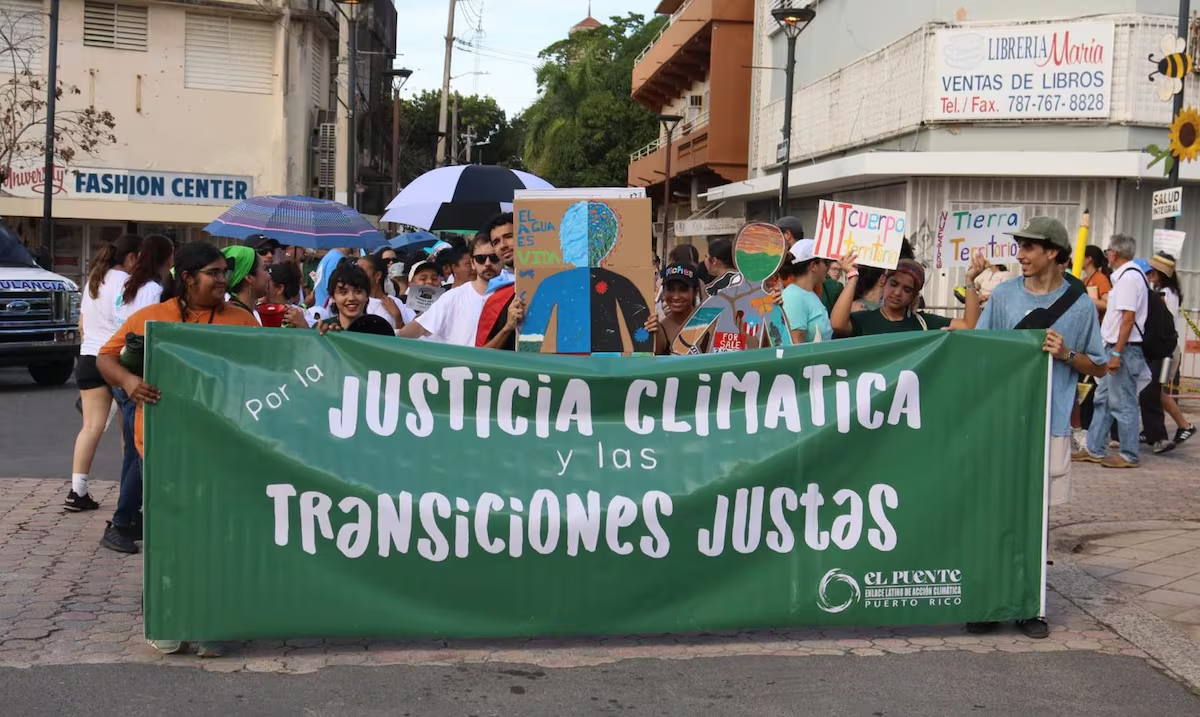
While awareness and citizen participation to confront the effects of climate change have been on the rise, government policies have moved in the opposite direction, he warned Federico Cintron Moscosodirector of the organization The Puerto Rico Bridgewhich this Saturday celebrated, in Río Piedras, the Eighth Puerto Rico Walk against Climate Change.
“On the government side, the trajectory is reversed. I remember 2019, which was the walk in which we have had the most people, with more than 3,000 people, it was the year in which the Climate Change (Mitigation, Adaptation and Resilience to) Law was signed. There were some phenomena happening in the world, a catastrophe and there was an important rise in awareness, and we felt that on the walk. But, from 2019 to now, what we have seen is a retraction of public policies, which we face today. “This inverse relationship is very clear at this time.”the researcher and community leader said via telephone.
The Law 33-2019precisely, he ordered the elaboration of the Mitigation, Adaptation and Resilience Plan to Climate Changea document prepared by a group of scientists and delivered, in 2024, to the Legislative Assembly. Since then, however, the legislative bodies – first controlled by the Popular Democratic Party and, now, for the New Progressive Party– have not given way to a final version to send to La Fortaleza.
During the march in Río Piedras, within the framework of the International Day Against Climate Changeemphasized the direct “link” between the manifestations of this phenomenon – such as global warming– and the health of people, said Cintrón Moscoso. Along these lines, El Puente set up clinics with services from surgeons, dermatologists, primary doctors and psychologists, as well as vaccination stations against influenza and to measure indicators such as glucose and pressure.
“The message is that the impacts of global warming have a greater effect on physically vulnerable populations and, therefore, some of these conditions are even aggravated.”. We want to make that link and that the participants can see that relationship, (that) they are not separate topics,” said Cintrón Moscoso, prior to the start of the walk, which passed through Robles, Brumbaugh, Paseo de Diego and Camelia Soto streets, until reaching the Plaza de la Convalcencia and continuing along Ponce de León Avenue.
According to El Puente, participation this Saturday was estimated at 1,000 protesters.
In 2025, El Puente organized the annual walk in Mayagüez. Returning to Río Piedras – where the headquarters of the community entity is located – is an opportunity to highlight how the urban area is one of the spaces “most affected by this heat island condition”, as well as the importance of the Resilience Center into which they seek to convert their offices on Robles Street.
“In the months with more heat advisories, we advertise the center as a cooling center, on the first floor; we also already have solar panels If the power goes out, we will continue working in the community center and offices. When was the droughtto members who did not have water We were allowing them to come to bathe and get water and, next week, thanks to a grant from the Hispanic Federationwe are going to install cisterns so we can have constant water in case of emergency. We are gradually creating the conditions,” he emphasized.
Over the years, Cintrón Moscoso highlighted, community and multisector initiatives to deal with climate change have become more sophisticated, with projects ranging from planting mangroves until the coastal reforestation and reconstruction of habitats corals and dunes, while interest in the subject has been reinforced among younger populations.
The big absentee, however, is the government, he pointed out.
“These projects continue to be precarious and are impossible to replicate without the government assuming its responsibility to be able to replicate it.”. I think that the role of communities is to continue showing and modeling actions that can be carried out, because the interesting thing is that much of this modeling is multisectoral, with non-profit organizations, academia and foundations. What we are missing is that enclave from the government sector, which unites and assumes its responsibility.”he stated.