
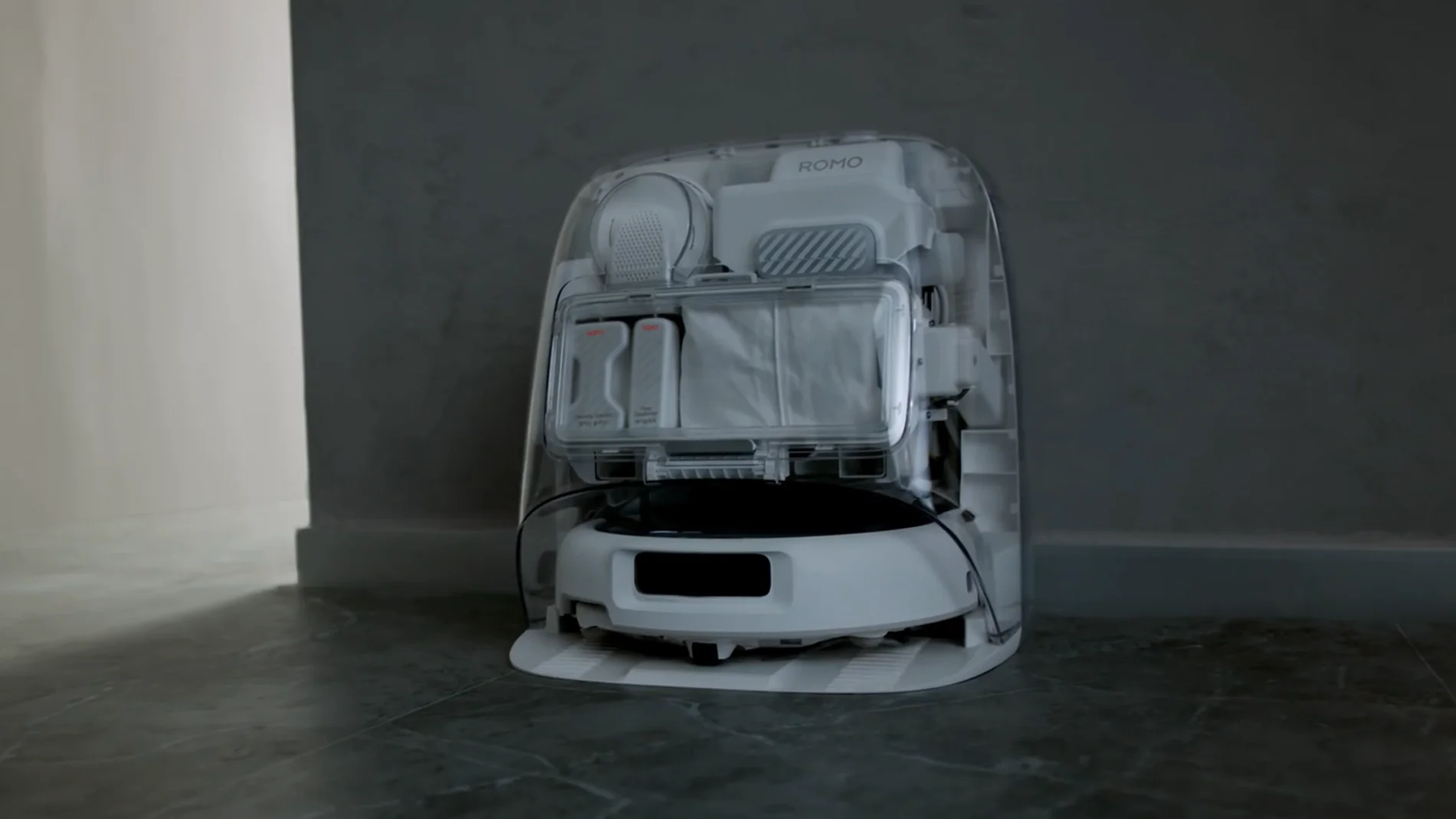
The first time I saw it was live at IFA and the “logic of surprise” (if that exists) stuck: it is obvious that the company specialized in guiding a drone in a three-dimensional space (flying) have the ability to create a robot vacuum cleaner that finds no difficulty in using its talent in two dimensions.
Despite the capacity of its “brothers with wings”, the Romo P2 is not especially fast. It also doesn’t look like a small appliance from the future (although its transparent design and white color help a lot), but because It starts to behave less like a vacuum cleaner and more like a machine that understands the space around it. He sees a chair leg, calculates the distance, changes his trajectory slightly and continues. Find a mat and change the way you work. He reaches an edge and extends one arm to reach a few inches beyond where his own body ends.
It’s a logical evolution for DJI, a company that has been making flying machines interpret the world from the air for years. In the ROMO P2, that same philosophy is transferred to the ground. The robot combines two fisheye cameras with LiDAR and ToF sensors to build a map of the home and detect objects. It can identify cables of about 2 millimeters in diameter and transparent obstacles such as glass or plastic, while a front illumination allows you to work even in very low light.
But the feature that draws the most attention is not in its cameras. It is on one of its sides. The ROMO P2 incorporates a LiDAR-guided cleaning arm that can rotate up to 123 degrees. Against the system of The original ROMO gains 7.8 centimeters of reach and can insert the mop up to 4.5 centimeters further under furniture. It’s a simple solution to a problem that all robot vacuum cleaners know: the floor is still there, even if the robot can’t reach it.
There is something almost biological about movement. The P2 doesn’t just approach the edge and turn; The arm looks for free space and moves the mop towards it. That way it can clean along walls, around table legs, and in corners where a circular robot would have to choose between coming up short or hitting the furniture.
Beneath that intelligence there is also strength. DJI advertises up to 36,000 pascals of suction power, accompanied by a split main brush and DualSweep side brushes designed to reduce hair tangles. The system detects carpets, automatically raises mops and can increase suction when necessary. In practice, however, the figures need context: its performance on both hard floors and carpets is very good. Or better yet: it is reliable when it comes to letting it work and trusting that we will return to a clean place.
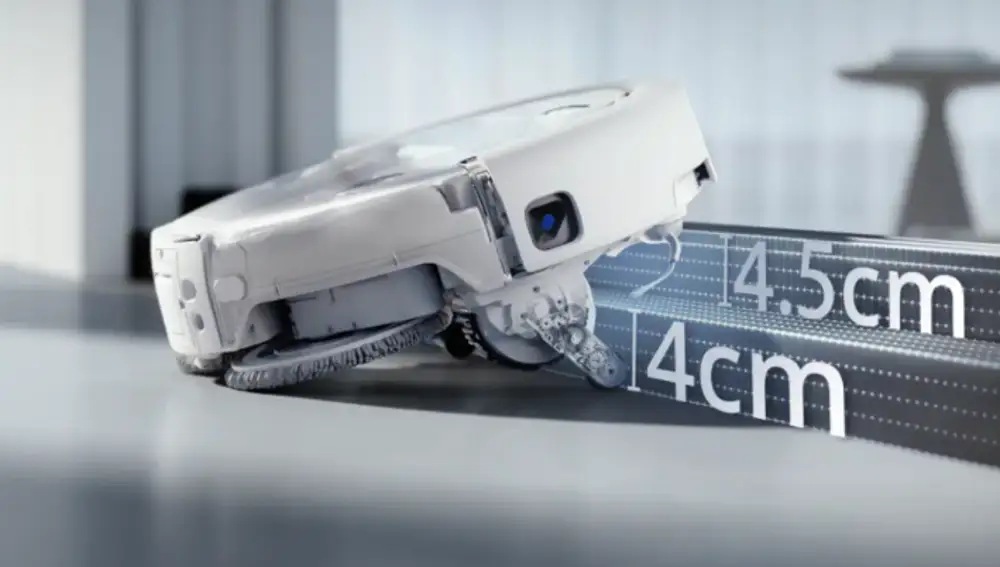
The other surprise is its legs. The ROMO P2 It can overcome obstacles of up to 4 centimeters and, through a movement that combines its supports, face differences in level of up to 8.5 centimeters in two stages. It does not mean that it can climb stairs like a mechanical animal, but it does mean that a threshold that would stop many robots is no longer necessarily a boundary.
When he finishes work, he returns to his station. Much of the less visible magic occurs there. The clean water tank has 4 liters and the dirty water tank has 3.2 liters; The mops are washed with hot water (up to 80º C) and then dried with hot air. The powder is stored in a 2.4 liter bag and the station also incorporates ultraviolet light in the bag area and a floor deodorization system. The set can operate for long periods without manual maintenance.
P2 doesn’t just clean when we tell him to, either. Its navigation system creates maps of several floors and allows you to define rooms, prohibited areas and areas where you should not scrub. From the DJI Home application you can also view live video, remotely control the robot, use two-way audio, and view statistics and dirt maps. It is, in a way, the same philosophy that we find in a drone: first observe, then build a representation of the space and finally decide how to move through it. The 5,000 mAh battery allows up to 180 minutes of operation in silent vacuuming, and when it needs to charge again the robot can return to the station and then continue from where it left off.
Finally there is the design, a variable that is not often taken into account in this type of device. The transparent body and station reveal part of their interior, an aesthetic decision that turns gears, tanks and mechanisms into part of the design. It may seem like a minor issue, but it makes sense here: DJI has made no attempt to hide that the ROMO P2 is a machine. It shows it. And that is the paradox of this robot vacuum cleaner: the only thing we will see is its interior, while dirt, dust, stains… disappear.