
It can take just seconds for a missile to turn a fighter jet into a target. To defend himself, the pilot today has electronic countermeasures, maneuvers and other systems designed to confuse or destroy the threat. But There is another possibility: not to launch another missile, but rather a beam of light against the one that is approaching.
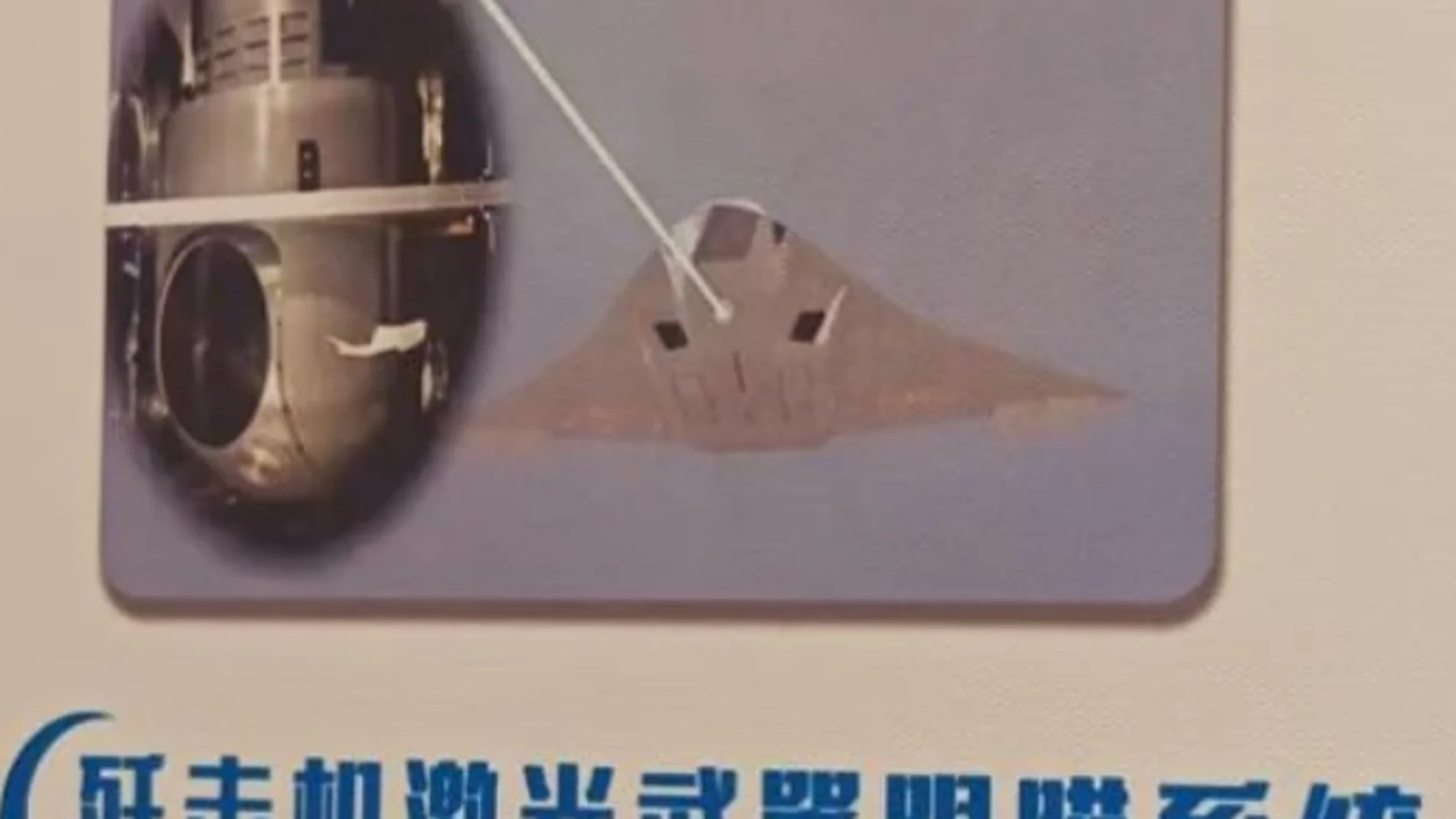
China has just shown a piece that could bring that idea closer to heaven. At a defense exhibition held in Beijing from September 15 to 17, a research institute of the Aviation Industry Corporation of China (AVIC) presented a system described as a tracking and aiming equipment for laser weapons intended for combat aircraft. The panel placed the system next to an image of the large tailless aircraft known to analysts as the J-36, considered one of China’s sixth-generation programs.
Interesting, if indeed legit! 😮
An alleged “Acquisition, Tracking, and Pointing (ATP) system of J-36’s laser weapon” showcased at the 14th China International Defense Electronics Exhibition.(Via @Devil_R22 in FighterJets)https://t.co/smTebLGC4Z pic.twitter.com/mmbkwo90g5
— @Rupprecht_A (@RupprechtDeino) September 16, 2026
That doesn’t mean the J-36 already has a laser installed. There is no public evidence that the plane was flown with such a weapon. But the presentation provides a rare clue about Chinese interest in carrying directed energy weapons aboard aircraft. The data visible on the panel is as striking as it is incomplete. The system would weigh less than 380 kilos and a power figure appears partially hidden as “*00 kW.” Analysts interpret that it could be a power of at least 100 kilowatts, although the exact data is not public. Also hidden is the dynamic precision of the aiming system, an essential feature when the target is moving at high speed.
Why is so much precision needed? Because a laser does not fire a projectile that can correct its trajectory. The beam must remain exactly on the chosen point for long enough to produce an effect. And doing it from a plane is especially complicated.: turbulence, vibrations and maneuvers continually modify the position of the emitter. At the same time, the target is also flying. Regarding power, one way to understand the possible 100 kilowatts is to equate it to a 136 horsepower vehicle… only all of them are concentrated in a point hundreds of times smaller.
The aiming system has to compensate for all these movements in real time. It is, in a way, like trying to hold a laser pointer on a fly while the person holding the pointer runs and the fly also moves. Only here the pointer can be mounted on a fighter plane and the fly can be a missile.
The laser would not necessarily have to destroy the missile either. With sufficient energy and exposure time it could physically damage some of its components, but at greater distances one possibility would be to act on its sensors. Many missiles use electro-optical or infrared seekers to locate their target. A beam aimed at them could interfere with or damage those sensors. The effective range to produce physical damage would, according to one analysis, be more limited than that necessary to affect an optical system.
And here appears one of the big problems of technology: power is not free. A high-energy laser needs electricity and, above all, a system capable of eliminating the heat it generates. On a plane, every kilo counts. The figure of less than 380 kilos is therefore especially interesting, although we still do not know what exactly it includes: It could encompass the laser source, the beam director and part of the cooling system, but the breakdown has not been made public.
The size of the supposed J-36 works in its favor. The plane, first observed over Chengdu in December 2024, is a large, three-engine aircraft. A design of these dimensions offers more space for generators, cooling systems and other equipment than a conventional fighter. Precisely for this reason, analysts consider that it could be a suitable platform for experimenting with directed energy weapons.
If China finally manages to integrate one of these weapons into a sixth-generation fighter, the change would not just be adding one more weapon to the arsenal. A missile needs fuel, a projectile needs ammunition. A laser needs energy. AND As long as the plane can generate it and dissipate the heat, the gun can fire again and again. The challenge, now, is to get that beam to find exactly where it needs to be when everything else (the plane, the missile, and the air separating them) is in motion.