
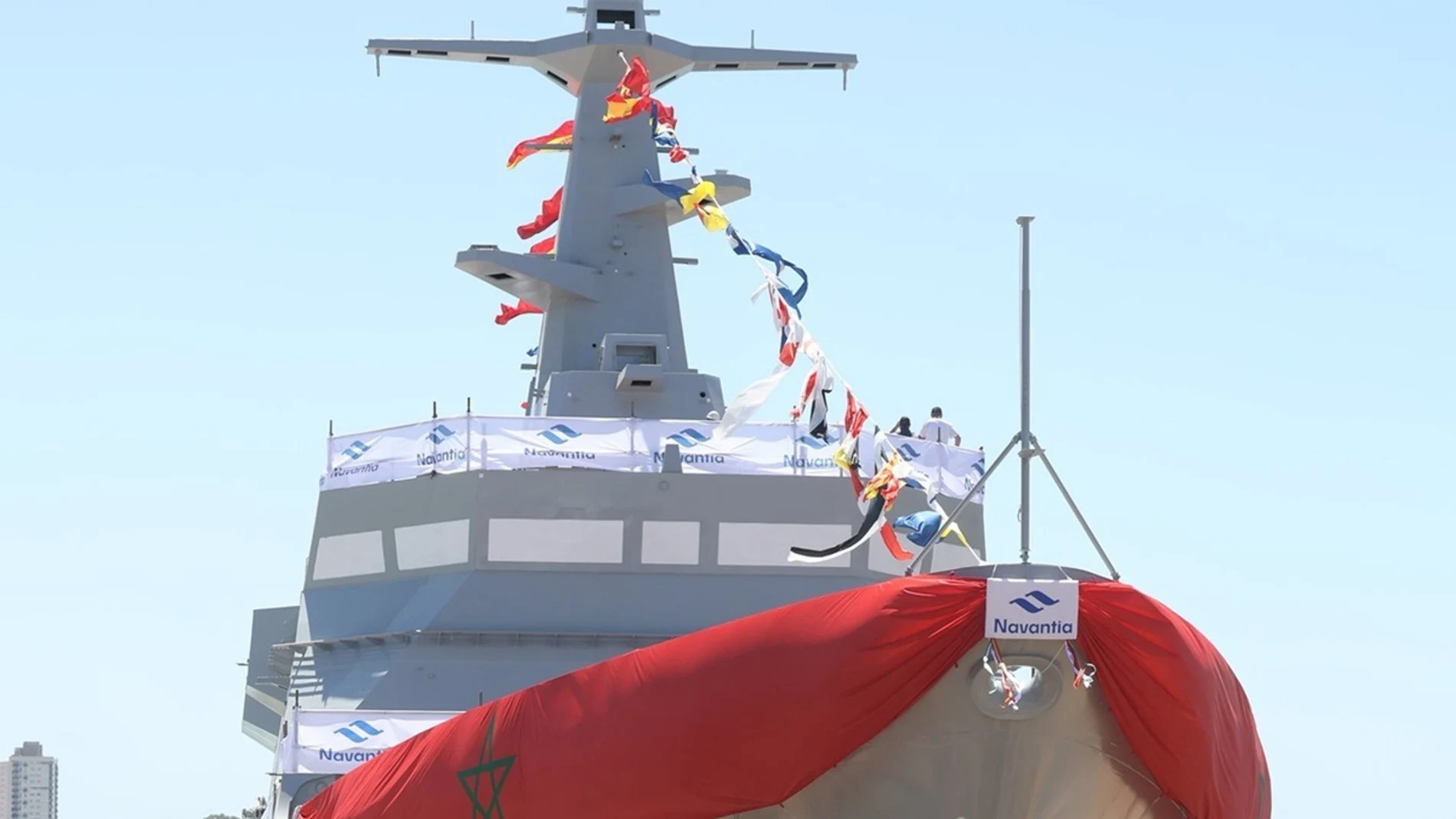
Navantia has delivered to Morocco a boat designed to spend long periods at sea: the “Moulay Hassan I”, an 87-meter high patrol boat built in San Fernando, Cádiz. The Spanish public company formalized the delivery on September 17, as confirmed to Europa Press. Rabat thus incorporates a unit that combines naval presence, the ability to operate with a helicopter and means to intervene on small boats.
The operation is around 130 million euros, according to the estimates published about the contract, although Navantia has not released a final breakdown price. Yes, a loan of 95 million granted to Morocco to finance the purchase is documented. The agreement was signed on August 31, 2022 and its approval appeared in the Moroccan official gazette, as reported by “Yabiladi”.
The credit covers part of the acquisition. The order was announced in January 2021, years before the current crisis in Ceuta. Navantia and the client agreed to dispense with the delivery ceremony, as we reported in LA RAZÓN a few days ago.
During construction there were public events: the patrol boat was launched on May 27, 2025, with Spanish authorities and representatives of the Moroccan Navy. The discretion of the delivery closes a program that had been announced for more than five years and that comes at the worst possible moment after relations between both countries have hardened.
Its design is part of the Avante 1800 family. The dimensions communicated by Navantia to Janes place the beam and the width of the hull at 13 meters and the draft at 4 meters. Fully loaded, it displaces 2,020 tons, a figure that expresses the weight of the assembly with its service loads. It is an ocean vessel with space to accommodate 60 people, according to the builder.
Navantia’s stated priority is to sustain prolonged deployments with a reduced complement and contain operating and maintenance costs. In a patrol, it matters how long the boat can remain in its work area and with what resources it can deal with an incident, because, even if it is a boat with war aims, it is still a patrol boat that can at most carry out reconnaissance tasks in its waters.
Fuel, provisions, spare parts and rest for sailors determine this permanence as much as the performance of the engines. The company has not published a verifiable number of days of autonomy for this unit. Below deck, the configuration disclosed during construction brings together four MAN 175D main engines in a CODAD arrangement, short for combined diesel and diesel propulsion. This architecture allows the power of several engines to be combined to move the ship.
The maximum design speed communicated to Janes is 24 knots, equivalent to about 44 kilometers per hour. This is the expected peak, different from the driving speed chosen to save fuel during prolonged surveillance.
The 175D belong to a family of four-stroke, high-speed engines that the manufacturer offers with 12, 16 or 20 cylinders arranged in a V. They use fuel injection through a common rail, known as “common rail”, and are marketed for propulsion and electrical generation.
The number of cylinders and the chosen adjustment change the available power, so the family name is insufficient to calculate the horsepower installed in the patrol car. The published file also includes five Baudouin 6 M26.3 generating sets. Its task is to produce electricity for onboard services, from electronic equipment to the facilities that allow working and living during deployment.
Propelling the hull and powering its equipment are different needs. Automation helps operate this machinery with fewer personnel. Navantia’s contracting records include supplies associated with the Moroccan program’s integrated platform control system. These systems bring together the monitoring of the ship’s services and present their status to the operators. According to the manufacturer’s description, they allow centralizing surveillance and control, facilitating decisions and managing breakdowns.
Its usefulness is in gathering dispersed information and helping the crew respond when a service fails. That function corresponds to the operation of the ship; By itself it does not demonstrate the ability to direct weapons and it is not known whether it has them or not, one of the great unknowns, as we will see.
The flight deck expands the patrol boat’s capabilities. Navantia confirmed that the design allows operation with a helicopter. Having an aircraft can extend the observation beyond what is seen from the bridge and help locate boats or people.
Its specific usefulness will depend on the device used and the equipment it carries. The existence of a deck does not prove that Morocco has assigned a permanent helicopter to the ship nor does it allow its model to be identified.
The complement on the water are up to two semi-rigid speed boats, known by the acronym RHIB. They facilitate the transfer of inspection equipment and approaches to vessels that an 87-meter hull cannot approach in the same way. They are also useful for picking people up from the water. The combination allows the patrol boat to remain as a support base while a smaller vessel carries out the intervention. Its use depends on the state of the sea and safety conditions.
An important part of the military file remains undetailed: the weapons. The information published on the occasion of the delivery indicated that its configuration had not been revealed. There is also no complete and verified public inventory of installed radars, sensors and electronic warfare equipment. This lack of data forces conclusions about its firepower and its ability to detect and combat threats to be left open. It does not show that it lacks those equipment.
The name Avante 1800 may cause confusion. Navantia markets a Combatant version, aimed at anti-aircraft, anti-ship and electronic warfare missions.
The possibilities of this offer do not certify the equipment acquired by Morocco. To attribute anti-ship missiles, anti-aircraft defenses or anti-submarine means to the “Moulay Hassan I”, its installation would need to be confirmed. The helmet provides space and support; Sensors, weapons and their integration determine what combats it can fight. They are elements that must be evaluated together.
With what is known, the clearest contribution for Rabat is to have another unit capable of maintaining a presence far from the port, with aerial means and auxiliary vessels when the mission requires them. This profile fits with maritime surveillance and inspection and with rescue support.
Among the tasks that Navantia assigns to its patrol vessels are the control of maritime traffic, the protection of fishing resources and the fight against illicit trafficking. These are jobs that require keeping a boat available for many hours, with personnel prepared to go from observation to intervention.
Construction began with the sheet metal cutting on July 3, 2023. The keel laying came on September 6, 2024: the placement of the first block on the slipway gave way to the assembly of the hull. After the launch, the program continued with the arming of the ship and sea trials. In naval language, this arming phase includes installing equipment and completing the ship, beyond its weapons.
For San Fernando, Navantia estimated the program’s load at more than one million hours and around 1,100 direct, indirect and induced jobs over three years. The relationship with the client also includes maintenance: the contract includes spare parts, technical documentation and tools.
The package is completed with training in Spain for Moroccan Royal Navy personnel.