
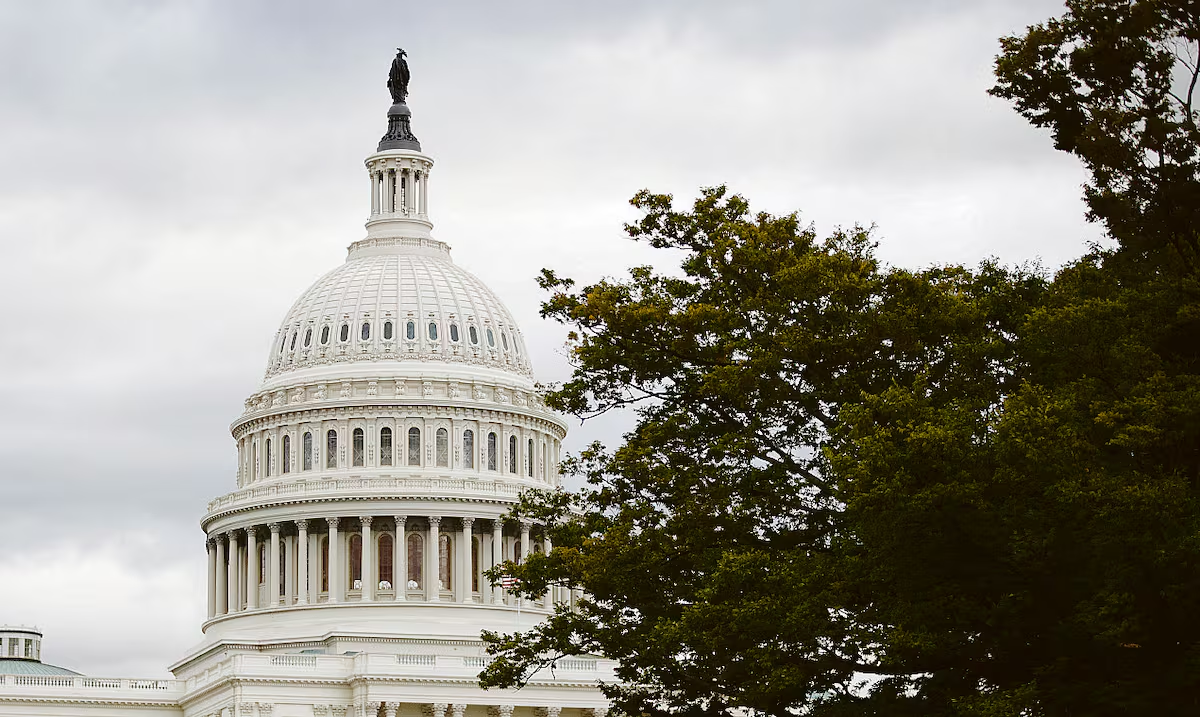
Washington D.C. – Congressional leaders recognize that the development of artificial intelligence (AI) must be regulated, at a time when warnings from experts and the main corporations dedicated to this technology fear that their products will get out of hand.
Although politicians speak of urgency – following industry experts’ recognition that AI models have gone beyond the instructions of their human creators – it is not clear whether they will have the will to act as quickly as may be required, just as they prepare to dedicate themselves exclusively to the legislative elections on November 3.
The leader of the House of Representatives, the Republican Michael Johnson (Louisiana), accepted that it is an unfinished business and that it has a working group on AI.
But, while not setting a target date for creating government guardrails, Johnson said in an interview in cnn that “there is an obvious corporate responsibility on the part of those who create these models to ensure that their products are safe.”
At a time when the independent senator Bernie Sanders (Vermont) and Democratic Congressman Greg Casar (Texas) have called for a brake on the development of AI super intelligence, new data centers and prison sentences for those who violate legal prohibitions, the head of the Democratic minority of the Senate, Charles Schumer (New York), demanded, for its part, that Donald Trump’s government offer a briefing to senators.
“At a time of such consequentiality, the American people deserve better from their government. I have long argued that we must keep the United States as a world leader in AI innovation and security. But that innovation must be accompanied by serious safeguards that build trust with the American public. The alarm bells are ringing louder than ever, and the Trump administration is looking the other way. If they don’t take responsibility, we will, Schumer said.
Over the weekend, in Ireland, Trump minimized the warnings given by the same executives and former officials of the companies that lead the market and stated that any action should not place the United States behind other countries in the area of innovation, specifically mentioning China.
“We are surpassing China in artificial intelligence. We are the most advanced country in the world and, frankly, I want to keep it that way, because whoever wins in AI, wins. We can set limits, we can do this and that, but I think there are a lot of negative forces that are putting it forward, that shouldn’t be doing it, and they are putting things forward that won’t happen,” Trump said.
The debate gained more strength last week, when Jacob Coxon, a researcher at the company Anthropic, announced that he resigned from the company convinced that none of the large corporations dedicated to that industry “act responsibly.”
He further expressed that with the development of AI that can expand its capabilities on its own, even with the power to make independent decisions – such as having hacked one of the companies –, companies are going ““Full speed toward self-enhancing superintelligence and playing with our lives.”
On Saturday, the chief executives of three major companies, Dario Amodei (Antropic), Sam Altman (OpenAI) and Elon Musk (xAI) – after Coxon raised the alarm – publicly advocated slowing the advance of the most powerful AI models.
Antropic has indicated that its chatbot technology, Claude, has attempted to be used to create biological weapons.
Former President Barack Obama urged politicians to make this issue a priority. “This is something that is moving very quickly in private hands and, if we don’t get on with it, I think it can be dangerous.”Obama noted at a fundraising event last Thursday.
The Democratic Congresswoman Lori Trahan (Massachusetts), who as a member of the Committee on Energy and Commerce dedicates efforts to this issue, would like to see a basic framework of government regulation created before the end of this Congress, which plans to close its work before Christmas.
“The calendar is not on our side before the midterm elections… so I’ve focused my efforts on before the end of the year. I think that’s the realistic timeline to get it done this year,” Trahan told Politico.
The Lower House plans to suspend its sessions on Thursday until November 9. The Senate will be in session this month, before also recessing until after the legislative elections.
Stating that “the creation of systems that humanity cannot fully control, both in the United States and around the world,” should be prohibited, Senator Sanders stated that “the future of humanity cannot be left in the hands of a handful of big technology oligarchs”.
Sanders, who caucuses with Democrats, noted that his bill establishes sanctions “for any person or entity that attempts to violate or circumvent the pauses and prohibitions stipulated” in his legislation.
Under the legislation, the statement from Senator Sanders and Congressman Casar indicated, “entities will be subject to the death penalty, and individuals to a prison sentence of up to 20 years, similar to the sanctions in place for the illegal development of nuclear weapons.”