
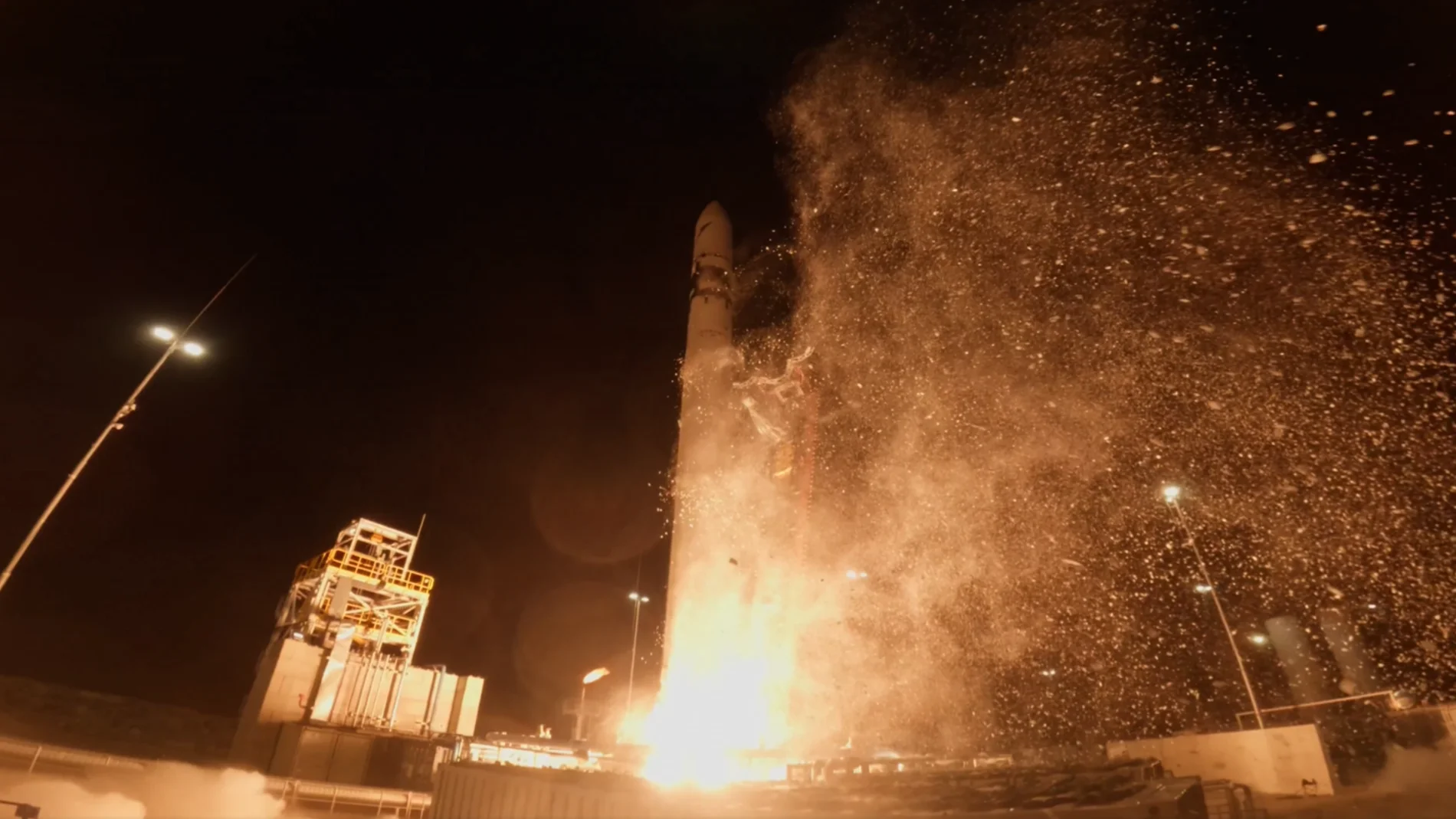
Isar Aerospace This Saturday he managed to put his rocket into orbit Spectrum from the spaceport Andoyain Norway. The German company thus becomes the first in Europe to achieve this goal with a completely commercial launcher. Success introduces a new competitor against Arianespace and Aviwhose rockets Ariane 6 and Vega-C They were developed with public financing.
Daniel Metzler, Josef Fleischmann and Markus Brandl founded Isar in 2018 after sharing their love for rockets in a workshop at the Technical University of Munichnaming the company after the river that runs through the city. Eight years later, it has almost 500 employees and has captured around 1 billion dollars in private rounds.
‘Today, Isar Aerospace has opened space from continental Europe. Launches remain the biggest bottleneck for the global space industry and, as of today, there is a real alternative for commercial and institutional customers‘, said Daniel Metzler, co-founder and CEO of the company, in a press release.
We made history. On just our second flight, we became the first commercial space company from Europe to deliver satellites into orbit. Mission ‘Onward and Upward’ successfully lifted off and deployed payloads into orbit. A new chapter for European spaceflight. More:… pic.twitter.com/AWvqG2l8Mn
— Isar Aerospace (@isaraerospace) September 5, 2026
‘We have achieved in a few years what the European space industry took decades to achieve. Europe now has sovereign access to space. We have entered a new chapter in European spaceflight. I am incredibly proud of our team, who has made this success story from Europe possible. Now we will focus on Rapidly increase launch vehicle production, fulfill our order book and respond to growing global demand‘ adds Metzler
The Spectrum measures 28 meters high and can transport up to a ton to low Earth orbit. Its two stages use motors Aquila fueled with propane and liquid oxygen. The nine engines of the first generate more than 675 kilonewtons of thrust and the second has one.
The first launch attempt, in March 2025, ended in accident. A valve failed The rocket lost control less than 20 seconds after takeoff and ended up crashing near the platform.
Orbit Achieved. Payload Deployed.
Mission ‘Onward and Upward’ delivered our first customer satellites to orbit, achieving major milestones:
✅ MaxQ
✅Stage separation
✅Stage 2 engine ignition
✅ Fairing separation
✅ORBIT
✅ Second engine cutoff and transfer orbit injection… pic.twitter.com/gEa99hJyAf— Isar Aerospace (@isaraerospace) September 6, 2026
Preparations for the second flight have been delayed since January due to technical problems, bad weather and launch field restrictions. On Saturday it finally took off at 10:12 p.m., Spanish peninsular time, with five small CubeSat satellites and a technological experiment that had to remain attached to the vehicle.
The first stage operated for two and a half minutes before separating over the Norwegian Sea. The second accelerated until reach orbital speed about seven minutes after takeoff. A new ignition was planned to circularize the orbit at about 500 kilometers. After the five small satellites were deployedwhile the technological experiment remained linked to the second stage. At least one of the satellites contacted the ground teams, although Isar has not specified the final parameters of the mission.
The advance reinforces European alternatives to launch satellites and reduce dependence on US suppliers like SpaceX. Europe already had its own access to space with Ariane and Vegabut seeks to make it cheaper through greater competition.
‘I think it’s important to understand that Europe can also act quickly and meet its objectives. I think everyone in Europe understands what this really means, because having strategic access to space and not depending on a monopoly It is extremely important for our security, our economy and our strategic autonomy. Europe has everything to promote these initiatives’Metzler said in a press conference this Sunday.
The European Space Agency last month awarded Isar a contract worth 197.8 million euros through the European Launcher Challenge. The program supports commercial launchers and requires reaching orbit no later than 2027. Isar has already met that requirement.
The Spanish PLD Space also participates in the program together with the German Rocket Factory Augsburg. Both plan to attempt their first orbital launch before the end of the year. PLD Space has already tested the Miura 1 in 2023, but that flight was suborbital. Its jump into orbit corresponds to Miura 5.