
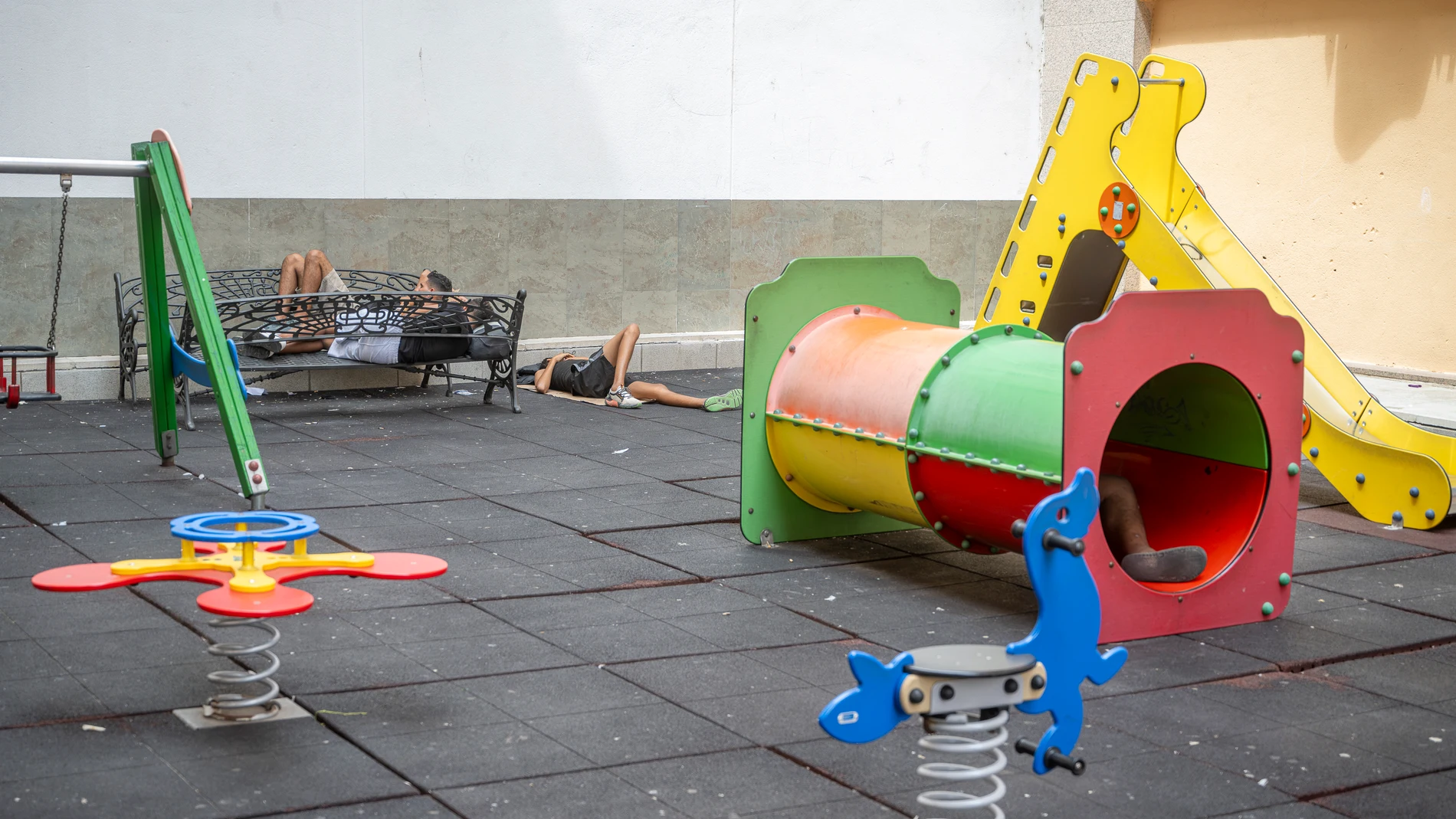
Normal. Outlawed word. No matter how much appearance you want to give it. Ceuta, September 8. At eight in the morning, the most uncertain start of the school year. The prognosis: bad. “We cannot talk about normality,” the Education Minister of the local government assures LA RAZÓN: Pilar Orozco. “It is not normal to see police or soldiers in front of your school.”
As of today, they begin to reopen their doors: sixteen public schools, six charter schools, six secondary education institutes, an integrated vocational training center, two adult education centers and two schools: one for art and the other for languages. More than twelve thousand children from Kindergarten, Primary, Compulsory Secondary Education and Baccalaureate They are called to occupy their desks. But many will not.
“The fears are still there”recognizes the Minister of Education. “Everyone has their own circumstances at home and there are parents who have teenage or younger children, perhaps they already organize themselves to take them to school and have no problem.” Others, in older age, will have to lose what they had gained in freedom of movement.
The Ministry of Education has tried to calm the spirits of an educational community mired in uncertainty. “The centers are safe,” the minister, Milagros Tolón, said yesterday, but the message has not penetrated. «They have told us that private security has been put in place, they have told us that a device has been organized so that the school environments are safe, but of course, what happens in Ceuta is not normal. The news we are seeing every day is scary.”says Orozco.
Even today, forty days after the “invasion”, some ten thousand illegal immigrants remain in the autonomous city, according to unofficial counts from neighborhood associations and social entities. To make matters worse, far from reducing tension, the social climate is getting worse.
This Monday’s day was marked, once again, by altercations. Fires, attacks, arrests. A group of illegals set fire to three vehicles. After a while, the firefighters arrived, whom they met with stones. The same thing happened with the Civil Guard. The events occurred next to the Polígono del Tarajal, where one of the illegal settlements is located.
On his Instagram account, a professor from San Antonio School published a photograph of three minors climbing on the fence that separates the establishment from the street. «And this is the course that awaits us… sneaking into our centers daily, forcing doors, destroying furniture, stealing material such as tools – screwdrivers, saws, hammers – that they can use as weapons, “I don’t even want to imagine when we start the dining room and they know that there is food stored.”he wrote.
At the San Daniel School, a state-sponsored educational center, hundreds of illegals occupied the recreation areas during the days of the “invasion.” It was the Army that was in charge of evicting them. But days later, on August 8, many returned and “They vandalized the warehouse.” Víctor, a teacher and cooperative member, does not hide his “sadness.”
The image of his destroyed school, in which he invested his life’s investment, cannot be erased from his mind: «They stole our physical education mats, sports equipment, balls, ropes. Bottles of urine, buckets of feces… medicines, drinks, food in poor condition have been found lying in a grave behind it. “All that was cleaned up, a complaint was filed, the judicial police were there, blood appeared.”
Now, a private security team will be in charge of guarding all the facilities. “In principle we pay for it”. The Ministry of Education has given its word that it will take care of even the last sentinel.
The problem is in the itinerary. The children who will go to class from the periphery. “We do not know to what extent students will perceive this support from different State security forces and bodies and the militarization of schools,” he points out. Juan Luis Muñoz ArbonaEnglish teacher at IES Clara Campoamor. Loma Colmenar, Los Rosales, are places where immigrants even “sleep in any corner”, the neighbors’ complaints are “constant.” The challenge is that, when the sun has not yet risen, parents and children can feel confident about traveling on routes crowded with immigrants.
The unanimous forecast of all the teachers is a start cut short by many empty chairs. “A director of the Príncipe Felipe School says that how is the school year going to start if they have a settlement outside and they sleep there,” he comments. David Muñoz Arbonaprofessor at the School of Art.
He has a “divided” heart. On the one hand, he doesn’t want the children to go to class. “Because this is like playing a game to the Government, which wants there to be normality.” But on the other hand, he longs for something resembling a routine. «Here the Government wants to give a feeling of security with educational centers when there is no security or normality. “Most children are not going to come to class.”
Reveals the testimony of a mother from her center. «He called us crying. He has a son who is our student and is autistic. It was first obtained from professional training, interactive graphic design. Well, what he had gained in autonomy from walking home alone, he has now lost.
In Ceuta, children with autism have been living for forty days with “streets full of national police, ambulances, sirens.” An overdose of noise pollution that has a direct consequence on your mood. Which is the same: in your health.
For the majority of actors involved, returning to the school year is reckless. Teachers and parents agree that safety conditions still do not exist. Even so, they maintain the commitment to try. Not all. There are temptations to strike that, at the moment, do not have sufficient support. But a date is beginning to gain strength: August 28. The perception is also shared by the city’s public representatives.
It is the case of Melchor Leonvice president of the Assembly and socialist deputy. Already known as the “discolo”, for criticizing the Government’s management. He has two daughters and, for now, they will continue at home. He doesn’t see it appropriate. «I submitted a letter to the Ministry of Education demanding that no school be opened as long as the safety and health conditions were not met. We believe that they are not met so that our children, who are the greatest value we have as a society, return to school. If there is no security to hold sporting and cultural events, obviously there is no security for our children to go to school alone,” he assures LA RAZÓN.
His opinion is that of many in a city that is experiencing the greatest challenge today: that tens of thousands of children attend classes among an undetermined number of illegal immigrants who crossed the border in a massive assault and who still remain in the worst conditions: on the streets, in shanties, or in illegal settlements. Separate issue: the almost impossible challenge of schooling unaccompanied minors.