
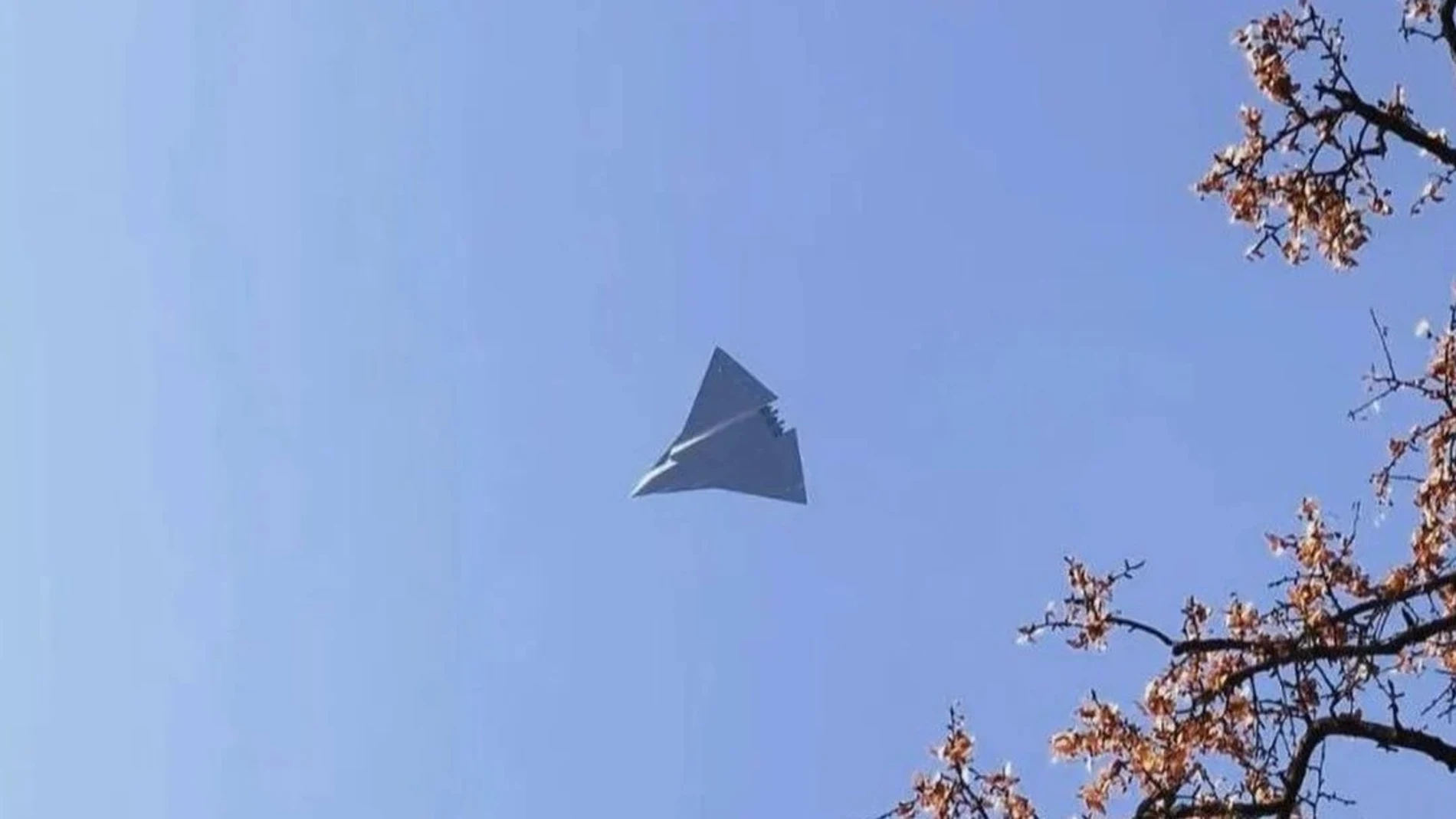
New images spread on the internet show what it could be the fifth prototype of the J-36the sixth generation fighter developed Chengdu Aircraft Corporationreports South China Morning Post. The material began to circulate on July 23 and reveals new changes in one of China’s most secret aeronautical programsalthough neither the identity of the device nor its development status have been officially confirmed.
The Chinese media, and others specialized in defense such as Army Recognition, speak of a possible fifth prototype based on the estimates of observers who believe they have identified five different aircraft in the J-36 sightings that have occurred so far. Andreas Rupprechtan analyst specialized in Chinese military aviation interviewed by SCMP, takes a more cautious position and only distinguishes at least three design configurations due to visible changes between some devices and others.
Thus, we would be talking on the one hand about the estimated number of prototypes built, while three corresponds to the main recognizable versions of the J-36. ‘It is still difficult to assess with certainty. But based on reports from reliable sources, there are fairly strong indications that this is several different prototypes‘, Rupprecht explains to the media.
J-36 No.5 pic.twitter.com/s8x5BSK7Uh
— David Wang (@DavidWangPLA) July 23, 2026
The J-36 was first seen publicly in December 2024, when images of a large tailless plane flying over chengdu. It is a large fighter, without vertical stabilizers and powered by three engines. Its internal volume points to a high fuel and weapons capacityas well as space and electrical power for advanced sensors and electronic warfare equipment. Its design seems oriented to long range and strike against air tankers, early warning platforms and other high value targetsaccording to Army Recognition.
Rupprecht distinguishes three great setups so far. The first aircraft had inverted V-shaped air intakes, a tandem main landing gear and rectangular gas outlets integrated into the fuselage. A later revision incorporated spacerless supersonic air intakes, side-by-side main wheels, and flat nozzles that could provide thrust vectoring.
In the last images, the plane It would retain the supersonic intakes without a separator and would recover gas outlets sunk in the fuselage similar to those of the first. Modifications are also seen in the nose and landing gear. Separatorless intakes reduce weight, complexity and surfaces that reflect radar waves. Recessed outlets can better conceal hot engine parts, while movable nozzles offer greater control to a tailless aircraft.
Chengdu could be testing different combinations on various aircraft to find the best balance between stealth, maneuverability, efficiency and ease of manufacture. Rupprecht acknowledges that ‘there is simply no experience in this area yet with a type of hunting like this.’ The changes could also coincide with the pitch of the engines WS-10C to the WS-15although it is an extreme that cannot be confirmed, like almost everything that surrounds the J-36.
The J-36 would not be the only Chinese sixth-generation project. Shenyang Aircraft Corporation develops another smaller, twin-engine aircraft provisionally known as J-50 either J-XDSwhich could look more like the future F-47 American, also a sixth generation fighter. Rupprecht believes that the J-36 could differentiate itself by its enormous size and by primarily playing the role of a long-range command platformheavily armed and capable of coordinating combat drones. The American F-47 will also operate alongside collaborative unmanned aircraft, although it is primarily conceived as the Air Force’s future air superiority fighter.
China seems to have advantage in the race because it has already shown several planes in flight. The F-47 that Boeing developed for the United States Air Force remains classified and has not been presented publicly. However, too little is known about the U.S. program to determine which country is truly more advanced.