
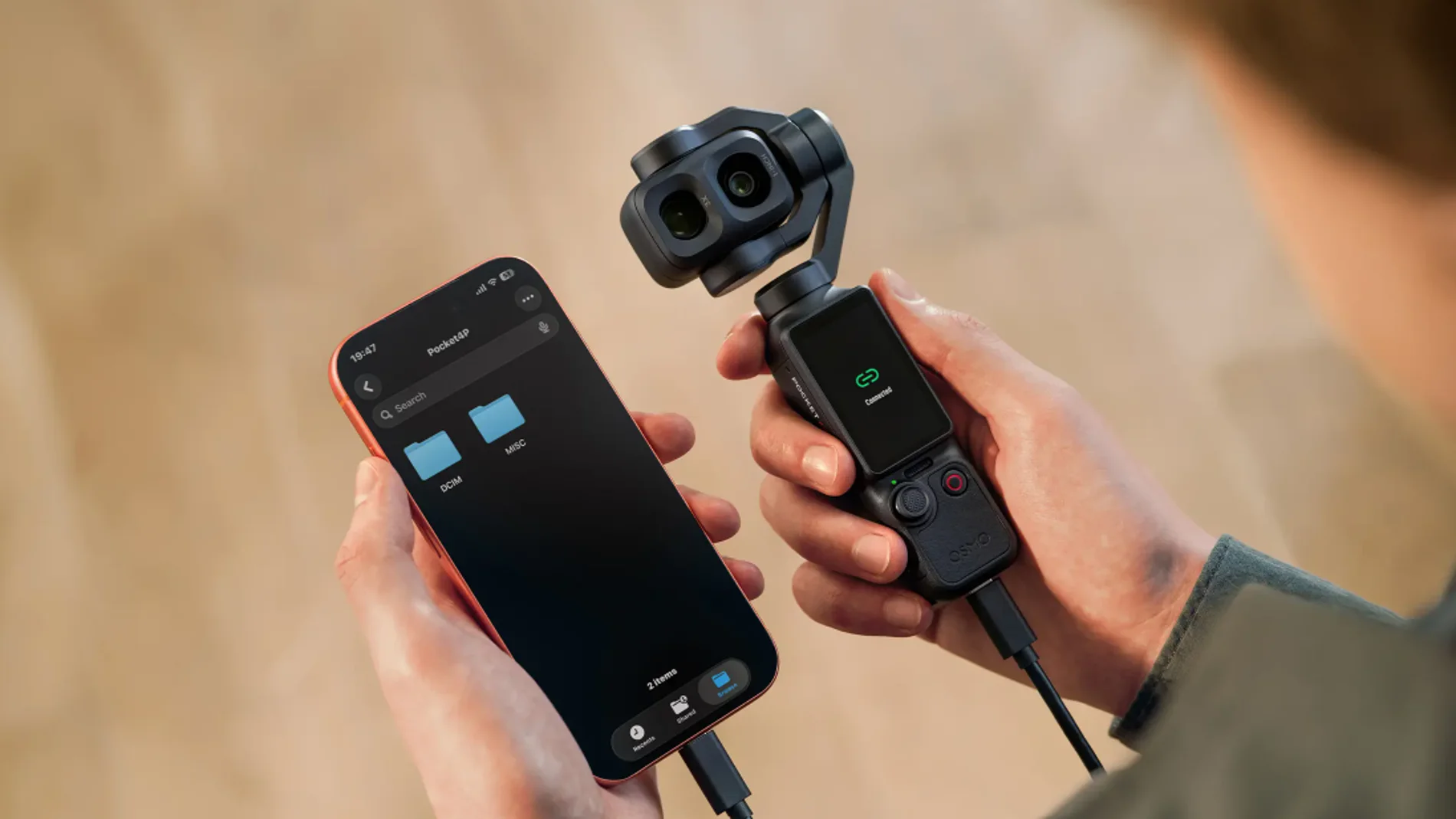
There is a curious moment that repeats itself every time a new camera appears. Brands talk about larger sensors, more resolution, more dynamic range or more artificial intelligence. They are important improvements, yes, but almost always They answer the same question: how do we get a better image? With the new DJI Osmo Pocket 4P the question changes.
It’s not just about getting a sharper or brighter image. It’s about having more resources when it comes to getting an image. The Pocket family has always had a virtue that is difficult to explain until you try it: its three-axis mechanical stabilizer. It is a technology that, paradoxically, goes unnoticed when it works well. As mobile phones increasingly rely on sophisticated algorithms to smooth out movements, The Pocket continues to do something almost artisanal: keep the camera physically stable.
And the result is immediate. The pans are fluid, walking stops producing that slight shaking sensation that even the best phones still show in certain situations. And the movements acquire a naturalness that is much more reminiscent of a professional camera than a pocket device. Because This camera is literally pocket-sized: 230 grams and less than 16 cm long.
In this case, it must also be clarified that the real protagonist is not the sensor. Many headlines will talk about the new one-inch sensor, 4K video at high frame rates, expanded dynamic range or the new D-Log 2 profile for those who edit professionally. All of that matters. But after trying for a while the Pocket 4P, the real revolution is somewhere else: in the new tele lens. Until now, using a Pocket meant looking at the world almost always from the same distance. It was a great camera for showing a landscape, following a conversation or recording a trip, but there was a certain visual uniformity.
The addition of a second lens completely changes that feeling. With a simple gesture we can go from a wide shot to a much more intimate portrait. Because the reality is that a camera not only records images, it also shows the emotional distance with which we observe a scene. And the Pocket 4P allows you to change that distance without changing cameras.
Another interesting advance comes from the new tracking system. The latest generations of ActiveTrack have reached a remarkable level of maturity. It is no longer just about following a person while they walk. The Pocket 4P anticipates movements, recomposes the frame and keeps the subject within the scene with surprising naturalness. The funny thing is, again, the better it works, the less we think about it. And that is probably the highest praise that can be given to artificial intelligence.
In general DJI seems to have understood something that many manufacturers still overlook. Whoever buys a Pocket does not usually do so because they need another camera: they buy it because they need a different camera. A tool capable of recording a vacation video, an interview, an improvised documentary, content for social networks or even support shots for a professional production. In that sense, The Pocket 4P is closer to a small audiovisual Swiss army knife than a simple compact camera.
Of course, not everything is perfect. The switch between the two lenses, although very fast, may show slight differences in color or exposure in certain situations. In addition, the telephoto lens requires a little more light to offer its best performance, an inherent limitation of this type of optics. Something that I really liked is the way its slow motion mode works: cinematic, but real. It does not lose a gram of resolution and maintains the stability of the images despite movement.
Taking into account the imperceptible use of AI, the comfort of its stabilization, the ease of handling and its versatility (of lenses, of recording modes, of formats) is the “least thought of” camera: we don’t have to turn around almost any of its functions to get the planned image.