
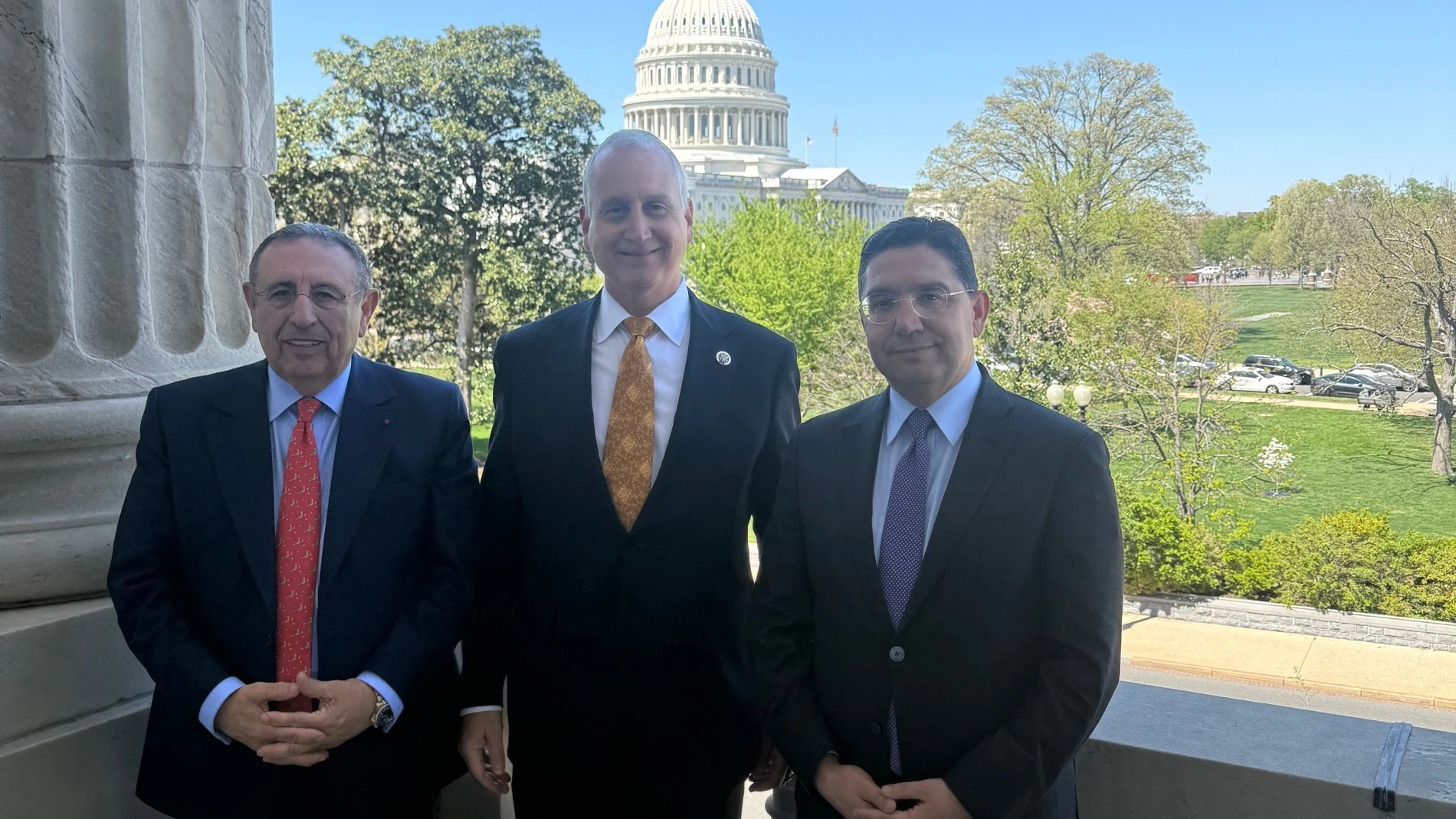
According to a document from the United States Department of Justice, received by the Foreign Agents Registration Unit, FARA, on February 28, 2013, at 12:53:48 pm, when Barack Obama was president of the United States, the company Western Hemisphere Strategies, LLC presented the documentation corresponding to its contractual relationship with the Moroccan American Center for Policy. Western Hemisphere Strategies was declaring the Moroccan American Center for Policy as its foreign principal and making public the agreement signed between the two on January 28, 2013.
And who signed this agreement? The first signatory was Fatima-Zohra Rachidi Kurtz, a relevant figure within the diplomatic, communication and influence network of Morocco in Washington. She had worked as a consultant for the Moroccan Ministry of Communication and was vice president of The Gabriel Company, a firm run by Edward Gabriel, former United States ambassador to Morocco. He is listed in the document as Senior Vice President of Operations at the Moroccan American Center for Policy. The other signatory was Lincoln Díaz-Balart, (EPD), managing member and owner of Western Hemisphere Strategies, LLC, a political, government relations and lobbying consultancy in Washington. Born in Cuba, Lincoln was a prominent Republican Party politician in Florida and a member of the United States House of Representatives until January 2011. His brother Mario Díaz-Balart had already been elected congressman in 2002 from a neighboring district. Both remained simultaneously in Congress for eight years, until Lincoln’s retirement.
Fatima-Zohra Kurtz was the one who, on behalf of the Moroccan American Center for Policy, an entity registered as an agent of Morocco, hired the firm of Lincoln Díaz-Balart to provide strategic advice and defend before Congress and the Executive Branch the strengthening of relations between Morocco and the United States. The hiring of Western Hemisphere Strategies, LLC to carry out these political advisory and lobbying tasks was agreed for the amount of $20,000 per month.
According to an article published by CBS Miami, Mario Díaz-Balart was a member of the Moroccan Caucus in Congress and had previously been one of its co-chairs. From his parliamentary position he had defended the interests of Morocco and publicly highlighted his ability to achieve an increase in funds allocated to the kingdom.
This relationship raises, at the very least, a clear appearance of a conflict of interest: while Lincoln Díaz-Balart was paid through his company to promote the interests of Morocco before the Congress and the Executive of the United States, his brother Mario served as a congressman, was part of the Moroccan caucus and supported policies favorable to that same country from Congress.
It is true that the contract contained a clause according to which Western Hemisphere Strategies would not engage in influence activities directly with Mario Díaz-Balart or his staff. Lincoln also later denied having lobbied his brother. However, this clause does not eliminate the obvious appearance of a conflict of interest produced by the coincidence between the family business and the congressman’s political activity.
The contractual relationship between Western Hemisphere Strategies and the Moroccan American Center for Policy officially ended in November 2017, although the last documented payment occurred in June of that year. For almost five years, Lincoln Díaz-Balart’s firm received approximately $1.2 million for its services to Morocco. However, Mario Díaz-Balart’s political alignment with Moroccan positions continued in subsequent years.
In April 2025, the congressman met in Washington with Nasser Bourita, Minister of Foreign Affairs of Morocco, and Youssef Amrani, Moroccan ambassador to the United States. After the meeting, Díaz-Balart publicly supported Rabat’s positions on Western Sahara and described Morocco as an essential ally and partner of the United States.
A year later, from his position as president of the Subcommittee on Homeland Security, Department of State and Related Programs, Díaz-Balart presented from the Appropriations Committee the official report that incorporated the Moroccan narrative on Ceuta and Melilla.
It is no secret to anyone that Congressman Mario Díaz-Balart has been publicly defending Rabat’s position on Western Sahara, and here we could open a broad debate on whether the Sahara should be established as a free and independent State or be part of Morocco. But that is not the central question of this article.
The point is that the congressman, I don’t know if intentionally or under the influence of the Moroccan lobby, has incorporated into an official Congressional document a statement that has added gasoline to the fire. That statement constitutes, in my opinion, an act of political complicity and an attack against a NATO member.
It also represents a sample of complete political and historical illiteracy. A simple historical consultation would have shown that Melilla has been Spanish since 1497.
Imagine that a Mexican lobby began to influence the Congress of Deputies, the Spanish Senate and the European institutions with the aim of claiming Texas and California, former territories of New Spain that later became part of Mexico and finally became territories of the United States.
This imaginary lobby would begin to frontally attack the doctrine of perpetual Union established by Abraham Lincoln in his First Inaugural Address, when he maintained that “the Union of these States is perpetual” and that “no State, on its own initiative, can legally leave the Union.” Lincoln was even clearer when he stated that “the central idea of secession is the essence of anarchy.”
This political and constitutional doctrine was later consolidated by the Supreme Court of the United States in the case Texas v. White, of 1869, where the idea of ”an indestructible Union, composed of indestructible states” was established.
I am sure that the congressman does not want to attack those fundamental pillars of the American Union, the legacy of Abraham Lincoln and the Republican Party.
However, the report presented by Díaz-Balart states that Ceuta and Melilla are cities “administered by Spain” that are located in “Moroccan territory.” We are not facing an impartial description, but rather a literal reproduction of the territorial narrative of Rabat.
This reckless action has fueled the Moroccan imperial dream of the so-called “Greater Morocco”, which not only includes Ceuta and Melilla, but also the Canary Islands. This is totally unacceptable, because we are talking about territories belonging to Spain, a member of the European Union and NATO.
The position of President Donald Trump and the State Department has been clear: “The United States stands with the people of Spain, and all Europeans, in the face of this flagrant violation of their sovereignty and human rights.”
We could criticize President Donald Trump for many reasons and, as the saying goes, “create fame and go to sleep.” However, in this case his position and that of the State Department have been clear. Because it is one thing to support the Moroccan proposal for Western Sahara and quite another to legitimize territorial claims over Ceuta, Melilla and the Canary Islands. Confusing both issues is an extremely serious political and diplomatic irresponsibility.
The current crisis also cannot be attributed solely to Washington, and the actions of a Miami political family. It is the result of years of weakness, contradictions and concessions of Spanish diplomacy towards Morocco, with different governments. Spain has allowed Rabat to repeatedly use border pressure as a political instrument, without responding with a constant and firm national strategy.
In short, it all boils down to the operations of a prominent political family in South Florida, in which economic interests and legislative actions favorable to Morocco converged. One of the brothers charged approximately 1.2 million dollars for lobbying for that country, while Mario Díaz-Balart ended up presenting an official report that faithfully reproduces the territorial narrative of Morocco against Spain.
Without stopping to consider that he was politically attacking a NATO partner, and that the president of the United States, despite his very great differences with the current Spanish Government, unquestionably considers Spain as an ally.
The statement of disagreement does not represent the official position of the USA or the State Department. It is the opinion of Mario Díaz-Balart embedded in a budget report. And, as we Cubans say, “one stick doesn’t make a mountain”: its subcommittee allocates funds, not sovereignties, or borders.
I do not affirm that there is proof of illegal coordination between both brothers. But the appearance of a conflict of interest is evident and the political consequences are also evident.
Ceuta, Melilla and the Canary Islands are not Moroccan territories administered by Spain. They are Spain. And no US congressman should use an official document to give legitimacy to the expansionist claims of a third country against an ally of the United States, and in open contradiction with the position expressed by the State Department and by the Presidency of the United States itself.
Sayde Chaling-Chong García He is president of the Ibero-American and European Association Against Communism (AIECC)