
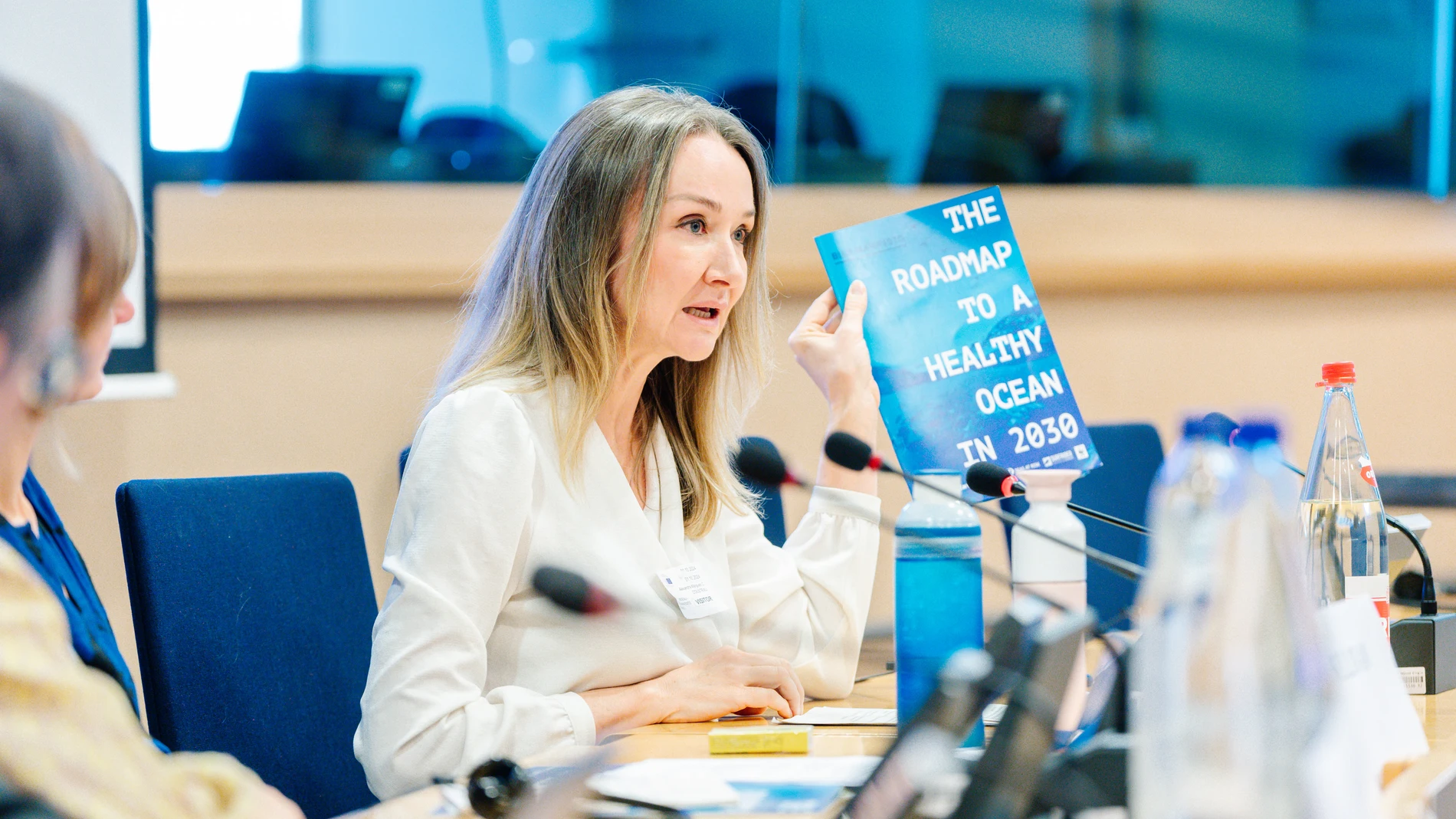
At a time when the protection of the oceans has become one of the great global environmental challenges, Alexandra Cousteau, granddaughter of the legendary French explorer Jacques Cousteau, has established herself as one of the most influential voices in the defense of the marine environment. Senior advisor at Oceana, the largest international organization dedicated exclusively to ocean conservation, Alexandra visited Spain and analyzed the challenges of conservation.
What is the biggest challenge to protecting the oceans?
The biggest challenge is political will. There is a lot we have to do about fishing, about protecting habitats, about pollution, and, especially in Europe, a lot of that goes through the political process. We started the campaign to extend the marine park in Cabrera (Mallorca) in 2013 and achieved it in 2019, but there is still no management plan to implement this protection. There is still industrial fishing. It has been more than 13 years and that is a lack of political will with a process that continues to be delayed. In Europe, and in Spain, there is a real need for our politicians to understand that protecting and restoring the ocean does not harm tourism, the economy, food security or freedoms. On the contrary, it protects and helps rebuild them. We can have more tourism, more fishing, more resources generated by a healthy ocean, but not by an ocean that is dying.
What is needed for this protection to come off paper?
In Cabrera, the political will to establish a management plan is lacking. There we have already done all the work, we know what fish are and where we have to put the boundaries of the park. This not only happens in Cabrera, but there are other marine protected areas in Spain that are in the same situation. The Mediterranean, in general, is the most overexploited, the most polluted. There are more acute challenges there than in other places and I think the equation remains the same: We need to very urgently reduce pollution and that is challenging because there are many different countries around the Mediterranean. By its nature this sea is closed and is warming rapidly, but we must ensure that it does not end up being a dead sea, precisely because it is a sea we love. Spain is moving towards a goal of protecting 30% of its waters by 2030, but less than 1% has strict protection.
Why is it necessary to take that step?
Protected areas are important because they create spaces where fish can rebuild their populations. Even fishermen will say, if they are honest, that legal fishing around a protected area is some of the best fishing possible. These protected areas become a source of life and help increase fishing resources and the possibilities for fishermen and local communities to benefit from it. Additionally, they increase resilience to climate change because more fish make the ocean more resilient and create more prosperity for the local economy. Spain loves the ocean, the artisanal fishermen loved my grandfather and even the history of Spain is based on the exploration of the oceans and fishing. There is a great culture and cuisine built around an abundant ocean. Letting your oceans die does not serve the people or the economy, tourism and culture. That is inexplicable, it is a lack of political will. Jacques Cousteau’s link with Spain is undeniable, his work left traces.
Is “bottom trawling” (industrial fishing) still one of the biggest threats to marine ecosystems?
Bottom trawling basically destroys everything in its path. David Attenborough’s recent documentary has unprecedented footage of bottom trawling. The ruined lives of so many different species in their destroyed habitats. On social media, people were shocked by the images, as the scale and extent of the damage was never understood, because no one wanted that practice, but we also did nothing to prevent it. This is one of the great campaigns that Oceana is doing. The Ranger Oceana (research catamaran) has been in the Mediterranean exploring, recording and searching for these habitats where there are essential species, such as deep sea corals.