
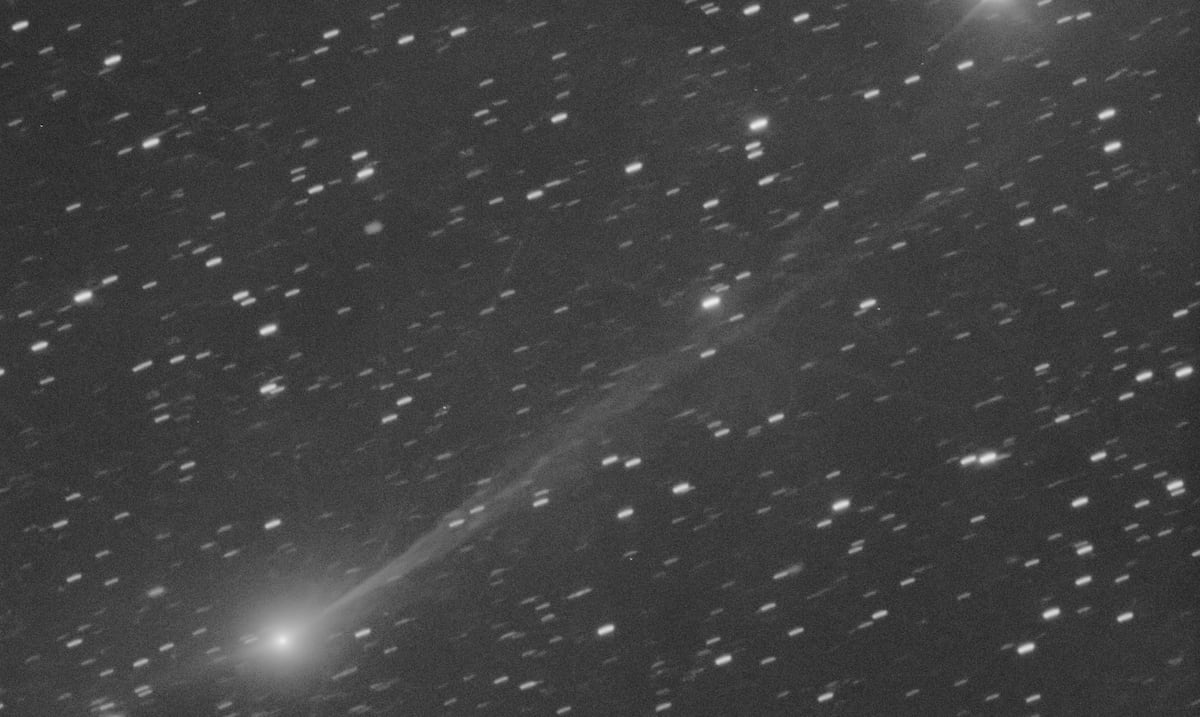
The POT revealed on Wednesday detailed images of the interstellar comet that is making a rapid and unrepeatable journey through the solar system.
Discovered a few months ago, the comet known as 3I/Atlas is only the third confirmed object to visit our corner of the cosmos from another star. It passed harmlessly near Mars last month.
Three NASA spacecraft on or near the Red Planet took close-ups of the comet as it passed just 18 million miles away, revealing a blurry white spot. The two European Space Agency satellites around Mars also made observations.
Other NASA space probes will remain vigilant in the coming weeks, including the Webb space telescope. At the same time, astronomers are pointing their ground-based telescopes in the direction of the comet, which is currently about 190 million miles from Earth. Gianluca Masi of the Virtual Telescope Project zoomed in on Wednesday from Italy.
The comet can be seen from Land before dawn using binoculars or a telescope.
“Everyone who has control of a telescope wants to observe it because it is a fascinating and rare opportunity,” said Shawn Domagal-Goldman, NASA’s acting director of astrophysics.
1 / 10 | NASA reveals stunning images from the James Webb Space Telescope. The James Webb Space Telescope has produced the sharpest and deepest infrared image of the distant universe. It is known as “Webb’s First Deep Field.” – NASA, ESA, CSA, STScI
The closest the comet will get to Earth will be 167 million miles, in mid-December. Then it will head back into interstellar space, never to return.
The Juice spaceship European Space Agencywhich is headed toward Jupiter, has been focusing its cameras and scientific instruments on the comet all month, especially after it made its closest pass to the Sun. But scientists won’t receive any of these observations until February, because Juice’s main antenna is serving as a heat shield as it passes close to the Sun, limiting data delivery.
Named for the telescope in Chile that first sighted it, the comet is believed to be between 1,444 feet in size and 3.5 miles wide. Observations indicate that the exceptionally fast comet may have originated in a star system older than our own, “which gives me goosebumps thinking about it,” said NASA scientist Tom Statler.
“That means that 3I/Atlas is not just a window to another solar system, it is a window to the deep past and so deep into the past that it even predates the formation of our Earth and our Sun,” Statler told reporters.
NASA officials quickly debunked rumors that this friendly visitor to the solar system, as they called it, could be an alien craft of some kind. They said that because of the federal government shutdown, they were unable to respond to all the theories that had emerged in recent weeks.
The space agency is always searching for life beyond Earth, “but 3I/Atlas is a comet,” said Amit Kshatriya, NASA associate administrator.