
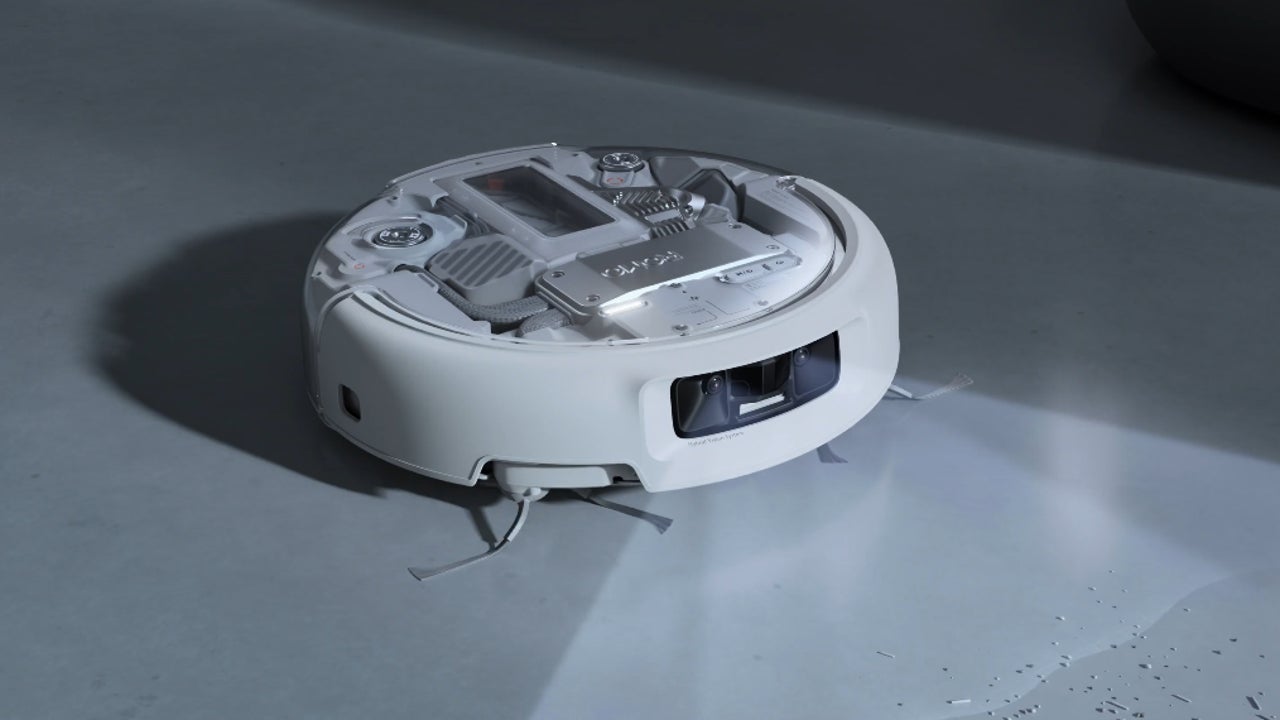
DJI has done two things to kick the (overcrowded) board of robot vacuum cleaners. The first of them was to think about its design like mobile phone manufacturers do. If we had to define the DJI Romo, would be what the Star Wars designers would have created thinking of a robot vacuum cleaner: defined lines, and transparencies that show the interior.
DJI’s second measure was to take advantage of the advances that they master in their drones (optical sensors, LiDAR, navigation algorithms, machine learning) and apply them to the Romo. In fact, on its official website it is described like this: “combines cutting-edge electromechanical and perception technology inspired by flagship drones” and they are not going wrong.
In this way, visually, the Romo can become an object that arouses curiosity without sacrificing performance. Thanks to its system of advanced detection (read optical sensors and wide-range LiDAR technology)plus a judicious use of artificial intelligence, can avoid obstacles (something as small as a cable and even a playing card), detect areas that require deeper cleaning and carry it out with insistence.
Point in favor that Complete cleaning of the robot and full charging of its battery can be carried out in two and a half hoursa time similar to that spent operating. High-pressure water jets and a waste washing and suction system have been placed at the base, designed for up to 200 days without maintenance… which does not mean that the bag does not have to be changed or the water load checked.
The navigation system is based on the planning algorithms that DJI uses for its drones and offers “minimal stopping, approaching edges and corners, avoiding jams.” In a nutshell: The manufacturer has spent about 10 years developing drones that master three dimensions, It is logical that the move to two dimensions ends up being a success.
TO What stands out about this Romo is its silence: it is capable of canceling up to 80% of the noise in vacuum mode.. And it shows, or rather the opposite: it is easy for your floor cleaning routine to go unnoticed. Taking into account that it has a suction capacity of up to 20 liters of air per second, this silence is somewhat complex to achieve.
The use of AI also avoids cross contamination: knows in which order to clean so as not to carry dirt to new rooms and also makes good use of the rollers to avoid clogging due to hair and dirt. Does it work with pets? Yes, both on floors and carpets. The extra compartment for deodorizing liquid is a detail to imitate.
But not everything is “rosy”. With all these features, It is logical that its price is not low: we are talking about investing from 1,200 euros. Because yes, it is an investment, one that can last for years and that we will use at least three or four times a week. To this we must add that, although the technology is of a high level, with so many elements (brushes, mops, suction base, cleaning liquids) it will be important to look at the medium-long term cost, as well as the reliability of the self-cleaning system.
What is really interesting is how DJI has brought a perception architecture that was previously exclusive to its drones to the home environment. For example, the claim that ROMO “detects ultra-thin objects… even playing cards or charging cables just 2mm thick,” means that “airborne” obstacle avoidance and autonomous navigation technology is now being applied to the home environment.
This poses a paradigm shift: Not just another robot vacuum cleaner, but an attempt to redefine what robotic cleaning can do when it incorporates sensors, mapping and learning typical of the high-end drone sector.
Verdict
If you’re looking for a premium robot vacuum cleaner, with cutting-edge technology, and you’re willing to pay for it, DJI’s ROMO is a very attractive proposition: powerful, intelligent, aesthetically well-designed, and backed by a strong brand.