
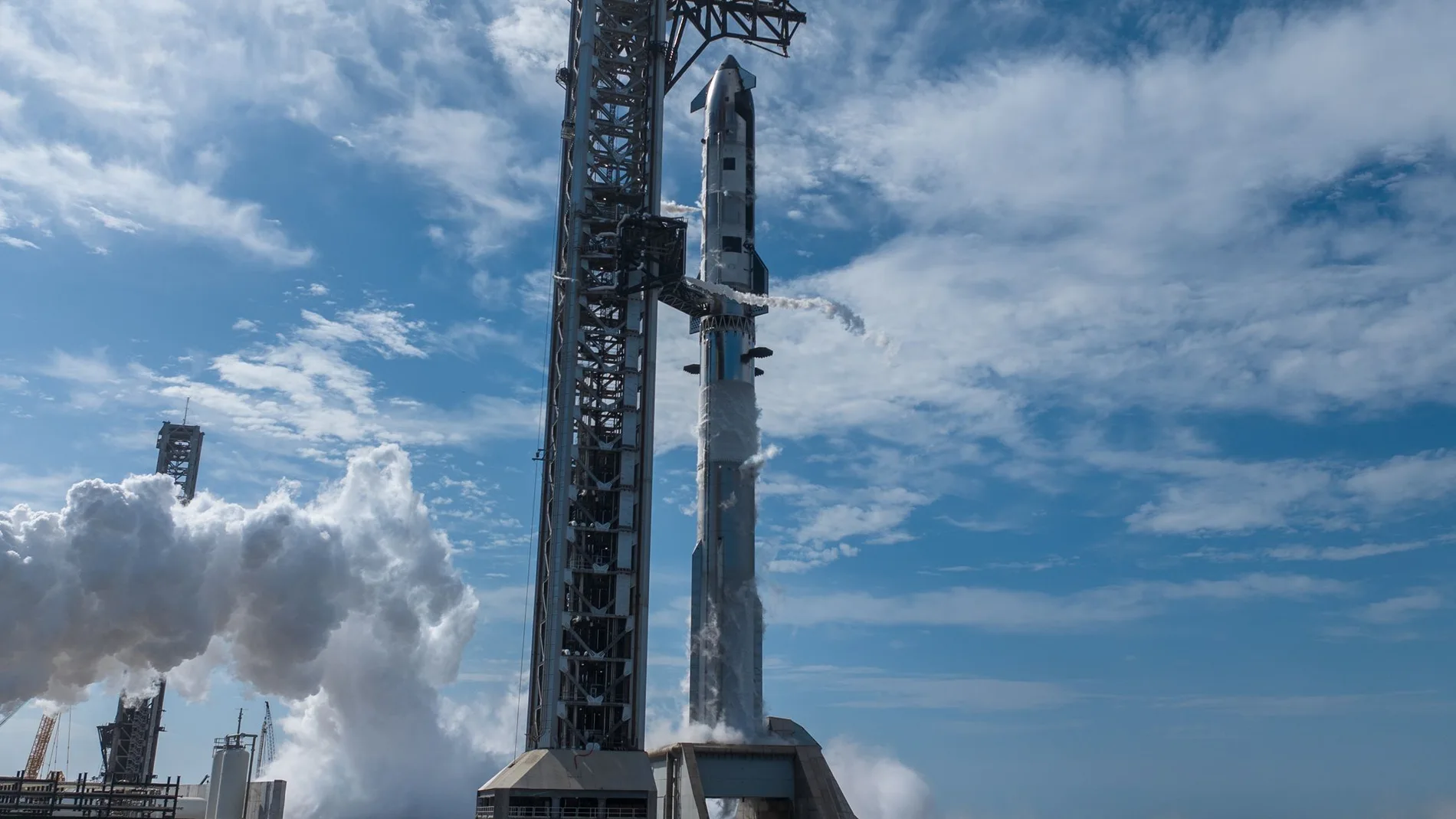
More than seven months after his last flight, SpaceX throw again Starship. The gigantic rocket, for the first time in its V3 versioneven larger than V2, with 124 meters high and numerous improvements added, is scheduled for release. 12th test flight this Thursday, May 21, which in Spain will already be the first hours of May 22.
The launch window will open at 00:30, Spanish peninsular timenext Friday and will last 90 minutes, until 02:00 hours. The launch, originally scheduled for Tuesday the 19th, but delayed without SpaceX commenting on the reasons, can occur at any time during that interval. The mission, called Flight 12, will take off from the test center starbase of SpaceX, south of Texas.
While five Starship flights occurred in 2025, the Flight 12 mission will be the first of 2026. SpaceX has a lot at stake in this Starship V3 flight test. The POT has chosen Starship to take astronauts to the Moon Artemis IV in 2028, but SpaceX has yet to send a Starship into a full orbit around Earth since testing began in 2023, let alone fly a vehicle capable of carrying a crew, refueling in orbit, docking with a capsule Orion in orbit or land on the lunar surface. Starship V3 should be the basis of that vehicle.
Where to watch the Starship V3 launch
The launch can be seen online, for which there are several alternatives. The first will be SpaceX, which will begin the broadcast 45 minutes before the start of the launch window, at 11:45 p.m. on Thursday, May 21. It can be followed both through its website and through X.
If you want to join the event before, you can do so from 21:30Spanish peninsular time, on Thursday the 21st on YouTube through the channel NASASpaceflight. It’s the window embedded below, so you’ll also be able to see it from this page.
NASASpaceflight has cameras throughout the Starbase facility and will provide live commentary during pre-flight activities and the first images of the Starship and Super Heavy vehicles before launch.
What will Flight 12 be like?
Flight 12 will last just over an hour and will follow a flight profile similar to that of its last mission, Flight 11. But, as mentioned, Flight 12 will test the new version 3 of Starship, so the mission will demonstrate a series of improvements of the reusable launch system.
‘The main objective of the flight test will be to demonstrate for the first time each of these new parts in the flight environment, with major redesigns into every element of the Starship architecture to enable complete and rapid reuse that incorporates what has been learned during years of development and testing,’ says SpaceX in a summary of the mission.
This mission will mark the first Starship launch from SpaceX’s pad 2 at Starbase, which has been upgraded with shorter and faster capture arms for smoother recovery of future Super Heavy boosters and Starship upper stages. Super Heavy has also been modified to remove one of its four grille finsused for control during reentry and landing, although the remaining three are now larger.
On this occasion, SpaceX will not attempt to capture the Super Heavy booster nor recover the Starship upper stage. ‘As this is the first flight test of a significantly redesigned vehicle, the booster will not attempt to return to the launch site to be captured,’ the company explains.
Instead, Super Heavy will return to Earth to perform a splashdown off the coast of Starbase, in the Gulf of Mexico. The upper stage, Starship, will continue on a suborbital trajectory that will take it around the world until a landing area in the Indian Ocean.
Starship will deploy 22 simulated Starlink satellitesa significant increase over the eight or ten simulated payloads from previous flights. Two of those simulated Starlinks carry cameras.
‘The last two satellites deployed will scan Starship’s heat shield and transmit images to operators to test analysis methods for Starship’s heat shield readiness for return to the launch site on future missions,’ writes SpaceX. The 22 simulated Starlinks will burn up upon re-entry into Earth’s atmosphere.
SpaceX has removed a tile from the heat shield to test the aerodynamic stresses on nearby tiles when a gap exists. The company will also try to imitate during reentry the stresses that Starship will endure in a return to the launch and landing site.
‘Finally, the ship will perform experimental actions tested on previous flights‘, including a movement to intentionally stress the structural limits of the vehicle’s tail fins and a dynamic roll maneuver to mimic the trajectory that future missions will follow returning to Starbase,’ SpaceX states.