
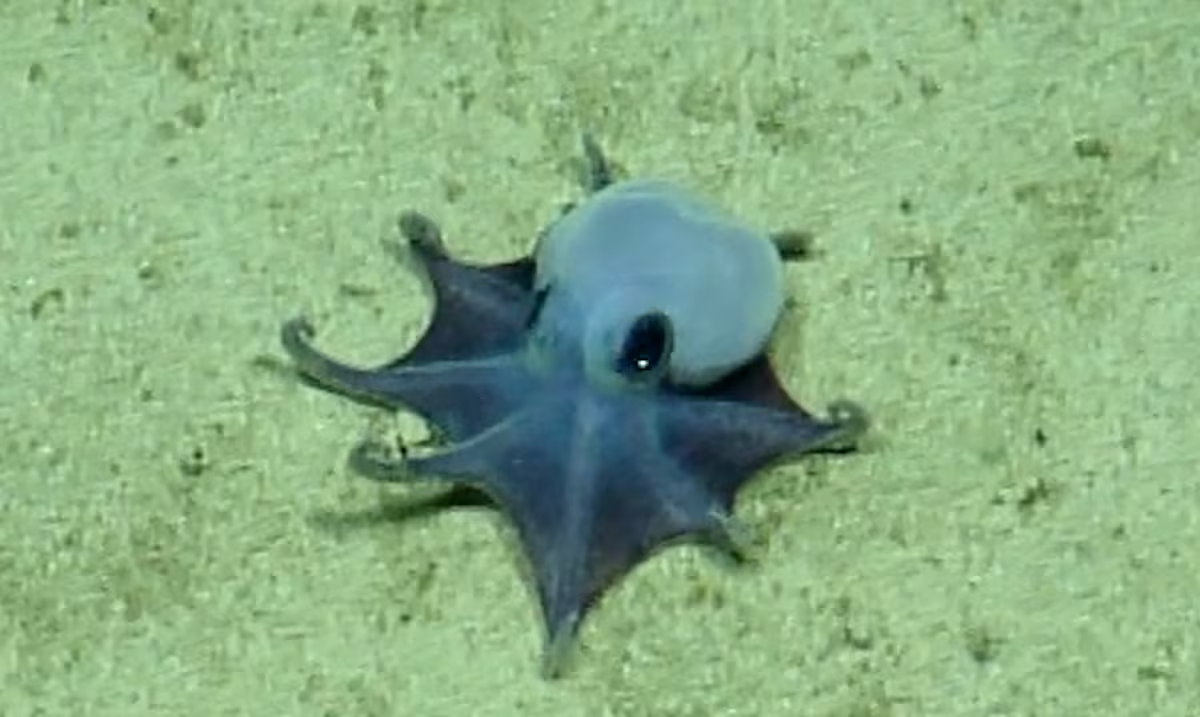
Scientists revealed this Monday the discovery of a new species of small blue octopus in the Galapagos archipelago, located about 1,000 kilometers from the Ecuadorian continental coasts and a World Natural Heritage Site since 1978.
The octopus was sighted for the first time during a deep-sea expedition in 2015 carried out aboard the E/V Nautilus, in collaboration with the Charles Darwin Foundation (CDF) and the Galapagos National Park Directorate.
From the ship, the crew used a remotely operated underwater robot (ROV) to explore the ocean floor near Darwin Island, at the northern end of the archipelago. As the ROV camera moved over the seafloor near an underwater mountain, 5,840 feet below the water’s surface, the researchers noticed an octopus.
Using the ROV, the crew collected the octopus and brought it to the Charles Darwin Research Station along with other deep-sea specimens collected during the expedition.
As CDF researchers sorted the collected specimens, the small blue octopus, about the size of a golf ball, stood out. Unsure of which species it belonged to, they contacted octopus expert Janet Voight and sent her a photo of the animal.
“I immediately knew it was something really special,” said Voight, curator emeritus of invertebrates at the Field Museum in Chicago and lead author of the study describing the new species. “I’ve never seen anything like it.”
The research team at the Galapagos Research Station preserved the octopus’s body in alcohol and formalin, and sent the specimen to Chicago for Voight to examine, the CDF revealed Monday.
CT scan
The octopus was truly one of a kind, which posed a challenge to scientific research.
“When you describe a new species of octopus, you have to look at all the parts, including the mouth, the beak and the teeth. And to see those things, you have to open the specimen. We only had one specimen, so I didn’t want to take it apart,” Voight said.
So he worked with Stephanie Smith, the manager of the Field Museum’s X-ray computed tomography (CT) lab, to create scans of the octopus, the CDF said in a statement.
With tomographic imaging, thousands of tomographic slices of an object are digitally compiled to create a 3D model of the object, inside and out. Thus, they can reveal what is inside an object without having to open it.
In the case of the little blue octopus, researchers were able to see fine details of its internal organs, including its mouth, which provided the information needed to declare it a new species to science and suggest where it fits among other octopods.
“These are small octopuses that live in the deep ocean, and almost no one on Earth has been able to see them,” Voight noted of the new species, Microeledone galapagensis.
Discoveries like these “remind us how much of the deep ocean in the Galapagos remains unexplored. Each new species helps us better understand these hidden ecosystems and why it is important to protect them,” said Salome Buglass, a marine scientist at the University of California, former CDF researcher and co-author of the octopus paper.
The Galapagos archipelago is considered, due to its high biodiversity, a natural laboratory that inspired the British scientist Charles Darwin to develop his theory of evolution and natural selection of species in the 19th century.