
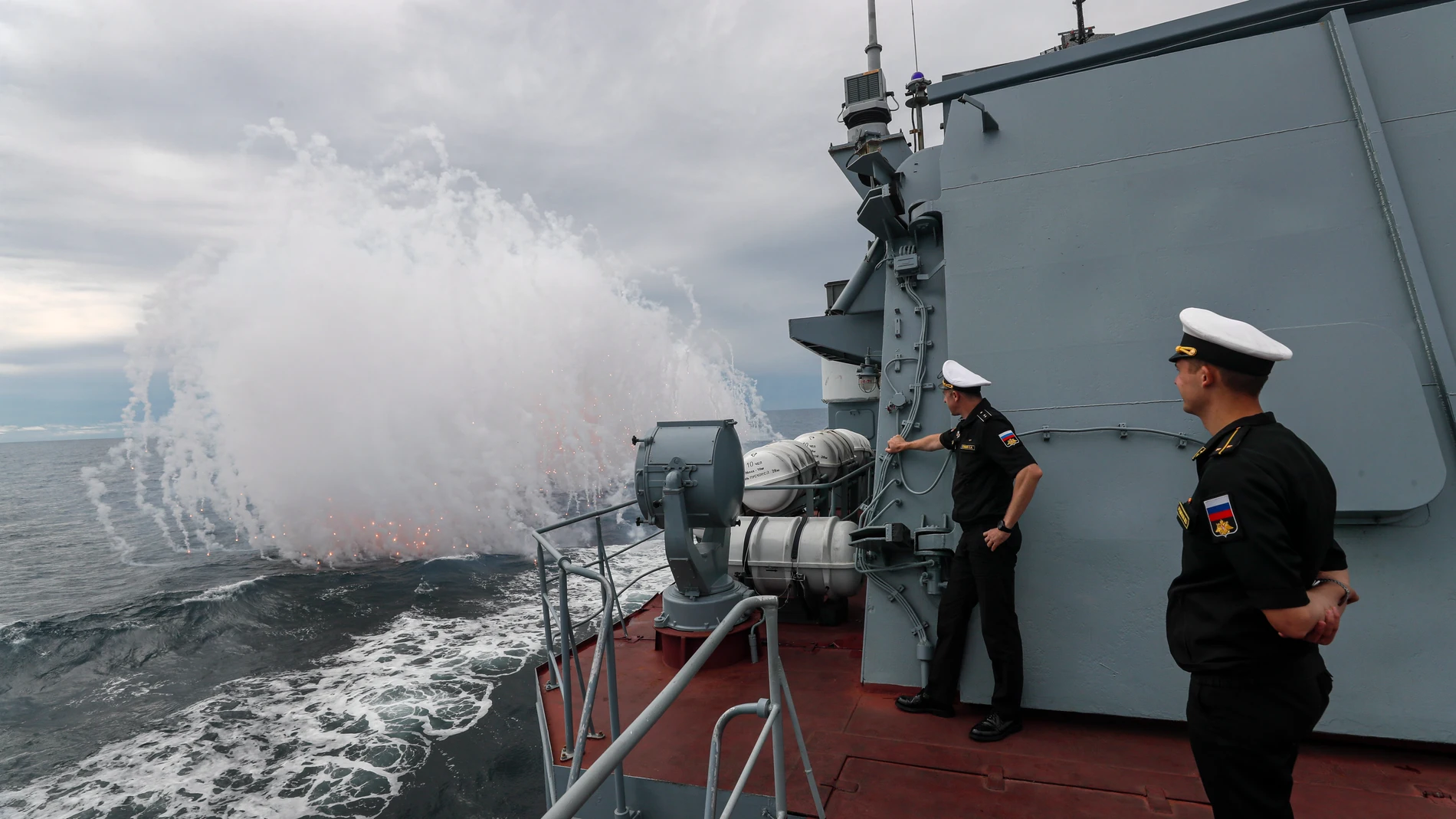
Russia has just begun one of its largest nuclear exercises in recent years, a three-day operation that involves nuclear submarines, strategic bombers, ballistic missiles and tens of thousands of troops distributed between land, sea and air. According to the Russian Ministry of Defense, the objective is test the response capacity of its nuclear forces “in the face of a threat of aggression.”
But beyond the official language, the deployment has an inevitably geopolitical dimension. The figures help to understand the magnitude of the exercise. According to official agencies, some 64,000 military personnel, more than 200 missile launchers, 140 aircraft, 73 warships and 13 submarines, including several equipped with nuclear ballistic missiles.
Among the key areas is the Barents Sea, in the Arctic, where the Russian Northern Fleet operates some of its most important nuclear submarines. Certain areas of this region have been temporarily closed to shipping to allow test launches of ballistic and cruise missiles.
In practice, these maneuvers function as a partial simulation of what Russia calls “strategic nuclear force readiness”: the ability to move, protect, coordinate and eventually launch nuclear weapons. from multiple platforms simultaneously. And that’s where submarines play a central role.
Since the beginning of the Cold War, nuclear submarines have been considered one of the most important pieces of the so-called “nuclear triad”: land-launched missiles, strategic bombers, and submarines capable of firing nuclear weapons from the ocean. The logic is simple: a missile silo can be located, the same goes for an air base, But a submarine submerged under miles of icy water can remain hidden for weeks or months. That makes it a kind of “retaliation insurance”: even if a country suffered a devastating attack, it would still retain the ability to respond.
For this reason, many experts consider nuclear submarines to be the most deterrent element in the modern atomic arsenal. Russia has some of the largest strategic submarines in the world, including those of the Borei classcapable of carrying intercontinental ballistic missiles with multiple nuclear warheads. Each of those missiles can attack separate targets thousands of miles away.
The maneuvers come at a particularly delicate time. The war in Ukraine continues to generate friction between Moscow and NATOwhile drone attacks on Russian territory and cross warnings between both blocks increase. In parallel, Belarus (a close ally of Russia) has also carried out exercises related to tactical nuclear weapons, including training to move and deploy this type of weaponry.
All of this occurs precisely after Russia recently modified some aspects of its nuclear doctrine, expanding the scenarios in which it could consider the use of atomic weapons. And this can be contradictory.
Nuclear weapons were created never to be used. Its true function is not military, but psychological: to convince the adversary that an attack would have unacceptable consequences. That’s why The great powers continue to carry out maneuvers of this type more than eighty years after Hiroshima. Not because they expect an immediate nuclear war, but because they believe that showing preparation reduces the possibility of one occurring.
The problem is that this balance depends on something extremely fragile: that no one misinterprets the signals. AND The more complex and frequent these exercises become, the finer the line between deterrence and escalation also becomes.