
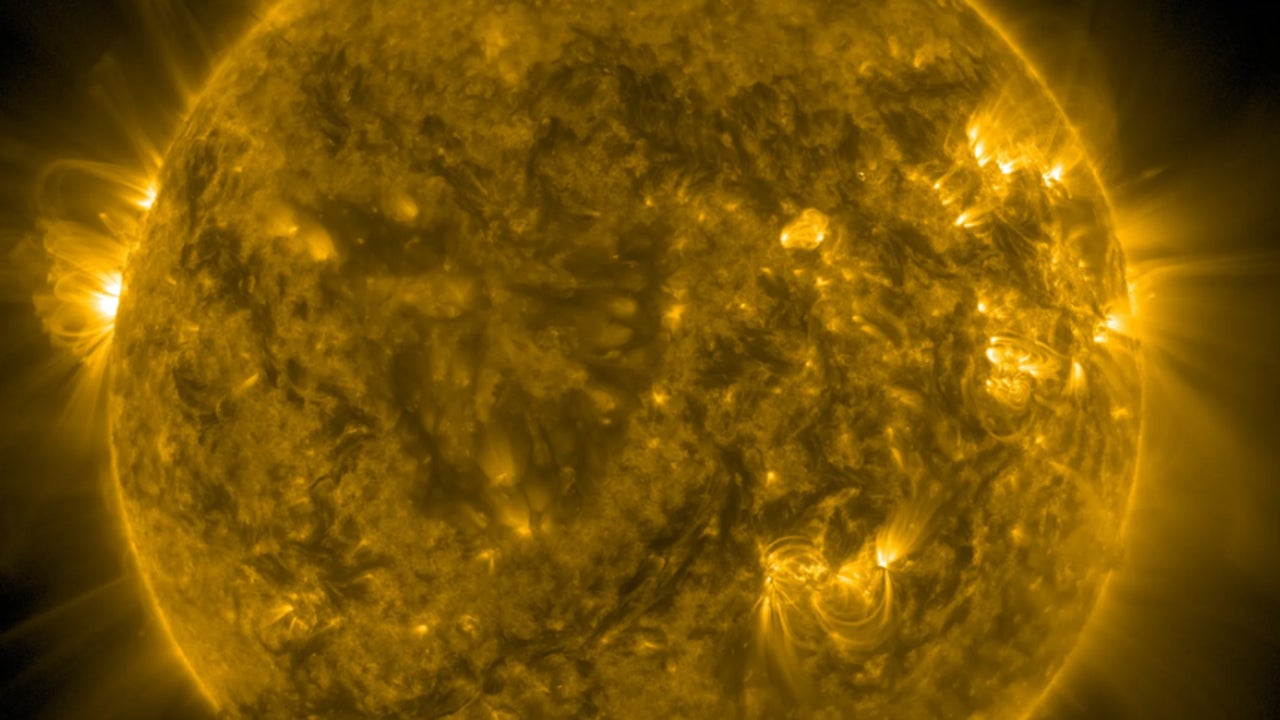
Minor fact, but scientifically proven: in Asturias, at least largely, it carries without raining (the rain of Asturias, not the Rácano drip or the untimely torrents of other lares) several months. The weather is changing. And now a new NASA study suggests that solar activity will remain high or increase even more in the coming decades, which contradicts the previous assumptions that the sun was calming down. And scientists “do not fully understand” why.
The studypublished in The Astrophysical Journal Lettershe warns that the sun could be “waking” after a brief period of relative inactivity, which contradicts previous assumptions about our star. If true, this could mean that decades of potentially dangerous climate await us. Both for The meteorology that affects our planet, as for the consequences it can bring in our satellites and communication systems the growing solar activity.
Until now, the sun followed a cycle of activity of approximately 11 years, which begins with a period of prolonged calm, known at least solar, and advances towards an explosive peak, known as Máximo Solar, when our star “shower” with solar storms. This pattern is known as the “cycle of sun spots”, since The number of dark spots on the solar surface increases and decreases with solar activity.
The cycle of sun spots, in turn, is governed by a longer cycle of 22 years, known as the Hale cycleduring which the solar magnetic field changes completely and then returns to its initial state.
But in addition to these two cycles, the sun also experiences long -term fluctuations in the solar activity that can cover several decades and are much more difficult to predict or explain. Some examples include periods between 1645 and 1715, known as the minimum of Maunder, and between 1790 and 1830, known as Dalton’s minimum, when the solar activity was generally much lower throughout successive cycles of sunscreen. In a nutshell, Of the thousands of sunscrew that are usually seen on the surface of our star, in those times there was just some. This caused an important decrease in temperatures on the planet.
But that is not what happens. The authors of the study, Marco Velli and Jamie M. Jasinski, both from the NASA jet propulsion laboratory, They analyzed multiple metrics of solar activity, such as the solar wind, the intensity of the magnetic field and the number of sun spots, and discovered that They have shown an ascending trend since approximately 2008 and could continue to increase in future cycles.
“Everything pointed to the sun would enter a prolonged phase of low activity – says Jasinski in A statement -. That’s why, It was a surprise to see that this trend was reversed. The sun is waking up slowly. “
Currently, we approach at the end of the most recent solarwhich officially began in early 2024, and has not turned out as expected.
When the current cycle of sun spots began at the end of 2019, experts from the Space Climate Prediction Center (SWPC), which includes NASA scientists and the Oceanic and Atmospheric National Administration (NOAA), They predicted that the solar maximum would probably begin at some point in 2025 and would be comparable to the previous, weaker cycle.
However, as the current cycle progressed, it became clear that this was not the case and that the solar maximum would arrive before and would be much more active than initially planned. SWPC scientists later recognized their mistake and They issued their first updated forecast, which arrived just in time for the arrival of the Máxima Solar.
Since then, the sun has reached Its largest number of sunscreen in more than 20 years And it has generated a record amount of powerful X -class eruptions, the most powerful type of explosion that the sun is capable of producing.
The new study warns that what we have witnessed in recent years will probably become the “status quo” in the coming decades. This could be especially problematic because we have become much more dependent on technologies prone to the interference of space climate, such as electrical networks, GPS controlled machinery and satellites in terrestrial orbit, than They can be demolished by solar storms.