
Under a global shadow of wars and bitter divisions, world leaders gather at the United Nations this week amid fresh fears that runaway artificial intelligence could threaten humanity, when climate impacts and rising prices are already making life much more difficult for hundreds of millions of people.
The annual high-level meeting at the UN General Assembly will also be marked by major wars in Iran, Gaza, Ukraine, Sudan, Congo and Myanmar, and by a persistent question: can leaders do anything to end them?
And what can they do in the face of the relentless rise of global warming that threatens the future of the planet, the growing inequalities within and between countries, and the shocks of the global economy, while blocked shipping routes and supply chains raise the cost of living and slow growth?
The future of the United Nations will also undoubtedly be on the agenda. At 81 years old, its powers are still the victorious nations of World War II, not the main global actors of the 21st century. The UN’s 193 member countries have agreed to a sweeping reform package that includes updating key institutions such as the powerful UN Security Council, where the United States, Russia, China, the United Kingdom and France wield disproportionate influence through their veto power. However, reform is easier said than implemented.
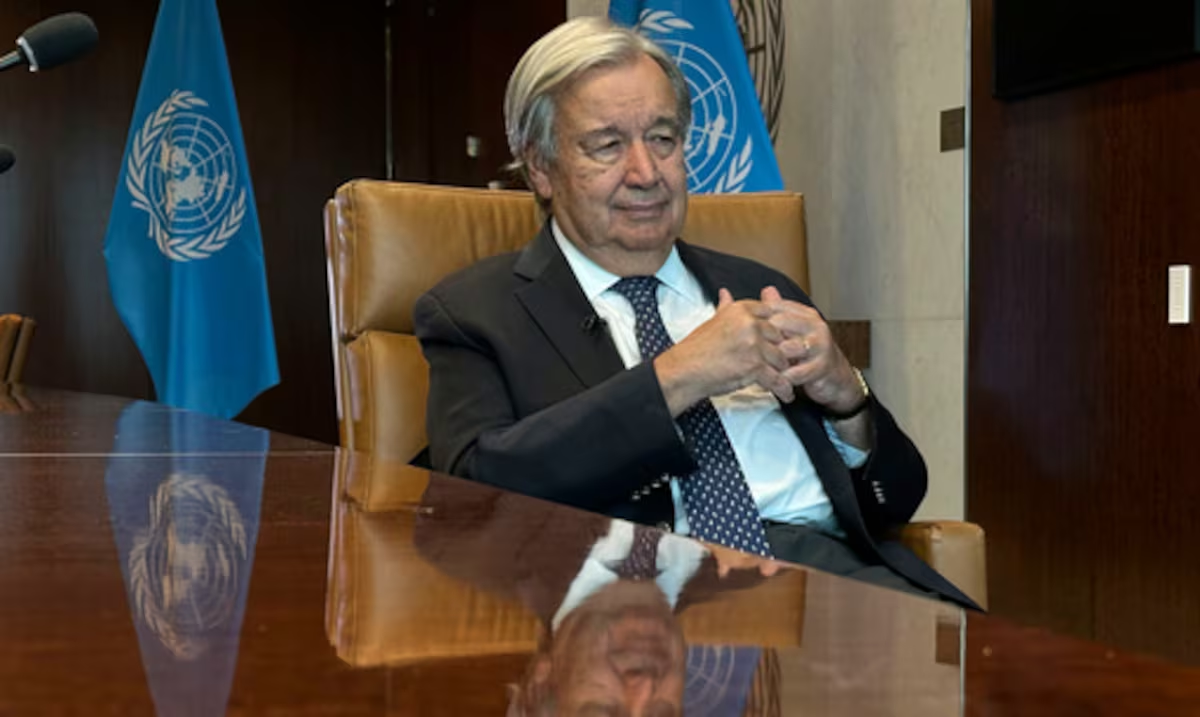
Behind the scenes, there will be speculation about who will lead the UN next. Secretary-General António Guterres’ second five-year term ends on December 31 and no clear successor has emerged.
This meeting remains crucial
There is no doubt that the UN remains the meeting place for its 193 member countries and their leaders. Some 130 heads of state and government are expected to speak before the General Assembly starting Tuesday, along with dozens of ministers.
1 / 13 | In images: the rubble of a school in Iran where 120 children died after a bombing. Colorful tree and flower decorations remain on the walls of a rubble-covered classroom at the Shajareh Tayyebeh school, damaged in a US airstrike on February 28, in Minab, southern Iran. – Vahid Salemi
Among the main figures will be the president of the United States, Donald Trump, and the president of France, Emmanuel Macron. The two will speak Tuesday after Guterres’ inaugural “state of the world” address. Ukrainian President Volodymyr Zelensky and Iranian President Masoud Pezeshkian will speak on Wednesday.
Israel’s Prime Minister Benjamin Netanyahu — whom New York Mayor Zohran Mamdani wanted to arrest over his treatment of Palestinians in Gaza until he learned he has no such authority — will address the assembly on Thursday. For the second year, Palestinian President Mahmoud Abbas will not attend the UN because the United States has refused to grant him a visa. Even so, he will address the assembly by video conference that same day.
The United States, under its agreement with the UN to host the organization, is required to allow diplomats from all member countries to attend meetings.
Equally revealing is the list of absentees. Chinese President Xi Jinping meets with Trump in Washington on Wednesday, but skips—according to some diplomats, spurns—the UN meeting and sends a vice president in his place. The president of Russia, Vladimir Putin, is also not attending, and the president of India, Narendra Modi, has withdrawn.
France’s ambassador to the UN, Jérôme Bonnafont, said it is “extremely critical” that world leaders this week support the UN as the place where the world’s nations meet, especially at a time of such polarization.
“We believe in multilateralism,” he said, “and we believe that the high-level week is the occasion for the countries of the world to reaffirm that they prefer cooperation and dialogue over confrontation.”
The United Nations has not had a great year
There is no doubt that it has been a difficult year for the world body. It has been left behind when it comes to its key responsibility of ensuring international peace and security and trying to end major conflicts in the Middle East and Ukraine. The failure of the United States to pay billions of dollars in outstanding arrears has left the organization’s finances in shaky condition.
But veteran UN observer Richard Gowan, director of the global affairs and institutions program at the International Crisis Group, argues that 2025 was even worse.
1 / 22 | 📷 This is how the planet burns: extreme heat and drought wreak havoc around the world. Extreme weather conditions have raised temperatures above 100 degrees Fahrenheit in several countries, triggering health alerts for millions of people. – Vadim Ghirda
A year ago, he explained, people were considering whether Trump would use his UN speech to announce that the United States would leave the world organization. Trump did not announce a withdrawal last September and the UN stumbled over the past 12 months with financial problems that forced cuts to its peacekeeping and humanitarian aid missions.
In recent days, the United States paid $725 million of its dues to the UN’s regular operating budget for this year, enough to prevent the Trump administration from losing its vote in the General Assembly. The payment was a strong signal that Trump will keep the United States in the United Nations.
The UN is no longer “in free fall,” Gowan noted, but “is trapped in an open or permanent crisis.” Put more graphically, he added: “The UN may not be in intensive care like last year, but it does appear to be stuck in a trauma center for the foreseeable future.”
Former UN Deputy Secretary-General Mark Malloch-Brown, a board member of the United Nations Foundation, noted that “although the world still trusts the UN, the global public is eager for change.”
AI makes its way to the center of the agenda
The future of artificial intelligence has come to the forefront of global concerns, with its accelerated advances and the dawning recognition that there are no industry controls, much less global safeguards, for a technology that has many advantages, but also many disadvantages and unknowns.
Days before the global meeting, leaders of three major AI companies warned about the possibility of the technology spiraling out of human control and called for a pause, but Trump dismissed their concerns as “a hoax” and urged continued progress to keep the United States ahead of China.
The UN Security Council added a high-level meeting on AI to its agenda for Wednesday afternoon, a sign of growing apprehension and the need to address the issue. He was already scheduled to hold a high-level meeting on Ukraine with Zelensky on Wednesday morning.
For the UN chief, this will be his last assembly meeting with world leaders. Last week he advanced his speech, telling UN reporters that power is shifting in “an era of profound uncertainty.”
“At a time when the world faces three existential threats,” he said, “international cooperation is more necessary than ever.”
Others will seek prominence on issues ranging from sea level rise and education funding to the fight for gender equality. Hundreds of private meetings will also be held in small UN rooms, hotels, diplomatic missions and restaurants.
Esther Brimmer, senior fellow in global governance at the Council on Foreign Relations and former U.S. undersecretary of state for international organization affairs in the Obama administration, said in-person meetings can help countries discuss ideas that are implemented months later.
He described the situation in 2026 as “much more serious and complex than in past decades.”
“That said, I’m not without hope either,” Brimmer noted. “In recent decades we have learned a lot about international cooperation.”
This story was translated from English by an AP editor with the help of a generative artificial intelligence tool.