
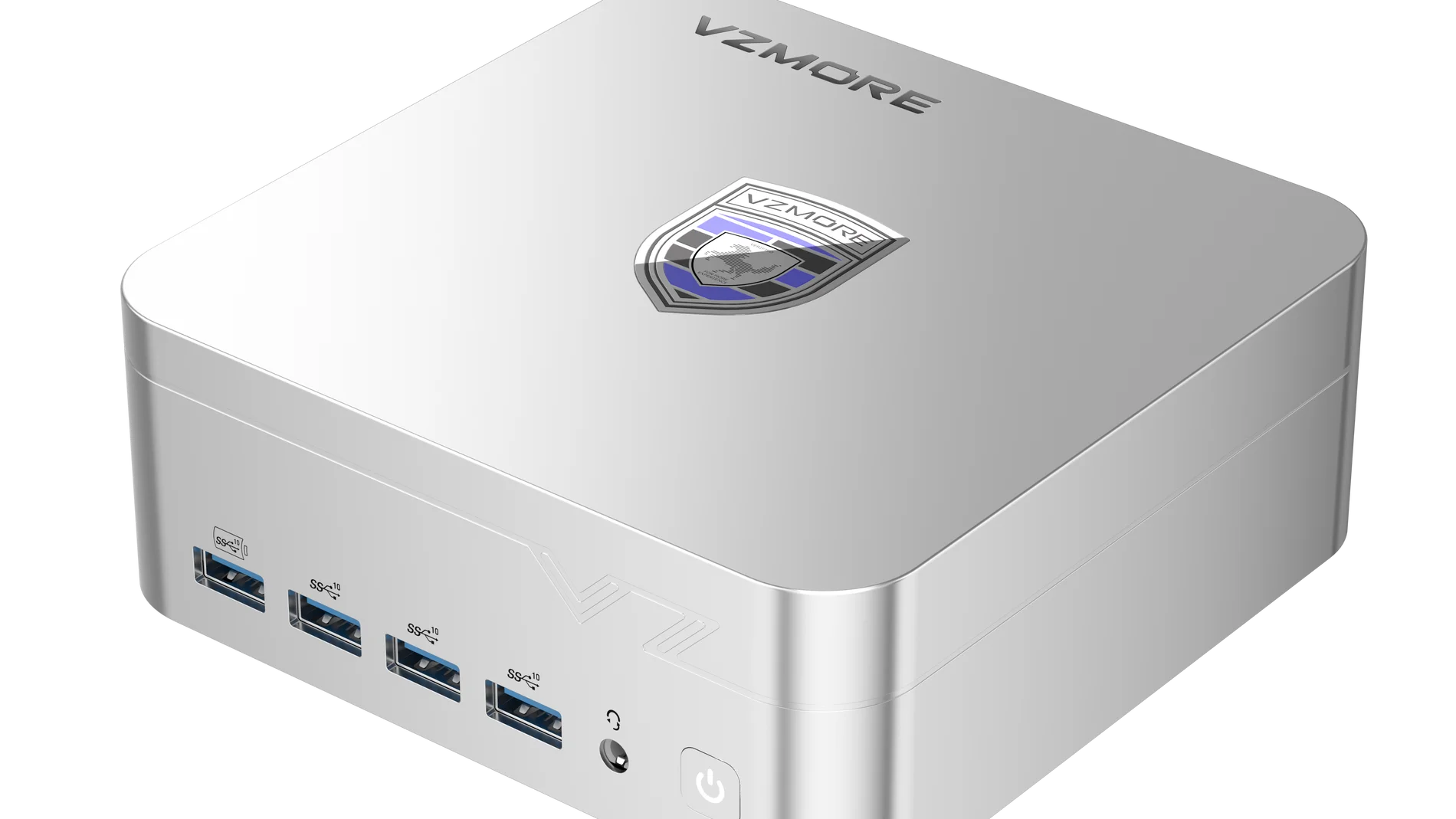
A few years ago, to have a powerful computer you had to make room for it under your desk. A tower, several fans and a good amount of space were the price you had to pay for having enough capacity to work, play or edit video. Mini PCs changed that equation. And now they are taking a step further: in addition to concentrating a lot of power in a very small space, they are beginning to incorporate hardware specifically designed to run artificial intelligence. It is the case VZMore AX9 Maxa computer measuring just 135 × 131.8 × 57.7 millimeters and 777.5 grams that uses as brain the AMD Ryzen AI 9 HX 470. Its size, like a travel notebook, is especially striking considering what is hidden inside.
The processor It has 12 cores and 24 threads, reaches a maximum frequency of 5.2 GHz and integrates a Radeon 890M GPU with 16 calculation units. But one of its most interesting features is not intended for running video games, but rather artificial intelligence algorithms: it incorporates an NPU capable of providing up to 55 TOPS. Adding CPU, GPU and NPU, AMD estimates the total AI processing capacity of the chip at up to 86 TOPS. In short: a computing beast.
The importance of these figures lies in the possibility of running certain artificial intelligence models directly on the computer, without depending on the Cloud, the Internet or any other source. VZMore points out that The AX9 Max can use models such as Qwen, DeepSeek, Gemma or Mistral through platforms such as LM Studio, Ollama or llama.cpp. Instead of necessarily sending data to a remote server, certain tasks can be performed locally. This can be especially interesting when working with private documents, databases or information that should not be removed from the computer.
This does not mean that a mini PC will replace large data centers that train the most advanced AI models. The idea is different: to transfer a part of those capabilities to the personal computer. Artificial intelligence is thus beginning to become a function integrated into the PC itself and not only a service that we access through the Internet.
The Radeon 890M also makes the AX9 Max more than just a machine for working with documents and office applications. It is an integrated GPU based on AMD graphics architecture and capable of managing up to four screens. It also has a video output of up to 8K, which enables it for gaming and content creation.
But packing so much power into a box less than six centimeters high poses an obvious problem: heat. To solve this, VZMore has developed a cooling system called V-Cooling, based on a large surface vapor chamber and a 360-degree air inlet system located at the bottom. The equipment offers three power profiles: 45 W in silent mode, 54 W in balanced mode and up to 65 W in performance mode.
There is an important nuance here. AMD specifies a configurable range of 15 to 54 W for the Ryzen AI 9 HX 470, while VZMore allows the system to reach 65 W. And, if this were not enough, The cooling system can keep the equipment around 38 dB under certain conditions, it is not imperceptible, but it is a very low sound range.
In memory and storage, the AX9 Max also offers room for expansion: it supports up to 256 GB of DDR5 memory in dual channel. For storage it has two PCIe 4.0 slots: one M.2 2280, which It comes standard with a 1 TB SSD and supports up to 4 TB, and another free M.2 2230, with a capacity of up to 1 TB. In total, VZMore includes up to 5 TB of storage. Connectivity is equally generous for a computer of these dimensions. It includes up to 8 USB ports, two HDMI, two Ethernet connections and a card reader. It also includes Windows 11 Pro and VESA support to place it behind a monitor.
Beyond its numbers, the interesting thing about this team is what it represents. The evolution of mini PCs is no longer just about getting more power in less space. Now it is also trying to ensure that capabilities that until recently seemed reserved for large servers can run directly on our desktop. The question is no longer how much computer fits under the table. Is how much computer we can get to disappear from it.