
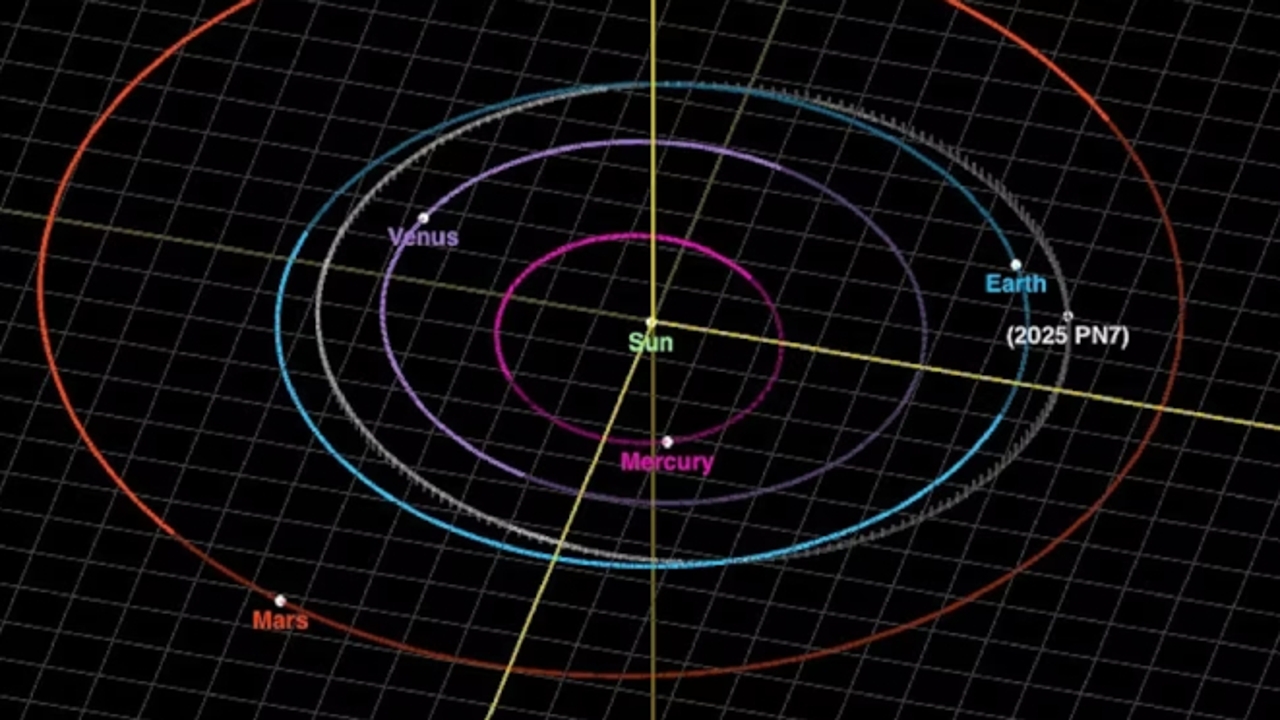
Astronomers have detected a quasi-moon near the Land which is likely to have been orbiting next to our planet, without being seen by telescopes, for about 60 yearsaccording to new research.
The celestial object, called 2025 PN7is a type of near-Earth asteroid that It orbits the Sun but remains close to our planet. A quasi-moon is not a real moon and does not actually orbit the Earth, but it sometimes appears that way for a period of time. The reason is that follows a trajectory very similar to that of Earth and it can accompany us for years and even decades, as in this case. Like Earth, 2025 PN7 takes a year to complete one orbit around the Sun.
Quasi-moons are also different from the temporary mini-moons that occasionally orbit the Earth, such as 2024 PT5which circled the planet for two months in 2024 and could be an ancient fragment detached from our Moon.
The newly found 2025 PN7 is just one of a handful of known quasi-moons with orbits close to our planet, including Kamoʻoalewawhich is also believed to be an ancient lunar fragment. Kamoʻoalewa is one of the mission destinations Tianwen-2 from China, launched in May, which aims to collect and bring samples of that space rock to Earth in 2027. Currently, there are seven quasi-satellites known near Earth, according to European Space Agency.
This new quasi-moon was detected by the observatory Pan-STARRSlocated on the Haleakala volcano, in Hawaii, the August 29. Archival data revealed that the object has been in an Earth-like orbit since the 1960s.
Carlos de la Fuente Marcos, co-author of the study and researcher at the Faculty of Mathematical Sciences of the Complutense University of Madrid, explained that the quasi-moon managed to go unnoticed by astronomers for so long because it is small and dimcollects CNN, and invisible to conventional telescopes.
The space rock is approaching 299,337 kilometers during its closest passage to our planet. According to NASA 2025 PN7, on average, is located 384,400 kilometers of the Earth.
A temporary companion
Astronomers are still trying to determine the size of 2025 PN7. According to Fuente Marcos, it could have 30 meters in diameterwhich would make it the smallest quasi-moon that has orbited close to the Earth that is known.
Over time, 2025 PN7 alternates between an orbit closer and almost circular, similar to that of the Earth, and an orbit in horseshoesimilar to that of Kamoʻoalewa. During the horseshoe orbit, the space rock can move as far away as 297 million kilometers of the Earth.
The quasi-moon is expected to remain in its near-Earth orbit for about 60 more yearsbefore the gravitational pull of the Sun makes it return to a horseshoe orbit.