
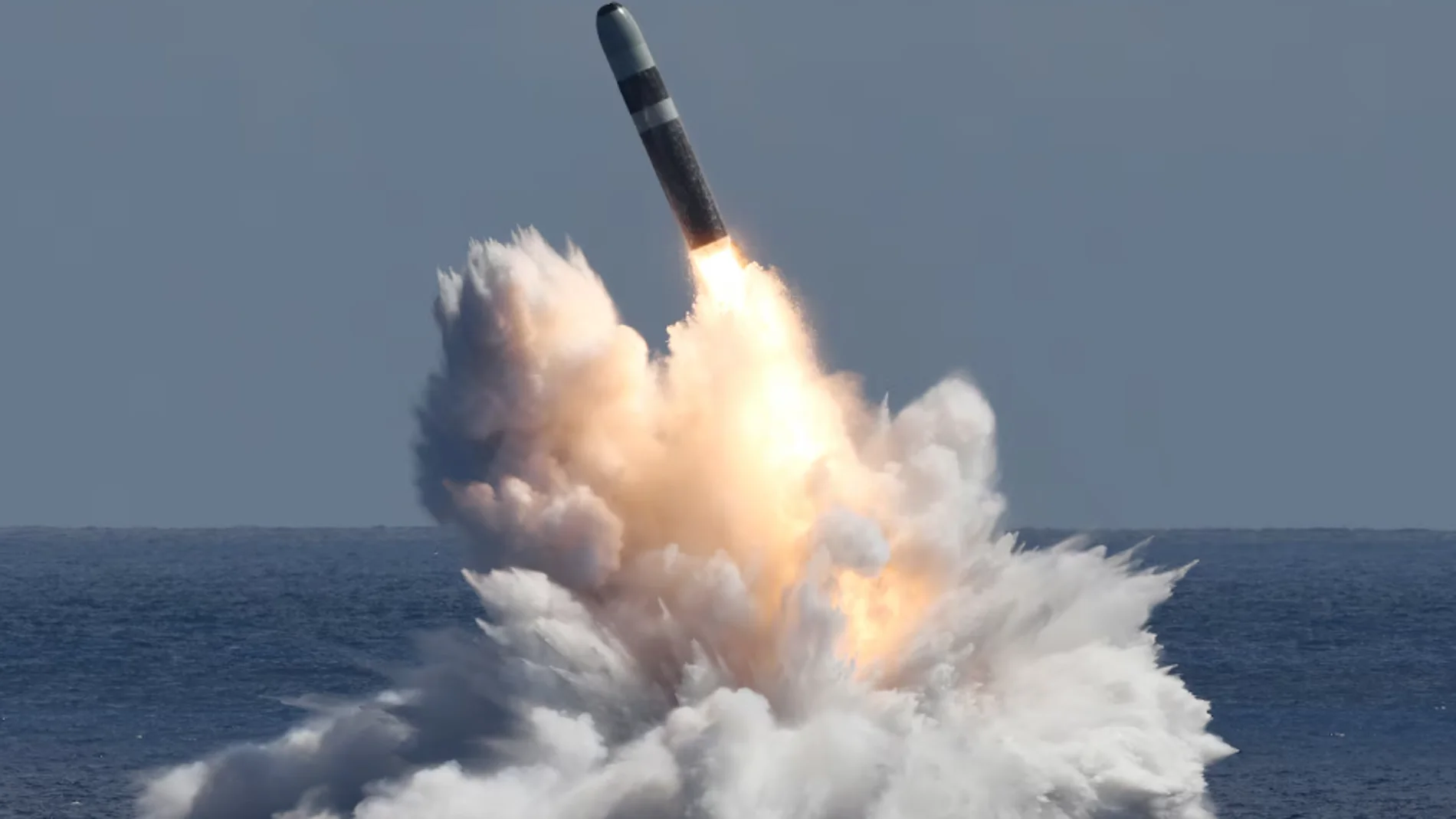
A ballistic missile over 13 meters long may seem like a machine in which millimeters should be a small enough unit of measurement. However, to ensure that one of America’s most sophisticated strategic systems functions as intended, There are scientists who work with a scale 100,000 times smaller than a millimeter.
They are the specialists at the Corona Naval Surface Warfare Center, a US Navy center located in southern California. There, the Measurement Science and Technology laboratory can test components with tolerances of millionths of a centimeter, approximately equivalent to 1 nanometer. But there is an important precision: Those nanometers do not represent the margin of error with which the missile reaches its target. They refer to the ability to verify with extraordinary accuracy the dimensions and characteristics of certain parts.
The protagonist of this story is the Trident II D5 Life Extension (D5LE), a submarine-launched ballistic missile that is part of the US strategic nuclear arsenal. Its function is provide a deterrence capability that, by its nature, must be extremely reliable. And to achieve that reliability, precision begins long before the missile leaves the submarine and focuses in the laboratory.
At the Naval Surface Warfare Center in Corona, scientists control and certify special tools known as special interface gauges, interface gauges specifically designed to test Trident system components. It is not simply a matter of measuring whether a piece is a certain length. These instruments allow their shape, fit and operation to be verified up to tolerances of millionths of a centimeter.
And the difference is important. One piece may appear to have the correct dimensions and yet not fit exactly as it should with another. In an extraordinarily complex system, small deviations can affect the assembly and subsequent behavior of the components. Gauges allow you to check that each part has the necessary shape and size to fit and function according to specifications when integrated into the missile.
“Every component from every manufacturer is built correctly thanks to these calibers – says Michael Pierce, head of the weapons interface evaluation branch of NSWC Corona in a statement -. The work we do here ensures that those weapons will function as designed every time they are used”.
And here appears one of the most interesting aspects of the story: the laboratory does not manufacture each of the parts of the missile. Its function is to establish and maintain measurement standards that allow them to be verified. NSWC Corona controls and ships these calibers to defense industry partners responsible for manufacturing and assembling Trident missiles. Its use is mandatory, so that the components produced by Different manufacturers must pass the same testing system and meet the requirements established by the Navy. It is, in a way, a chain of precision. Engineers design the calibers. These are then certified using the most demanding measurement standards in the United States. Finally, manufacturers use them to check their components.
“We have engineers who design these highly specialized tools – adds Pierce -. “They are certified against the highest national measurement standards to ensure their accuracy.”
The result is a paradox of scale. The Trident is a huge machine compared to what can be observed in a laboratory. But some of the checks that guarantee its operation are carried out with a precision that practically belongs to the microscopic world. The measuring capacity of one millionth of a centimeter is equivalent to 1 nanometer. That is to say, a dimension about 100,000 times smaller than a millimeter. That doesn’t mean the missile parts are nanometric. They are perfectly visible components and, in many cases, of dimensions much larger than that scale. What’s extraordinary is that scientists can detect and monitor nanometer differences in macroscopic pieces. And this level of control is not limited to the Trident.
And in the case of this missile, this requirement also has a temporal dimension. It is a strategic system that must remain operational for long periods, so the ability to check its components with extraordinary precision is essential for its maintenance and availability. The story, therefore, is not that of a missile that hits a target with a precision of nanometers, rather it is the story of a scientific infrastructure capable of guaranteeing that a part manufactured by a company and another manufactured by a second company respond to exactly the same measurement rules.
The missile measures meters, its components can weigh kilos, but behind them there are scientists capable of detecting differences on a scale thousands of times smaller than a millimeter. Because In more complex systems, the precision we see in the end begins much earlier, on a scale our eyes could never appreciate.